
自免疾病治疗

Search documents
美国医药调研反馈:肿瘤、代谢、自免、中枢神经系统赛道推荐更新
Haitong Securities International· 2026-02-06 11:33
Investment Rating - The report provides an "Outperform" rating for multiple companies in the healthcare sector, including BeiGene, JD Health, WuXi Biologics, and others, indicating a positive outlook for these stocks [1]. Core Insights - The macro and industry environment is improving due to the resolution of policy uncertainties, the release of significant clinical data, and a resurgence in global M&A activity, leading to a notable increase in investor sentiment towards innovative drugs for 2026 [4][11]. - In oncology, the PD-1/VEGF dual antibody approach is transitioning from "mechanism validation" to "clinical and industrial resonance," with multiple global Phase III trials underway, expected to catalyze approvals and data releases within the year [5][17]. - The metabolic sector is seeing growth in the cash-pay market for GLP-1 drugs, driven by limited insurance coverage and high out-of-pocket costs, prompting companies to enhance accessibility through direct sales and pricing adjustments [6][25]. - In the autoimmune space, there is a growing concentration risk among major products from multinational corporations (MNCs), with new antibody platforms expected to yield significant data in 2026, potentially leading to new business development opportunities [7]. - The central nervous system (CNS) investment focus remains on advancing Aβ monoclonal antibody treatments, with key data expected to open up early intervention market opportunities [9]. Summary by Sections Oncology - The PD-1/VEGF dual antibody's clinical and industrial certainty is strengthening, with major companies conducting multiple global Phase III trials across high-value indications [17]. - The Pan-RAS precision therapy is entering a realization phase, with key Phase III data expected in 2026 for pancreatic cancer and NSCLC [22]. Metabolic - The cash-pay market for GLP-1 drugs is expanding due to limited insurance coverage, with companies like Eli Lilly and Novo Nordisk adopting different direct-to-consumer strategies to enhance accessibility [25][26]. - Small nucleic acid therapies are expected to upgrade treatment paradigms, showing competitive data in weight loss and safety profiles when combined with GLP-1 [30]. Autoimmune - MNCs are increasingly reliant on a few blockbuster products, with structural opportunities arising from new antibody platforms expected to report data in 2026 [7]. - The trend towards oral formulations in autoimmune diseases is gaining traction, offering advantages in adherence and competitive differentiation [7]. CNS - The focus in CNS remains on Aβ monoclonal antibody treatments, with advancements expected to shift treatment towards earlier intervention populations [9]. - New delivery methods, such as systemic administration of small nucleic acids, are being explored as complementary approaches [9].


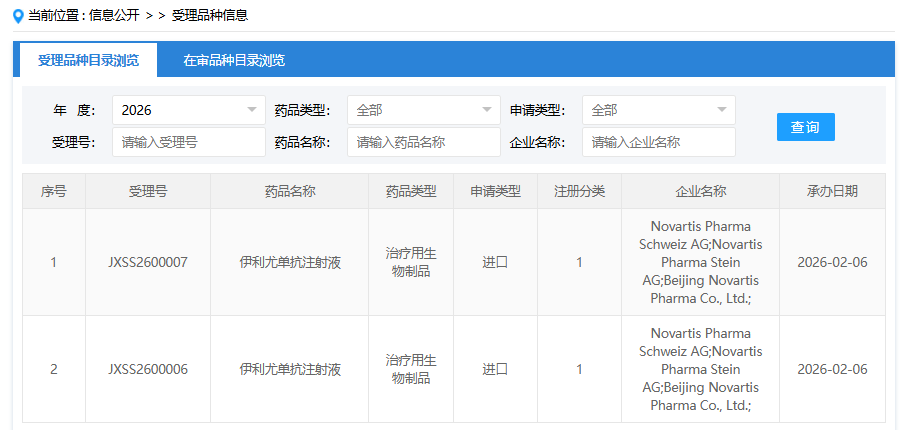
诺华制药(NVS.US)全球首创自免新药在中国申报上市
智通财经网· 2026-02-06 06:52
Core Viewpoint - Novartis has submitted a market application for Ianalumab in China, a fully human monoclonal antibody targeting BAFF-R, which has dual mechanisms of depleting B cells and inhibiting BAFF-R, aimed at treating various autoimmune diseases [1]. Group 1 - Ianalumab is the first anti-BAFF-R antibody to complete Phase III studies [1]. - The drug is indicated for conditions such as Sjögren's syndrome, immune thrombocytopenia (ITP), and systemic lupus erythematosus (SLE) [1]. - The application was officially submitted on February 6, 2026, under the registration number JXSS2600007 [2]. Group 2 - The drug is classified as a therapeutic biological product and is imported [2]. - The application involves multiple entities, including Novartis Pharma Schweiz AG, Novartis Pharma Stein AG, and Beijing Novartis Pharma Co., Ltd [2].


卡位港股创新药稀缺赛道,“MCE第一股”科望医药手握多个新药研发突破点
智通财经网· 2025-11-28 09:32
Core Insights - Innovative immune therapies, particularly immune cell engagers, are gaining significant attention in the international industry, with major multinational corporations (MNCs) like Pfizer, AstraZeneca, and Novartis accelerating their involvement [1][5] - The T-cell engagers (TCE) technology has seen rapid development, especially in hematological malignancies, with 13 business development (BD) transactions in 2025 totaling over $3.1 billion [1][3] - However, TCE technology faces limitations in solid tumors, prompting MNCs to shift focus towards myeloid cell engagers (MCE) technology, which shows promise in treating both solid tumors and autoimmune diseases [1][3] Company Overview - Kewang Pharmaceuticals is recognized as an early proponent of the MCE concept, holding $1.7 billion in significant BD deals and advanced MCE technology, which underscores its unique value [2] - The company has secured over $250 million in investments from leading institutions, including Eli Lilly Asia Fund and Tencent Investment, indicating strong market confidence in its future potential [2] Recent Developments - In late 2023, Kewang Pharmaceuticals entered into a BD deal exceeding $1.7 billion with AstraZeneca, focusing on the PD-L1/SIRPα dual antibody candidates from its proprietary BiME® platform, attracting global industry attention [3][4] - This collaboration highlights the innovative potential of the BiME® technology and reinforces the global competitiveness of the MCE platform as a next-generation immunotherapy [4] Market Potential - The MCE technology is positioned to address the challenges in treating solid tumors and autoimmune diseases, with Kewang's BiME® platform expected to achieve deeper and more durable B-cell depletion, leading to longer remission periods and lower relapse rates [4][6] - The autoimmune disease market is projected to grow to $176.7 billion by 2030, with Kewang's focus on multi-target inhibition of key pro-inflammatory cytokines and immune cell regulation [6][7] Pipeline and Innovations - Kewang Pharmaceuticals is advancing its pipeline with several candidates, including ES302 and ES304, targeting inflammatory bowel disease (IBD) and other autoimmune conditions, which are expected to improve patient compliance and treatment outcomes [7] - The company also holds a globally pioneering CD39/TGFβ dual antibody, ES014, which shows potential in treating various solid tumors and is set to present promising clinical trial results at the 2025 ESMO Asia conference [8] Industry Trends - The global focus on immune cell engagers is intensifying, with MCE technology gaining recognition among industry players, suggesting a growing value realization for Kewang Pharmaceuticals in this domain [8]
诺诚健华(09969.HK)点评:上调2025年销售指引 自免管线加速推进
Ge Long Hui· 2025-11-18 20:02
Core Insights - The company reported a 60% year-on-year revenue growth for the first three quarters of 2025, reaching 1.12 billion yuan, with a net loss of 64 million yuan, narrowing by 77% compared to the previous year [1] - The core product, Oubatinib, saw a 46% increase in sales to 1.01 billion yuan in the first three quarters, with third-quarter sales reaching 373 million yuan, reflecting a 35% year-on-year growth and a 14% quarter-on-quarter growth [1][2] - Research and development expenses for the first three quarters amounted to 676 million yuan, a 10% increase year-on-year, while sales expenses rose by 41% to 386 million yuan, with a sales expense ratio decreasing by 4.7 percentage points to 35% [1] Product Performance - Oubatinib's sales accelerated due to the approval for 1L CLL/SLL indications and increased contributions from MZL, leading to an upward revision of the 2025 sales target from over 35% to over 40% [2] - The company has initiated commercialization of Tanshizhuo monoclonal antibody for r/r DLBCL, approved in May 2025, and is conducting two registration studies for mesutoclax [2] Pipeline Development - The company plans to submit a new drug application for ITP indications for Oubatinib in the first half of 2026 and expects to read out IIb phase data for SLE by the end of 2025 [3] - The early-stage pipeline includes various technology platforms, with plans to submit 5-7 IND applications targeting malignancies and autoimmune diseases by 2026 [3] Financial Outlook - The earnings forecast for 2025 has been revised from a loss of 0.19 yuan per share to a profit of 0.09 yuan, with similar upward adjustments for 2026 and 2027 [4] - The target price has been increased from 11.8 HKD to 19.0 HKD, indicating a potential upside of 25% [4]
