自动驾驶安全

Search documents
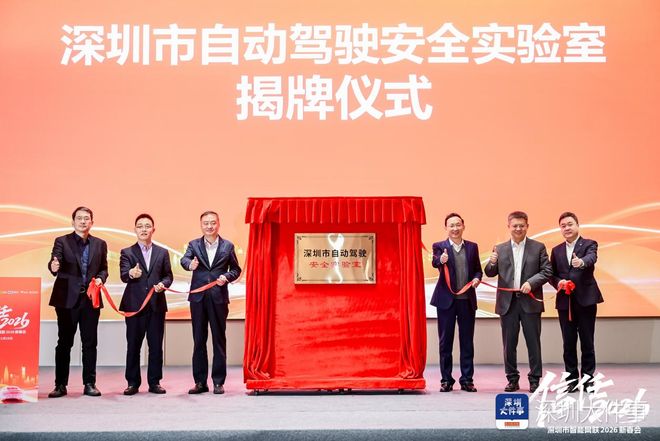
深圳自动驾驶安全实验室揭牌成立,将重点攻坚十大方向
Nan Fang Du Shi Bao· 2026-01-18 11:04
Core Viewpoint - The Shenzhen Autonomous Driving Safety Laboratory has been established to address safety challenges in the autonomous driving industry, focusing on collaborative innovation to enhance safety and credibility in the sector [1][3]. Group 1: Laboratory Establishment and Mission - The laboratory was launched at the Shenzhen Intelligent Connected Spring Festival and is initiated by the Shenzhen Intelligent Connected Transportation Association, with guidance from local government bodies [1]. - It aims to create a collaborative innovation platform involving various stakeholders, including government, academia, and industry leaders like BYD and Meituan, to tackle safety issues throughout the autonomous driving lifecycle [1][3]. Group 2: Operational Model - The laboratory employs a dual-driven model of "joint topic tackling + co-construction of research and infrastructure," focusing on key industry needs and promoting shared technological advancements [3]. - It plans to open testing facilities, equipment, and data resources to support research and development, while also applying for major scientific projects [3]. Group 3: Key Focus Areas - By 2026, the laboratory will concentrate on ten critical areas, including vehicle safety evaluation, accident investigation systems, cloud-based safety technologies, dynamic capacity regulation, and the development of intelligent driving insurance systems [3]. - The establishment of the laboratory is expected to strengthen the safety framework for the autonomous driving industry in Shenzhen and extend its influence across the Greater Bay Area and nationwide [3]. Group 4: Initial Collaborations - A signing ceremony for the first batch of member companies took place, with nearly twenty organizations, including universities and tech firms, formalizing their collaboration to form a comprehensive autonomous driving safety innovation consortium [5].

12毫秒暴露自动驾驶致命缺陷,北航新研究实现场景感知的动态物理对抗攻击|TPAMI2025
量子位· 2025-12-28 03:06
Core Viewpoint - The approval of L3 autonomous driving vehicles by the Ministry of Industry and Information Technology marks a new phase in China's autonomous driving industry, but the emergence of physical adversarial examples (PAE) poses significant safety risks for these systems [1][2]. Group 1: DynamicPAE Framework - The DynamicPAE framework has been developed to address the challenges of real-time generation of physical adversarial examples, achieving millisecond-level generation in dynamic environments [4][5]. - This framework combines feedback issues in adversarial training with residual-guided adversarial pattern exploration and scene alignment techniques, enhancing the efficiency and optimization of PAE generation [5][6]. Group 2: Challenges in Adversarial Sample Generation - Two core challenges in adversarial sample generation are identified: noise in adversarial training hinders effective exploration of scene-related PAEs, leading to training degradation, and the difficulty in aligning digital adversarial samples with real-world scenarios [6][7]. - The DynamicPAE framework effectively addresses these challenges through innovative design, ensuring stable PAE generation that adapts in real-time to various environments [6][7]. Group 3: Performance and Application - The DynamicPAE framework demonstrates significant performance improvements in various physical attack scenarios, showcasing its potential applications in real-world autonomous driving safety tests and physical adversarial attacks [7]. - Experimental results indicate that DynamicPAE achieves an average inference time of only 12 milliseconds per adversarial sample on an NVIDIA A40 GPU, representing a speed increase of over 2000 times compared to traditional methods [26][27]. Group 4: Experimental Validation - In experiments using the COCO and Inria datasets, DynamicPAE achieved a 58.8% drop in average precision (AP) for strong models like DETR, resulting in a 2.07 times increase in attack success rate [25]. - The framework's adaptability to dynamic physical environments was validated through tests involving lighting changes and varying perspectives, demonstrating its robustness and effectiveness in maintaining attack efficacy [34].

软件问题致亚马逊(AMZN.US)Zoox再召回车辆,自动驾驶安全警钟又响
Zhi Tong Cai Jing· 2025-12-23 11:30
Core Viewpoint - Amazon's autonomous driving division, Zoox, is recalling 332 vehicles in the U.S. due to a software error in its autonomous driving system (ADS) that increases the risk of collision at intersections [1] Group 1: Recall Details - The recall affects vehicles equipped with software versions released before December 19 [1] - The issue involves vehicles potentially crossing the yellow center line when approaching or at intersections, leading to a higher risk of accidents [1] - Zoox has provided a free software update to address the ADS issue for the recalled vehicles [1] Group 2: Previous Incidents and Actions - In May, Zoox conducted a previous recall involving 270 vehicles following an accident in San Francisco [1] - After the May incident, Zoox quickly released a software update to improve pedestrian tracking and ensure vehicles remain stationary when pedestrians approach [1] Group 3: Regulatory Approval - In August, the National Highway Traffic Safety Administration (NHTSA) approved Zoox's vehicles for demonstration operations, concluding an investigation that began in 2022 regarding compliance with federal requirements [1]

工信部今年汽车标准化工作要点聚焦新能源汽车与自动驾驶安全、新业态标准化等 构建自动驾驶系统安全基线
Guang Zhou Ri Bao· 2025-04-29 21:32
Policy Highlights - The Ministry of Industry and Information Technology (MIIT) has released the 2025 automotive standardization work points, focusing on enhancing the safety of new energy vehicles, strengthening standards for intelligent connected vehicles, and accelerating the revision of automotive chip standards [1][2] - The work points emphasize the need to improve the safety level of new energy vehicles, particularly in terms of battery safety and convenience, and to establish a safety baseline for autonomous driving systems [3][4] Focus Areas - **Battery Safety**: The work points highlight the importance of improving the safety and convenience of power batteries, including the review and approval of standards for battery durability and thermal management systems, as well as the development of standards for solid-state batteries and battery labeling [3] - **Autonomous Driving Safety**: There is a strong emphasis on establishing safety standards for autonomous driving systems, including the revision of standards for lane-keeping assistance and the development of standards for parking assistance systems [4] - **Chip Standards**: The work points call for the acceleration of the revision of automotive chip standards, including the implementation of standards for safety chips and power drive chips, to address the industry's challenges related to chip shortages [5] Industry Analysis - The frequent mention of "safety" in the 2025 automotive standardization work points indicates a strong focus on ensuring the safety of new energy vehicles and traditional automotive safety standards [6] - The industry recognizes that safety is paramount for the sustainable and healthy development of the new energy vehicle sector, especially during this critical phase of industry transformation [7]
工信部:加快研制自动驾驶安全要求强制性国标
Bei Jing Ri Bao Ke Hu Duan· 2025-04-29 11:06
Group 1 - The Ministry of Industry and Information Technology (MIIT) has released key points for automotive standardization work for 2025, focusing on five areas with 23 specific items, particularly addressing the safety of intelligent driving systems [1] - The MIIT aims to accelerate the development of mandatory national standards for automatic driving system safety requirements and to promote the approval and implementation of standards related to automatic driving design, operation conditions, and simulation testing [1][2] - There is a strong emphasis on enhancing the safety levels of driving assistance products, including the revision of standards for lane-keeping assistance systems and the development of standards for reversing assistance [1] Group 2 - The MIIT will promote the implementation of information security engineering standards and accelerate the establishment of mandatory national standards for automotive passwords, as well as complete the review of data security management systems and standards for classifying automotive security vulnerabilities [2] - In response to the development of new energy vehicles, the MIIT will continue to advance the formulation of safety standards, including those for remote services and management of electric vehicles, and the implementation of safety requirements for power batteries [2][3] - The MIIT plans to enhance the performance of power batteries by advancing the review and approval of standards related to battery durability and thermal management systems, as well as developing standards for solid-state batteries and battery labeling [3]
Arbe Robotics .(ARBE) - 2024 Q4 - Earnings Call Transcript
2025-03-05 17:21
Financial Data and Key Metrics Changes - Total revenue in Q4 2024 was $0.1 million, a decrease from $0.35 million in Q4 2023. For the full year 2024, total revenue was $0.8 million compared to $1.5 million in 2023 [17] - Gross margin loss for Q4 2024 was $0.2 million, consistent with Q4 2023. The full year gross margin loss for 2024 was $0.8 million compared to a break-even gross margin in 2023 [18] - Operating loss for Q4 2024 was $12.8 million, compared to a loss of $12.1 million in Q4 2023. The full year operating loss totaled $49.7 million, up from $46.9 million in 2023 [21] - Net loss in Q4 2024 was $12.2 million, compared to a net loss of $9.3 million in Q4 2023. The full year net loss for 2024 was $49.3 million, compared to a loss of $43.5 million in 2023 [21] Business Line Data and Key Metrics Changes - The company reported a backlog of $0.3 million as of December 31, 2024 [18] - R&D expenses for Q4 2024 were $9 million, up from $8.4 million in Q4 2023. For the full year, R&D expenses totaled $35.1 million compared to $34.1 million in 2023 [20] Market Data and Key Metrics Changes - The company highlighted significant opportunities for growth in the non-automotive market, particularly through collaborations with key partners [12] - The company expects to ship around 5 million imaging radar chipsets to customers by 2030 based on current engagements [13] Company Strategy and Development Direction - The company is focused on driving radar technology evolution and enhancing customer relationships, with a commitment to innovation [5][6] - Collaborations with major players like NVIDIA and partnerships with top global auto OEMs are central to the company's strategy [7][8] - The company aims to pursue four design-ins with automakers in 2025, with projected annual revenue between $2 million to $5 million [24] Management's Comments on Operating Environment and Future Outlook - Management noted that while broader economic shifts have led to delays in automakers' rollout of advanced driver assist systems, the total addressable market continues to expand [24] - The company remains optimistic about its market potential, supported by recent fundraising initiatives totaling nearly $17 million [15][23] Other Important Information - The company raised gross proceeds of $54.5 million in January 2025, enhancing its financial stability [23] - The company maintains a strong focus on R&D to ensure continuous innovation and technological advancements [20] Q&A Session Summary Question: What programs are expected to drive $1 million-plus revenue quarters towards the end of 2025? - Management identified three leading projects in final stages: Tianyi (non-automotive), trucks in Europe, and a collaboration with HiRain for a Chinese car manufacturer [31] Question: What is the current cash balance and share count post-fundraising? - The current cash balance is approximately $73 million, with a share count of 85.7 million [35][38] Question: Can you provide an update on the China EV market opportunity? - The company noted that Chinese car manufacturers are focusing on launching self-driving services and are looking for radar solutions to enhance their offerings [39] Question: What is the status of discussions with OEMs? - Management indicated that evaluations with OEMs are in final stages, with the company shortlisted against one or two competitors [44] Question: What is the expected operating expense trajectory over the next few years? - The company expects operating expenses to remain similar over the next few years, with additional investments in next-generation technologies [47]