航运绿色化

Search documents
上海公示国际航运中心建设五年规划,明确重点任务
Di Yi Cai Jing· 2026-02-11 07:34
Core Viewpoint - The Shanghai International Shipping Center aims to enhance its global influence and operational capabilities by 2030, focusing on becoming a leading hub with modern shipping services and a resilient governance system [1]. Group 1: Development Achievements - Since the 14th Five-Year Plan, Shanghai's International Shipping Center has shown significant development, ranking third globally in the Xinhua-Baltic International Shipping Center Development Index, with improvements in operational efficiency and service quality [2]. - Shanghai Port became the first in the world to exceed 50 million TEUs in container throughput, achieving a water-to-water transshipment ratio of 52.7% [2]. - The airport has established regular flights to 54 countries with 302 passenger and cargo routes, setting historical records in flight operations and passenger throughput [2]. Group 2: Strategic Opportunities and Challenges - Despite global challenges like trade wars, the trend of international industrial restructuring and the shift of economic trade towards the Asia-Pacific region presents opportunities for the development of the Shanghai International Shipping Center [3]. - The construction of the shipping center is now a national strategy, supported by the Yangtze River Delta integration strategy, which enhances its development potential [3]. Group 3: Development Bottlenecks - The construction and operation of hub ports face resource constraints, and the overall efficiency of the logistics network needs improvement [4]. - There is a need to cultivate a high-end shipping service ecosystem and optimize the soft environment for shipping development [4]. - The green transition of the shipping industry requires better industry support, and the digital logistics system needs to be established more rapidly [4]. Group 4: Key Tasks and Goals - The planning document outlines six major goals, including solidifying the world-class shipping hub status and enhancing the networked logistics system [6]. - The focus is on developing high-end shipping services, particularly in areas like shipping insurance and information consulting, to differentiate from other international shipping centers [6][7]. - The integration of digital and green shipping technologies is emphasized to create a new development pattern in the shipping industry [7]. Group 5: Future Directions - The planning document highlights the importance of integrating air and sea transport, aiming for a container throughput of approximately 58 million TEUs and significant passenger and cargo throughput at airports [8]. - There is a call for targeted talent development in the maritime sector to support the growth of the shipping center and enhance its international competitiveness [8].
出炉!2025年全球十大航运新闻
Sou Hu Cai Jing· 2026-01-02 13:21
Core Insights - The shipping industry in 2025 experienced significant changes driven by geopolitical tensions, particularly between the US and China, affecting port fees and operational costs [2][4] - The transition towards decarbonization and digitalization has become essential for companies to navigate challenges, with the International Maritime Organization (IMO) delaying the adoption of the Net-Zero Framework, impacting regulatory certainty [2][9] - The emergence of new shipping routes and supply chains, such as the Simandou iron ore project, is reshaping global shipping dynamics and demand [2][11] Group 1: US-China Port Fee Dispute - In 2025, the US and China escalated their policy conflict to the level of port fees, with the US imposing fees on certain Chinese vessels starting October 14, 2025, followed by China's retaliatory fees [4] - The suspension of these fees on November 10, 2025, led to a restructuring of shipping routes and strategies, with a notable decline in freight rates and a shift in capacity deployment [4][5] - The compliance premium has been systematically priced into various operational aspects, affecting costs and accessibility across the shipping industry [5] Group 2: IMO Net-Zero Framework Delay - The IMO's Net-Zero Framework was delayed until 2026 due to unresolved key issues, pushing back the industry's need for regulatory certainty and extending the uncertainty window for investments [9][10] - Despite the delay, the overall goals of the IMO 2023 reduction strategy remain unchanged, creating a paradox where regulatory delays coexist with ongoing industry actions towards decarbonization [9] - Shipping companies are increasingly focusing on tangible emission reductions and diversifying fuel strategies, including LNG, methanol, and future zero-carbon fuels [9] Group 3: Simandou Iron Ore Project - The Simandou iron ore project commenced commercial operations in November 2025, with the first shipment of approximately 200,000 tons of high-grade iron ore to China [11] - This project is expected to create a new long-haul shipping route from West Africa to China, significantly impacting the dry bulk market and potentially replacing some Australian iron ore routes [11] - The project's success will depend on the stability and reliability of its export rhythm and the efficiency of its transportation infrastructure [11] Group 4: Container Shipping Market Dynamics - In 2025, container shipping companies shifted their competitive focus from fleet size to reliable delivery capabilities, driven by increased market uncertainty [12][16] - Major players like MSC expanded their capacity significantly, leading to heightened competition and a simultaneous push towards integrated logistics and terminal control [12][16] - The trend of integrating logistics and terminal operations is expected to continue, although it may introduce asset burden and return on invested capital (ROIC) pressures if freight rates decline [13] Group 5: Shadow Fleet and Sanctions - The global shadow fleet, involved in transporting sanctioned oil, reached approximately 1,423 vessels, with 921 already sanctioned by the US and its allies [19] - Enforcement methods have shifted from financial sanctions to direct maritime actions, with the US actively seizing vessels involved in transporting oil from Venezuela [19][20] - The expansion of the shadow fleet has increased the premium for compliant vessels, while also raising operational risks and insurance costs [19] Group 6: Chinese Shipbuilding Dominance - Despite temporary disruptions from US port fees, Chinese shipbuilding orders rebounded quickly, maintaining a dominant position with over 60% of global orders [21][23] - In the first half of 2025, China received new orders totaling approximately 44.33 million deadweight tons, while deliveries were around 24.13 million deadweight tons, indicating a backlog in shipbuilding capacity [23] - The profitability of Chinese shipyards is improving, providing cash flow for continued investment in advanced and green ship designs [23] Group 7: Electric Vessels and Green Transition - 2025 marked a significant push towards electric vessels in China's inland and coastal shipping, with numerous electric cargo ships launched and operational [24][25] - The Chinese government supported the transition to clean energy vessels, with plans for 1,000 new energy vessels over the next five years [25] - Internationally, notable advancements in electric vessel technology were observed, indicating a shift towards larger and faster electric ships [25] Group 8: Crew Welfare and Regulations - The importance of crew welfare gained prominence in 2025, with new agreements enhancing protections and raising minimum wages for seafarers [26][27] - The industry is increasingly recognizing crew welfare as a measurable management issue, driven by rising health and psychological risks among seafarers [27] - Future focus will be on implementing actionable governance for crew welfare and integrating respect for seafarers into compliance and delivery standards [27] Group 9: Emerging Markets and Nationalization of Shipping - Emerging markets are increasingly elevating shipping and port development as national strategic initiatives, with India leading by establishing a maritime development fund [28][29] - Investments in port infrastructure and shipping capabilities are being made to enhance regional hub positions, with significant projects underway in various emerging markets [28][29] - This trend suggests that competition in the future will extend beyond shipping routes to include vessel registration, compliance, and local service capabilities [29]

院士解读核动力集装箱商船未来路径
Huan Qiu Shi Bao· 2025-12-02 22:55
Core Viewpoint - The 2025 China International Maritime Exhibition, held in Shanghai, focuses on green and sustainable development in the maritime industry, highlighting the global first design of a 24,000 TEU nuclear-powered container ship by Jiangnan Shipyard [1][2] Group 1: Nuclear-Powered Container Ship Design - The nuclear-powered container ship design utilizes an all-electric solution, improving space and energy utilization compared to low-sulfur oil and other alternative energy solutions [2] - The ship design features a "battery" replacement scheme, allowing for battery changes every 15 to 20 years, mitigating concerns over green fuel price fluctuations and refueling issues [2] - This design represents China's first application of nuclear power in civil vessels, receiving preliminary recognition from the Norwegian classification society [2] Group 2: Advantages and Market Trends - The nuclear-powered container ship is expected to eliminate fuel costs, reduce greenhouse gas emissions, and enhance transport speed while maintaining safety and economic competitiveness [3] - According to Clarkson's latest statistics, alternative fuel vessels accounted for 55.5% of global new ship orders in the first half of the year, indicating a significant shift in the shipbuilding market [3] - A 15,000 TEU nuclear-powered container ship can operate 39% faster than traditional vessels, increasing annual cargo capacity by 38% [3] Group 3: Regulatory and Development Challenges - The International Atomic Energy Agency (IAEA) and the International Maritime Organization (IMO) are working on establishing rules and standards for marine nuclear power, with significant initiatives planned for 2025 [2][3] - Despite the potential of marine nuclear power, there are numerous technical challenges and regulatory hurdles that need to be addressed, including the lack of a supporting approval system and the need for improved legal frameworks [4]
如何让全球航运“快起来”?临港“一站式”服务有妙招
Guo Ji Jin Rong Bao· 2025-09-19 13:57
Group 1 - The core viewpoint emphasizes the transformation of the shipping service industry in the Shanghai Lingang New Area, showcasing a "one-stop" digital platform that enhances efficiency and promotes green and intelligent development [1][2][3] - The Lingang New Area International Shipping Service Center has attracted numerous shipping service companies, integrating various functions such as administrative services, green and digital innovation, and high-end talent training [1][2] - The digital transformation significantly improves operational efficiency by streamlining processes from multiple submissions to a single-window acceptance, and implementing "no-touch" customs clearance for vehicles [2] Group 2 - The center features advanced training facilities for high-quality talent development, utilizing simulation and virtual reality technologies to provide immersive training experiences for maritime professionals [3] - The establishment of a green low-carbon development innovation center supports the shipping industry's transition to sustainable practices, including the development of a public service platform for green fuel certification [2][3] - The Lingang International Shipping Service Center plays a crucial role in the construction of Shanghai as an international shipping hub, contributing to global shipping industry transformation and international trade development [3]

上海国际航运中心与阿联酋开启高端对话,引领全球航运新征程 ——第五届北外滩国际航运论坛将于10月启幕
Di Yi Cai Jing· 2025-05-07 09:01
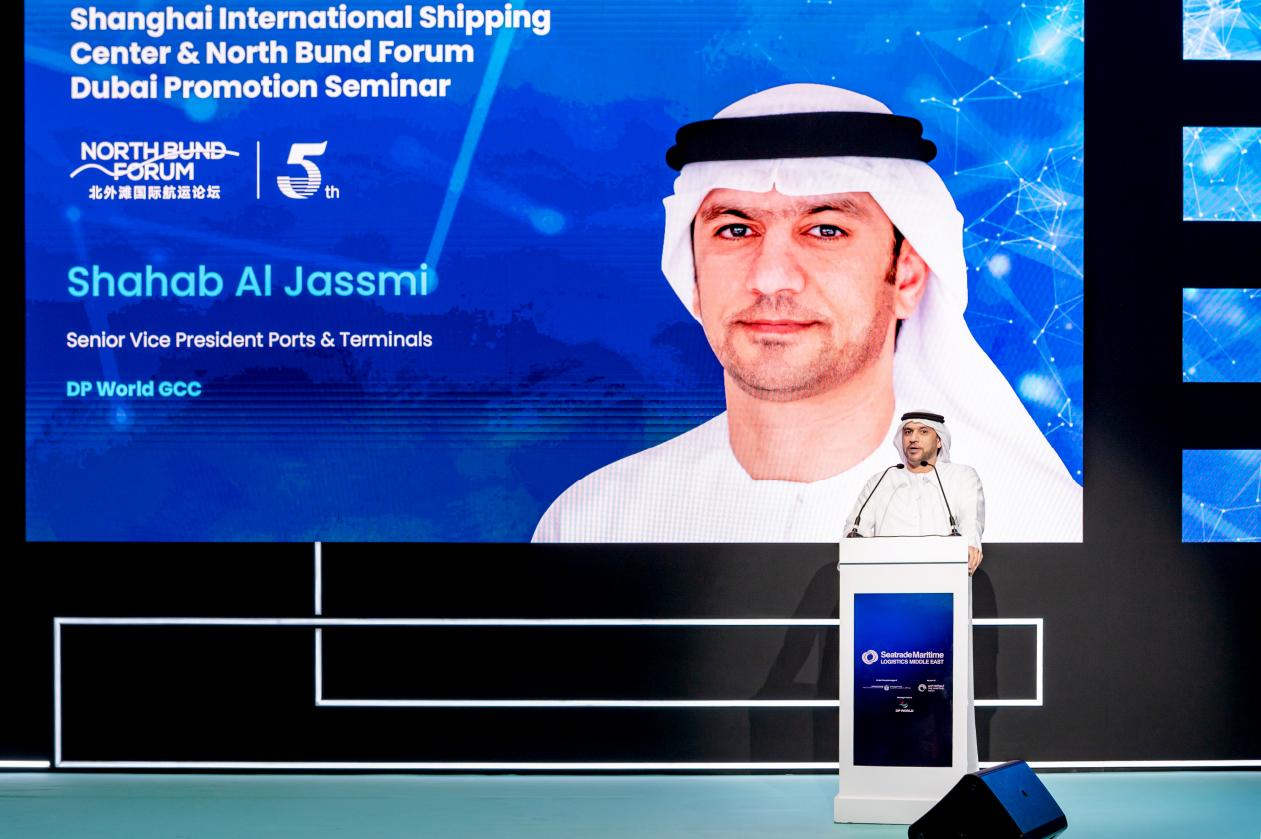
Core Insights - The article emphasizes the importance of openness and cooperation in the face of global economic challenges, highlighting the strategic partnership between Shanghai and Dubai as key shipping hubs [1][2][6] Group 1: Event Overview - The Shanghai International Shipping Center global promotion event took place at the Dubai World Trade Center, attracting around 150 elite professionals from the global shipping industry [1][2] - The event was organized by the North Bund International Shipping Forum Committee and hosted by the UK Maritime Media Group, aiming to strengthen communication and cooperation between Shanghai and the UAE in the shipping sector [1][2] Group 2: Key Speeches - Key figures, including Zhang Yiming, the Chinese Ambassador to the UAE, and Yu Fulin, Director of the Shanghai Municipal Transportation Commission, delivered speeches emphasizing the close ties and the importance of collaboration between Shanghai and Dubai [2][4][6] - Yu Fulin advocated for enhanced mechanism-based exchanges and collaboration across the entire industry chain to seize opportunities and address challenges [4] Group 3: Economic Cooperation - The bilateral trade between China and the UAE is projected to exceed $100 billion in 2024, with over 90% of goods transported by sea, showcasing the effectiveness of their cooperation [6] - The article highlights that more than 60% of goods from China to Gulf countries are transshipped through UAE ports, underscoring the strategic role of these ports in international trade [6] Group 4: Industry Challenges and Innovations - The shipping industry faces challenges from climate change, economic shifts, and geopolitical conflicts, necessitating a focus on digitalization and green transformation [7] - The Shanghai International Shipping Center has improved its global ranking from seventh in 2014 to third, reflecting its advanced infrastructure and innovative development concepts [7] Group 5: Future Directions - The event marked a new starting point for collaboration between Shanghai and Dubai, with a focus on shipping technology innovation, sustainable development, and optimizing global shipping service networks [10] - The North Bund International Shipping Forum aims to continue fostering high-quality development in the shipping industry and serve as a platform for international dialogue and policy development [12]