
电动货船

Search documents
出炉!2025年全球十大航运新闻
Sou Hu Cai Jing· 2026-01-02 13:21
Core Insights - The shipping industry in 2025 experienced significant changes driven by geopolitical tensions, particularly between the US and China, affecting port fees and operational costs [2][4] - The transition towards decarbonization and digitalization has become essential for companies to navigate challenges, with the International Maritime Organization (IMO) delaying the adoption of the Net-Zero Framework, impacting regulatory certainty [2][9] - The emergence of new shipping routes and supply chains, such as the Simandou iron ore project, is reshaping global shipping dynamics and demand [2][11] Group 1: US-China Port Fee Dispute - In 2025, the US and China escalated their policy conflict to the level of port fees, with the US imposing fees on certain Chinese vessels starting October 14, 2025, followed by China's retaliatory fees [4] - The suspension of these fees on November 10, 2025, led to a restructuring of shipping routes and strategies, with a notable decline in freight rates and a shift in capacity deployment [4][5] - The compliance premium has been systematically priced into various operational aspects, affecting costs and accessibility across the shipping industry [5] Group 2: IMO Net-Zero Framework Delay - The IMO's Net-Zero Framework was delayed until 2026 due to unresolved key issues, pushing back the industry's need for regulatory certainty and extending the uncertainty window for investments [9][10] - Despite the delay, the overall goals of the IMO 2023 reduction strategy remain unchanged, creating a paradox where regulatory delays coexist with ongoing industry actions towards decarbonization [9] - Shipping companies are increasingly focusing on tangible emission reductions and diversifying fuel strategies, including LNG, methanol, and future zero-carbon fuels [9] Group 3: Simandou Iron Ore Project - The Simandou iron ore project commenced commercial operations in November 2025, with the first shipment of approximately 200,000 tons of high-grade iron ore to China [11] - This project is expected to create a new long-haul shipping route from West Africa to China, significantly impacting the dry bulk market and potentially replacing some Australian iron ore routes [11] - The project's success will depend on the stability and reliability of its export rhythm and the efficiency of its transportation infrastructure [11] Group 4: Container Shipping Market Dynamics - In 2025, container shipping companies shifted their competitive focus from fleet size to reliable delivery capabilities, driven by increased market uncertainty [12][16] - Major players like MSC expanded their capacity significantly, leading to heightened competition and a simultaneous push towards integrated logistics and terminal control [12][16] - The trend of integrating logistics and terminal operations is expected to continue, although it may introduce asset burden and return on invested capital (ROIC) pressures if freight rates decline [13] Group 5: Shadow Fleet and Sanctions - The global shadow fleet, involved in transporting sanctioned oil, reached approximately 1,423 vessels, with 921 already sanctioned by the US and its allies [19] - Enforcement methods have shifted from financial sanctions to direct maritime actions, with the US actively seizing vessels involved in transporting oil from Venezuela [19][20] - The expansion of the shadow fleet has increased the premium for compliant vessels, while also raising operational risks and insurance costs [19] Group 6: Chinese Shipbuilding Dominance - Despite temporary disruptions from US port fees, Chinese shipbuilding orders rebounded quickly, maintaining a dominant position with over 60% of global orders [21][23] - In the first half of 2025, China received new orders totaling approximately 44.33 million deadweight tons, while deliveries were around 24.13 million deadweight tons, indicating a backlog in shipbuilding capacity [23] - The profitability of Chinese shipyards is improving, providing cash flow for continued investment in advanced and green ship designs [23] Group 7: Electric Vessels and Green Transition - 2025 marked a significant push towards electric vessels in China's inland and coastal shipping, with numerous electric cargo ships launched and operational [24][25] - The Chinese government supported the transition to clean energy vessels, with plans for 1,000 new energy vessels over the next five years [25] - Internationally, notable advancements in electric vessel technology were observed, indicating a shift towards larger and faster electric ships [25] Group 8: Crew Welfare and Regulations - The importance of crew welfare gained prominence in 2025, with new agreements enhancing protections and raising minimum wages for seafarers [26][27] - The industry is increasingly recognizing crew welfare as a measurable management issue, driven by rising health and psychological risks among seafarers [27] - Future focus will be on implementing actionable governance for crew welfare and integrating respect for seafarers into compliance and delivery standards [27] Group 9: Emerging Markets and Nationalization of Shipping - Emerging markets are increasingly elevating shipping and port development as national strategic initiatives, with India leading by establishing a maritime development fund [28][29] - Investments in port infrastructure and shipping capabilities are being made to enhance regional hub positions, with significant projects underway in various emerging markets [28][29] - This trend suggests that competition in the future will extend beyond shipping routes to include vessel registration, compliance, and local service capabilities [29]

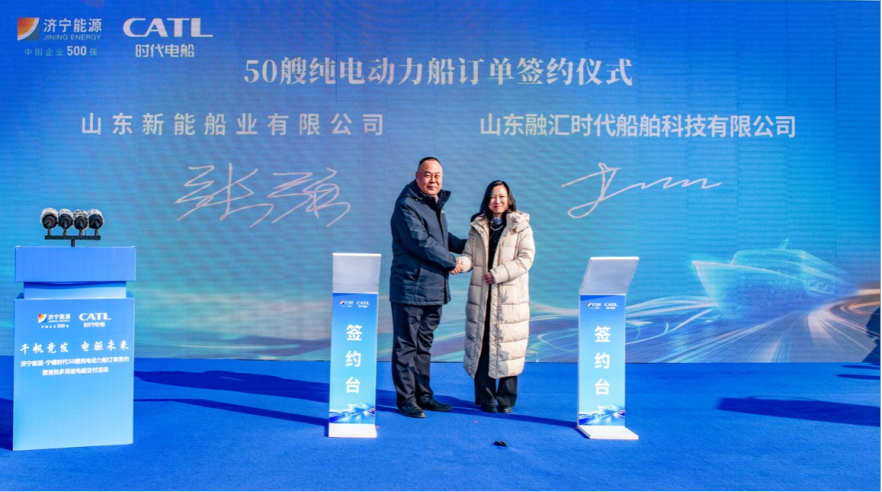
5船下水+50艘签约,宁德时代水面交通领域迎“千艘”突破!
Xin Lang Cai Jing· 2025-12-30 11:05
Core Viewpoint - The partnership between CATL and Jining Energy Group marks a significant milestone in the electric shipping industry, with the launch of the world's first large-scale, structured fleet of pure electric cargo ships, transitioning from technology validation to commercial operation [1][7]. Group 1: Electric Shipping Development - CATL entered the electric shipping sector in 2017, achieving its first pilot ship launch in 2018, and has since completed over 900 electric vessels in safe operation by 2025, with the recent launch of 5 ships and a contract for 50 more, making it the first company to surpass 1,000 vessels in this field [3][9]. - The Jining Port "6006" pure electric cargo ship has been recognized as an exemplary case for the integration of transportation and energy in 2025, showcasing advancements in design, structure, and construction processes that enhance reliability and applicability [3][9]. Group 2: Technological Integration and Solutions - The "Ship-Shore-Cloud" integrated solution, launched on December 4, 2025, has enabled the rapid signing of 50 vessel orders within just 25 days, providing a comprehensive service that integrates power systems, shore-based energy networks, and cloud management [5][11]. - This solution addresses key challenges in initial investment, energy efficiency, operational economics, and responsibility delineation, offering a replicable business model for large-scale promotion [5][11]. Group 3: Market Impact and Future Prospects - The 55 electric cargo ships will operate along the Grand Canal, covering key logistics routes from the Yangtze River Delta to North China, with each ship expected to exceed an annual capacity of 500,000 tons [7][11]. - CATL's comprehensive product matrix now includes various types of vessels, and its innovative business model is set to facilitate the transition to electric shipping in China and globally, propelling the renewable energy industry into a new era of growth [12].

山东出台今年第三批政策清单
Qi Lu Wan Bao· 2025-09-05 11:07
Group 1: Core Policy Initiatives - Shandong Province has introduced the third batch of policy measures aimed at promoting economic stability and quality improvement, focusing on service industry development, project construction support, and assistance for enterprises [1][2] - The policy list includes 16 measures that provide direct financial support, including 200 million yuan for service industry development and an additional 100 million yuan for high-growth enterprises [1][2] Group 2: Service Industry Support - The province will enhance the support for the service industry by implementing a 200 million yuan fund to assist newly registered enterprises and key projects in high-end and quality service sectors [1] - There will be a focus on boosting consumer demand through initiatives like the old-for-new consumer goods program and housing market incentives for cities that effectively promote healthy real estate development [1] Group 3: Project Construction Assurance - Shandong aims to expedite the construction of key projects at provincial, municipal, and county levels, ensuring that policy-driven funding reaches enterprises and projects directly [2] - The province plans to issue all local government special bonds by the end of October and will provide additional land use support for cities facing shortages [2] Group 4: Enterprise Assistance and Financing - The province is expanding the coverage of technology achievement transformation loan interest subsidies to all 16 cities, with a maximum subsidy of 500,000 yuan available for qualifying enterprises [3] - Measures to reduce logistics costs include extending the subsidy period for the Xiaoqing River shipping route and providing support for the construction and operation of new energy vessels [3] - The government will address operational difficulties for enterprises by coordinating solutions for raw material supply, financial credit, and market expansion [3]