
航运软实力

Search documents
中国内贸第一大港如何成功转型“双循环枢纽”?|粤讲粤明
2 1 Shi Ji Jing Ji Bao Dao· 2026-01-27 07:57
Core Insights - The Guangdong provincial government aims to strengthen its port construction and enhance the international hub status of Guangzhou Port, with a target of achieving over 6.96 billion tons in cargo throughput and over 28 million TEUs in container throughput by 2025, maintaining its position among the top six global ports [3][4] Port Development - Guangzhou Port's foreign trade container throughput is expected to grow by nearly 20% in 2025, indicating a shift from network expansion to operational efficiency and higher value per container [4] - The number of foreign trade liner routes from Guangzhou Port will expand to 182 by 2025, with a focus on enhancing coverage and density to major economies and emerging markets [3][4] Export Growth - Guangzhou's foreign trade export value reached 7.56 trillion yuan from January to November 2025, with a year-on-year increase of 20.1%, significantly outpacing the growth of liner routes [4] - High-value products such as new energy vehicles, lithium batteries, and photovoltaic products are driving the increase in export value density, reflecting a shift towards higher-value international trade [4] Strategic Transformation - Guangzhou Port is transitioning from a logistics channel focused on throughput to a strategic node that supports regional industrial upgrades and higher-value international trade [4] - The port is actively constructing a hidden port network to gather inland cargo sources and has established 39 sea-rail intermodal routes and 73 shuttle barge routes, enhancing its service network across 11 provinces [4][5] High-End Shipping Services - The development of high-end shipping services is proposed to follow a two-step strategy, starting with domestic services and gradually expanding to international markets [5] - Policy support for high-end shipping services includes tax incentives and the establishment of a high-end shipping service development zone in Nansha [5] Digital and Smart Port Infrastructure - The construction of a digital infrastructure for ports is emphasized, including the integration of key technologies and the establishment of a unified data platform for port logistics [6] - The aim is to lead the development of standards and rules for green and smart ports, leveraging automation and digital technologies [6]


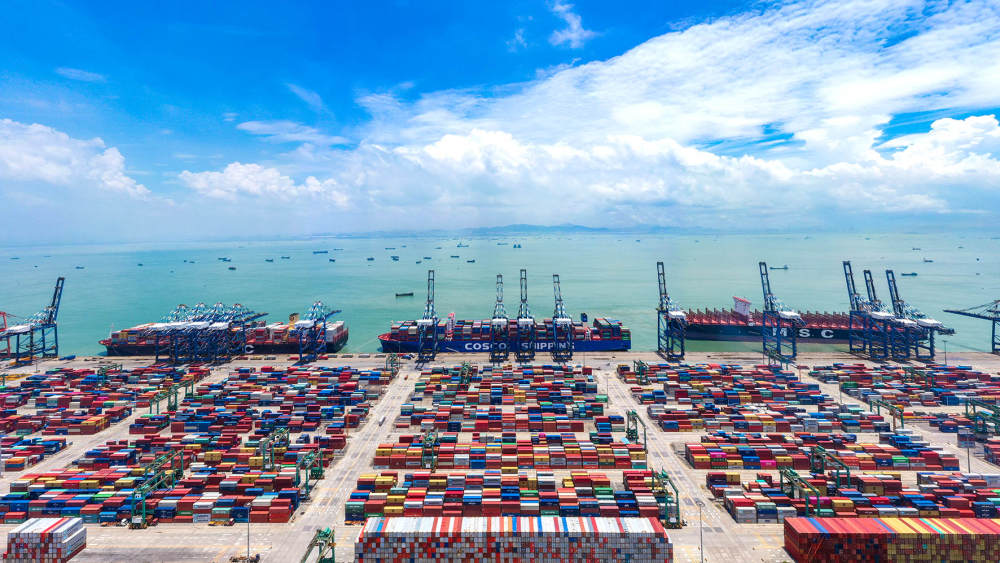
中国内贸第一大港如何成功转型“双循环枢纽”?
2 1 Shi Ji Jing Ji Bao Dao· 2026-01-27 07:53
Core Viewpoint - The strong momentum of Guangzhou's foreign trade is driven by the proactive advancement of ports and deep integration into the industrial hinterland, creating a closed loop of "cargo organization - efficient channels - value enhancement" [1][5]. Group 1: Port Development and Performance - The Guangdong Provincial Government's report emphasizes the enhancement of port construction and the elevation of Guangzhou Port's status as an international hub [2]. - In 2025, Guangzhou Port is projected to handle over 696 million tons of cargo and exceed 28 million TEUs in container throughput, maintaining its position among the top six global ports [2]. - A significant change is noted as the proportion of foreign trade containers at Guangzhou Port surpasses 50%, marking its successful transformation into a "dual circulation hub" [2]. Group 2: Growth in Trade and Export - The number of foreign trade liner routes from Guangzhou Port is expected to expand to 182 by 2025, with a year-on-year increase of 10.73% in foreign trade cargo throughput and nearly 20% growth in foreign trade container throughput, indicating improved cargo structure and shipping efficiency [3]. - Guangzhou's foreign trade export value reached 7.56 trillion yuan from January to November 2025, reflecting a year-on-year increase of 20.1%, significantly outpacing the growth in the number of routes and container throughput [4]. - The export of high-value products such as new energy vehicles, lithium batteries, and photovoltaic products has surged, enhancing the overall export value density [4]. Group 3: Strategic Development Model - The strong dynamics of Guangzhou's foreign trade stem from the proactive establishment of an invisible port network and the expansion of high-value shipping routes, which enhance export capabilities [5]. - The port has opened 39 sea-rail intermodal routes and 73 shuttle barge routes, effectively gathering inland cargo and transforming from "cargo from the port" to "port gathering cargo" [5]. - The logistics flow around the Nansha Port area has led to the emergence of nearly 2,500 enterprises in the port industry cluster, creating a complete value closed loop that supports regional economic development [5]. Group 4: Future Directions and Recommendations - The next steps involve shifting from "hardware expansion" to "software empowerment" by developing shipping soft power, including a two-step strategy for upgrading high-end shipping services [7]. - A combination of policies is recommended to support the development of high-end shipping services, including tax incentives and the establishment of offshore accounts for high-end shipping service enterprises [8]. - Accelerating the construction of digital smart port infrastructure is crucial, focusing on integrating key technologies and establishing a unified data platform for port logistics [9].