蒙特卡洛模拟

Search documents
蒙特卡洛回测:从历史拟合转向未来稳健
ZHESHANG SECURITIES· 2026-01-07 09:03
Quantitative Models and Construction Methods - **Model Name**: Monte Carlo Backtesting **Model Construction Idea**: Shift from historical path fitting to future robustness testing by generating multiple random paths to evaluate strategy performance across diverse scenarios [1][10] **Model Construction Process**: 1. Generate thousands of random price paths that follow historical statistical characteristics (e.g., return distribution, volatility, correlation) but differ from the original historical path [10] 2. Perform stress tests on strategies across these simulated paths to observe performance under various market conditions [10] 3. Calculate risk metrics such as Sharpe ratio, maximum drawdown, and value-at-risk (VaR) based on the distribution of strategy returns [10] **Model Evaluation**: Effectively reduces overfitting to specific historical paths and provides a more comprehensive robustness assessment [10][46] - **Model Name**: Non-Parametric Monte Carlo Simulation **Model Construction Idea**: Use historical data directly without assuming any parametric distribution, preserving cross-sectional correlation [2][13] **Model Construction Process**: 1. **Method 1**: Multi-Asset Time-Series Return Joint Rearrangement - Extract daily returns of all assets as a "data block" - Randomly sample and sequentially concatenate these blocks to form simulated paths [18] 2. **Method 2**: Multi-Asset Time-Series Return Block Bootstrap - Divide historical returns into fixed-length overlapping/non-overlapping blocks - Randomly sample blocks and concatenate them to form simulated paths [19] **Model Evaluation**: Preserves cross-sectional correlation but disrupts time-series structures like volatility clustering and autocorrelation [14][20] - **Model Name**: Residual Bootstrap (Factor Model-Based) **Model Construction Idea**: Separate systematic risk and idiosyncratic risk using factor models, then randomize residuals for simulation [2][23] **Model Construction Process**: 1. Construct risk factors (e.g., market, size, value, momentum) and calculate historical daily returns [23] 2. Perform cross-sectional regression to estimate factor exposures (β) and extract residual returns [23] 3. Randomly shuffle residuals while preserving cross-sectional correlation [23] 4. Reconstruct paths using historical factor returns and randomized residuals [23] **Model Evaluation**: Useful for analyzing alpha and risk exposure but limited by the explanatory power of the factor model [24][25] - **Model Name**: Geometric Brownian Motion (GBM) Simulation **Model Construction Idea**: Assume asset returns follow a normal distribution and simulate paths using drift and volatility parameters [2][28] **Model Construction Process**: $$d S_{i}(t)=\mu_{i}S_{i}(t)d t+\sigma_{i}S_{i}(t)d W_{i}(t),i=1,\ldots,n$$ - \( \mu_{i} \): Drift rate (expected return) - \( \sigma_{i} \): Volatility - \( W_{i}(t) \): Standard Brownian motion Discretized path: $$S_{i}^{(j)}(t_{k})=X_{i}(0)\,e x p[(\,k\Delta t+\sum_{l=1}^{k}\sum_{p=1}^{n}L_{i p}Z_{l,p}^{(j)}\,]$$ - \( L \): Cholesky decomposition of covariance matrix - \( Z_{l,p}^{(j)} \): Independent standard normal random variables [28] **Model Evaluation**: Accurately replicates volatility and correlation but fails to capture tail risks and price jumps [28][47] Model Backtesting Results - **Monte Carlo Backtesting**: - Historical price path Sharpe ratio: 0.96 (25-day window) - Simulated path Sharpe ratio: 0.19 (25-day window, GBM method) [45][46] - **Non-Parametric Monte Carlo Simulation**: - Historical price path Sharpe ratio: 0.96 (25-day window) - Simulated path Sharpe ratio: 0.22 (15-day window, joint rearrangement method) [45][46] - **Residual Bootstrap**: - Historical price path Sharpe ratio: 0.96 (25-day window) - Simulated path Sharpe ratio: 0.19 (25-day window) [45][46] - **Geometric Brownian Motion (GBM)**: - Historical price path Sharpe ratio: 0.96 (25-day window) - Simulated path Sharpe ratio: 0.19 (25-day window) [45][46] Quantitative Factors and Construction Methods - **Factor Name**: Momentum and Volatility Dual Factor **Factor Construction Idea**: Combine momentum and volatility factors using Z-score normalization and equal weighting [35] **Factor Construction Process**: $$S c o r e_{i}=0.5*Z S c o r e_{i,m o m}+0.5*Z S c o r e_{i,v o l}$$ - Momentum and volatility calculated over different window lengths (N ∈ [15, 20, 40]) [35] **Factor Evaluation**: Provides a balanced scoring mechanism for style rotation strategies [35][37] Factor Backtesting Results - **Momentum and Volatility Dual Factor**: - Historical price path cumulative return: 535% (25-day window) - Simulated path cumulative return: 62.25% (15-day window, GBM method) [38][42]

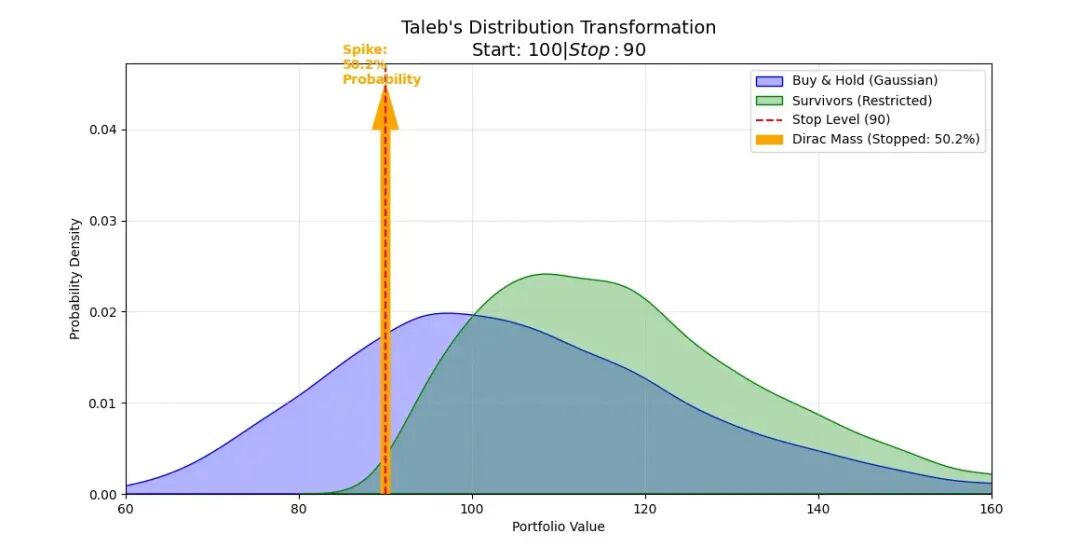
为什么止损也能让账户破产?
3 6 Ke· 2025-12-22 02:14
Core Viewpoint - The article discusses the controversial topic of "stop-loss" strategies in investing, highlighting a recent paper by Nassim Nicholas Taleb that quantifies the effects of stop-loss through Monte Carlo simulations, suggesting that stop-loss may lead to more losses rather than preventing them [1][2]. Summary by Sections Stop-Loss Strategy Analysis - The paper presents a key graph showing the distribution of returns with and without stop-loss, indicating that while stop-loss can reduce the probability of large losses, it also creates a peak of losses at the stop-loss threshold, termed "Dirac Mass" [5][6]. - In a market with a volatility of 20-25%, a fixed 10% stop-loss has a 50% chance of being triggered, which is higher than many investors expect [5][6]. - For A-shares, particularly in small-cap and tech stocks, the annualized volatility can reach 60%, resulting in an 85% chance of triggering a 10% stop-loss [6]. Recommendations for Stop-Loss - The paper suggests that a fixed stop-loss below 20% is ineffective against random noise and should be reconsidered [6]. - Stop-loss levels should be adjusted based on market volatility; in low-volatility markets, a 10% stop-loss may only trigger 15% of the time, making it a viable strategy [6]. - Fixed percentage stop-losses are not ideal; investors should consider their investment strategy and fundamentals to set stop-loss levels that are unlikely to be triggered under normal conditions [7]. Practical Issues with Stop-Loss - The article identifies three main issues that can exacerbate the negative impact of stop-loss on accounts: 1. Poor opportunity selection can lead to unnecessary stop-loss triggers, as illustrated by the trading experiences of Jesse Livermore [11]. 2. Trading in a non-trending, volatile market can result in frequent stop-loss triggers, leading to cumulative losses [12]. 3. High leverage increases the risk of permanent losses, making stop-loss more critical but also amplifying its negative effects [13]. Value Investing Perspective - Value investors, like Warren Buffett, typically do not advocate for stop-loss based on price declines, as they view such declines as opportunities to buy more shares at a discount [17]. - Instead of price-based stop-loss, value investors should focus on fundamental changes in the investment thesis to determine when to exit a position [18][19].

吴琪:扎根西藏 助计算物理在高原“加速”
Zhong Guo Qing Nian Bao· 2025-09-17 23:39
Core Insights - The article highlights the journey of Wu Qi, a theoretical physicist who chose to work in Tibet, contributing to the development of physics research in the region and addressing the gap in scientific resources and education compared to mainland China [1][2][3]. Group 1: Research Development - Wu Qi faced significant challenges in establishing her research career in Tibet, including a lack of personnel and equipment when she started in 2015 [2]. - By 2019, Wu Qi's research team began to take shape with the addition of graduate students, and the "Multiscale Material Simulation and Application Research Laboratory" was officially established [2]. - Wu Qi's efforts have led to increased collaboration between Tibet University and other institutions, expanding the scope of academic exchanges [2][3]. Group 2: Innovative Research Approaches - Wu Qi's research focuses on utilizing computational physics to accelerate material research, particularly in the context of oxygen production in high-altitude environments [3][4]. - The team aims to find alternative porous materials for oxygen production, leveraging Tibet's abundant solar energy for water electrolysis [3][4]. - The application of computational methods has significantly reduced the time and cost associated with material synthesis, with potential production costs for oxygen being lower than current market prices [4]. Group 3: Educational Impact - Wu Qi has made significant contributions to teaching at Tibet University, enhancing the learning experience for students in physics through innovative teaching methods [5][6]. - She emphasizes the importance of nurturing young talent and encourages students to participate in academic conferences to broaden their horizons [5][6]. - The educational initiatives at Tibet University reflect a broader trend of improving higher education and research capabilities in the region, contributing to local economic development [6][7].
并购市场即将转向增量时代,中介机构怎么说?
2 1 Shi Ji Jing Ji Bao Dao· 2025-08-08 22:32
Group 1 - The core viewpoint of the discussions at the closed-door seminar "M&A Breakdown: Investment and Exit Games in the Era of Stock" highlights a shift in focus from due diligence and transaction design to litigation and dispute resolution in the M&A landscape since 2018 [1] - The investment in distressed asset funds has been a notable area of growth since 2018, with successful outcomes in property rights investment, debt investment, and bankruptcy restructuring [1] - Recent M&A activities have predominantly concentrated in sectors such as semiconductors, biomedicine, artificial intelligence, and new energy vehicles, which present valuation complexities due to their reliance on patents and R&D outcomes without immediate revenue generation [1] Group 2 - Traditional market methods like PE, PB, and PS are less applicable for early-stage valuations of companies in these sectors, leading to the adoption of alternative metrics such as equity value to GMV and equity value to R&D expenses [2] - For biomedicine companies, valuation methods must adapt to different R&D stages, utilizing techniques like binomial tree models or Monte Carlo simulations to meet listing requirements [2] - Cross-border M&A transactions, particularly involving A+H share companies with state-owned backgrounds, face significant operational challenges due to the need for triple regulatory approvals, highlighting the critical role of valuation firms in navigating these complexities [2]
专利并购陷估值困局?仲量联行刘小翠祭出三招
2 1 Shi Ji Jing Ji Bao Dao· 2025-07-31 05:08
Group 1 - The core viewpoint of the article highlights the challenges and opportunities in the M&A market, particularly focusing on sectors like semiconductors, biomedicine, artificial intelligence, and new energy vehicles, which have seen increased activity in recent years [1][2] - The complexity of valuation in these sectors is emphasized, as many companies possess significant patents and intangible assets but have not yet generated substantial revenue or profits, making traditional valuation methods less applicable [1] - Alternative valuation methods such as equity value to GMV ratio and equity value to R&D expenses ratio are suggested for better assessment in early-stage companies [1] Group 2 - The article discusses the operational difficulties in cross-border M&A, particularly for A+H share listed companies with state-owned backgrounds, which require multiple layers of regulatory approval [2] - It notes the differing regulatory logic among various authorities, with state-owned asset protection being a primary concern, leading to the necessity of using multiple valuation methods for cross-verification [2] - The article also points out the cautious approach of the Hong Kong market towards the income method, which requires additional documentation and can complicate the approval process [2]