虚拟货币投资风险

Search documents
比特币12月开门就迎“过山车”:虚拟资产狂潮渐退,监管重拳筑牢风险防线
Sou Hu Cai Jing· 2025-12-03 12:44
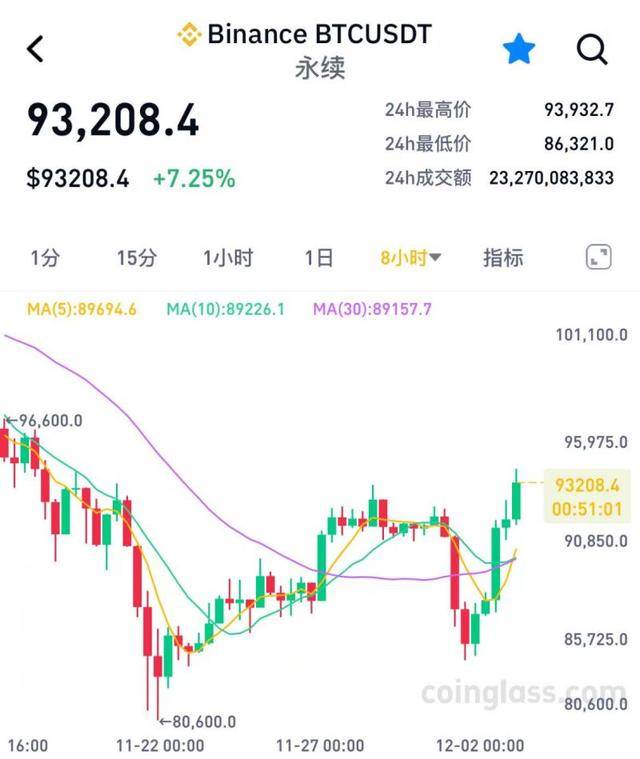
Market Overview - Bitcoin experienced significant volatility in early December, dropping below $85,000 on December 1 with a maximum daily decline exceeding 7%, before rebounding above $90,000 on December 2, closing at $93,208.4, a 7.25% increase within 24 hours [2][3] - Over 120,000 traders faced liquidation in the last 24 hours, with total liquidations amounting to approximately $500 million [2] Price Volatility Factors - The price of Bitcoin is heavily influenced by market sentiment, lacking backing from national credit or actual cash flow, leading to extreme price fluctuations due to policy changes, technical vulnerabilities, or market emotions [2] - The high leverage trading structure within the Bitcoin ecosystem can trigger a "death spiral" of price drops and liquidations from minor price changes [2] - Bitcoin's price has seen over 50 instances of declines exceeding 10% since 2010, with an average drop of 30% during these corrections [3] Market Dynamics - The cryptocurrency market is characterized by insufficient depth and weak liquidity, making it susceptible to significant price swings from large trades or sudden shifts in sentiment [4] - Factors contributing to the recent downturn include persistent outflows from Bitcoin ETFs, uncertainty surrounding Federal Reserve interest rate cuts, selling by large investors, and tightening domestic policies [4] - Data indicates that BlackRock's Bitcoin spot ETF saw a net outflow of $2.34 billion in November, with trading volumes on centralized exchanges dropping to $1.59 trillion, a 26.7% decline from October [4] Regulatory Environment - The Chinese government continues to enforce strict regulations against cryptocurrency trading, emphasizing that virtual currencies do not hold the same legal status as fiat currencies and are considered illegal financial activities [6] - Legal experts warn that engaging in cryptocurrency investments poses legal risks, as activities related to virtual currencies may be deemed invalid under civil law [6] Future Outlook - Experts express skepticism about Bitcoin's future, suggesting it cannot replace fiat currencies and lacks intrinsic value as an investment asset [5] - The ongoing tightening of regulations by major economies may signal the end of the "currency experiment" that Bitcoin represents, with the potential for significant market adjustments [5][9] - The future of stablecoins is contingent on the speed and rigor of regulatory compliance, with products relying heavily on high leverage facing increased scrutiny [9]

盈利佣金25%、风险自担,从周杰伦寻人看比特币投资的危险游戏
Bei Jing Shang Bao· 2025-10-24 01:43
Core Viewpoint - The involvement of celebrities like Jay Chou in Bitcoin trading has added a speculative layer to the cryptocurrency market, particularly highlighted by a recent incident involving his friend, magician Cai Weize, who allegedly went missing after managing a significant investment in Bitcoin for Chou [1]. Group 1: Investment Behavior - The incident reflects a broader trend where individuals engage in cryptocurrency trading through acquaintances, often leading to hidden risks associated with such informal arrangements [1][5]. - Many participants in the cryptocurrency market are drawn by the allure of high returns, which has led to the rise of "signal providers" who share profitable trades on social media to attract followers [3][6]. - Trust plays a crucial role in these informal investment relationships, where individuals often overlook the lack of regulatory oversight and legal protections in the cryptocurrency space [5][8]. Group 2: Risks and Challenges - The lack of formal agreements and regulatory frameworks in informal cryptocurrency trading increases the risk of disputes, especially when losses occur [7][8]. - Investors often fail to conduct thorough due diligence due to personal relationships, which can lead to significant financial losses without clear accountability [7][8]. - The volatility of Bitcoin, which has seen dramatic price fluctuations, exacerbates the risks associated with informal trading arrangements, as evidenced by the recent price movements [9]. Group 3: Market Dynamics - Bitcoin has experienced substantial price increases, with its value nearly doubling in recent months, reaching a peak of $126,080 before experiencing significant volatility [9]. - The speculative nature of Bitcoin trading, combined with the potential for both high returns and substantial losses, creates a challenging environment for investors, particularly those relying on informal arrangements [9][10]. - Legal and technical challenges persist in the cryptocurrency market, particularly regarding the clarity of asset control and the potential for information asymmetry between investors and those managing their funds [8].
比特币被美没收,中国散户血本无归,幕后黑手是谁?
Sou Hu Cai Jing· 2025-10-18 06:19
Core Points - The U.S. government recently seized $15 billion worth of Bitcoin, which primarily belonged to Chinese investors who had invested their savings, including retirement funds, in cryptocurrency with the hope of making profits [1][3] - The seized Bitcoin originated from the Bitfinex platform, which had previously suffered a hack, and the U.S. Department of Justice has frozen the funds while investigating suspects [3][5] - Many affected investors, mostly from China, have not been notified about the status of their funds, raising questions about the jurisdiction and rights of foreign investors in such cases [3][7] Group 1 - The seizure of Bitcoin is framed as a measure against crime, but it effectively shifts the burden onto the victims, who are unlikely to receive compensation as the U.S. legal system classifies the Bitcoin as illicit funds [7][9] - The Chinese regulatory environment had previously warned about the risks associated with virtual currencies, but many investors ignored these warnings, driven by the fear of missing out on potential profits [7][9] - The emotional and financial toll on individual investors is significant, with many sharing personal stories of financial loss, highlighting the vulnerability of retail investors in the cryptocurrency market [5][9] Group 2 - The incident underscores the inherent risks of Bitcoin and similar cryptocurrencies, which lack government backing and financial safety nets, leaving investors exposed to potential losses without recourse [9] - The ongoing allure of quick wealth continues to attract new investors, despite the risks, indicating a persistent cycle of speculation and loss within the cryptocurrency market [9] - The situation raises broader concerns about the accountability of cryptocurrency exchanges and the protection of investors, particularly those from jurisdictions with different regulatory frameworks [3][7]

严禁信用卡套现炒股,多家银行发声!
券商中国· 2025-08-20 03:42
Core Viewpoint - The A-share market is experiencing a positive trend with increased investor enthusiasm, leading to daily trading volumes exceeding 2 trillion yuan, but this has also heightened trading risks [1] Group 1: Bank Announcements - Several banks have reiterated that credit card funds are prohibited from entering the stock market, emphasizing compliance with regulatory requirements [1][3] - In mid-August, Shaanxi Rural Credit Union clarified that credit card funds cannot be used for investment purposes, including stocks, funds, futures, and virtual currencies, warning of potential transaction failures for violations [3] - Following Shaanxi Rural Credit Union's announcement, multiple rural commercial banks in Shaanxi and Yunnan issued similar statements regarding the prohibition of credit card overdrafts for investment-related transactions [3] Group 2: Regulatory and Risk Management - Analysts indicate that the current market recovery has led some credit card holders to attempt cash advances for stock market investments, posing risks of financial misallocation [4] - Regulatory bodies have long prohibited the use of credit funds for non-consumption purposes, and recent bank announcements serve as a reminder of these regulations amid rising market sentiment [4] - Violating these regulations can lead to various consequences for individuals, including transaction failures, account restrictions, and potential negative impacts on credit ratings [4] Group 3: Preventive Measures - Banks are encouraged to implement stricter customer qualification reviews during the credit card application process and utilize big data and AI for real-time transaction monitoring [5] - The inclusion of new prohibited categories, such as virtual currencies and investment-type precious metals, reflects the need for banks to adapt their risk management strategies to market changes [5] - Strengthening multi-dimensional risk control systems and enhancing customer education on the proper use of credit card funds are recommended to prevent misuse [5]