
行政令

Search documents
特朗普发表国情咨文演讲,有议员抗议被带离场
Zhong Guo Ji Jin Bao· 2026-02-25 03:25
Group 1 - President Trump delivered his first State of the Union address of his second term, focusing on border security, immigration, economy, and crime issues [1] - Several Democratic lawmakers were absent from the speech, with House Democratic leader Jeffries urging members to either attend in silence or participate in alternative events [1] - Trump's speech coincided with setbacks in his key policies on tariffs and immigration, including a Supreme Court ruling that limited his authority to impose large-scale tariffs [1] Group 2 - Texas Democratic Congressman Al Green was removed from the chamber for protesting during Trump's address [2] - A controversial video posted on Trump's social media account, which included edited images of former President Obama and his wife, sparked widespread condemnation and was subsequently deleted by the White House [2]
特朗普第二任期内狂签行政令,超首届任期总和!
Jin Shi Shu Ju· 2025-12-16 13:09
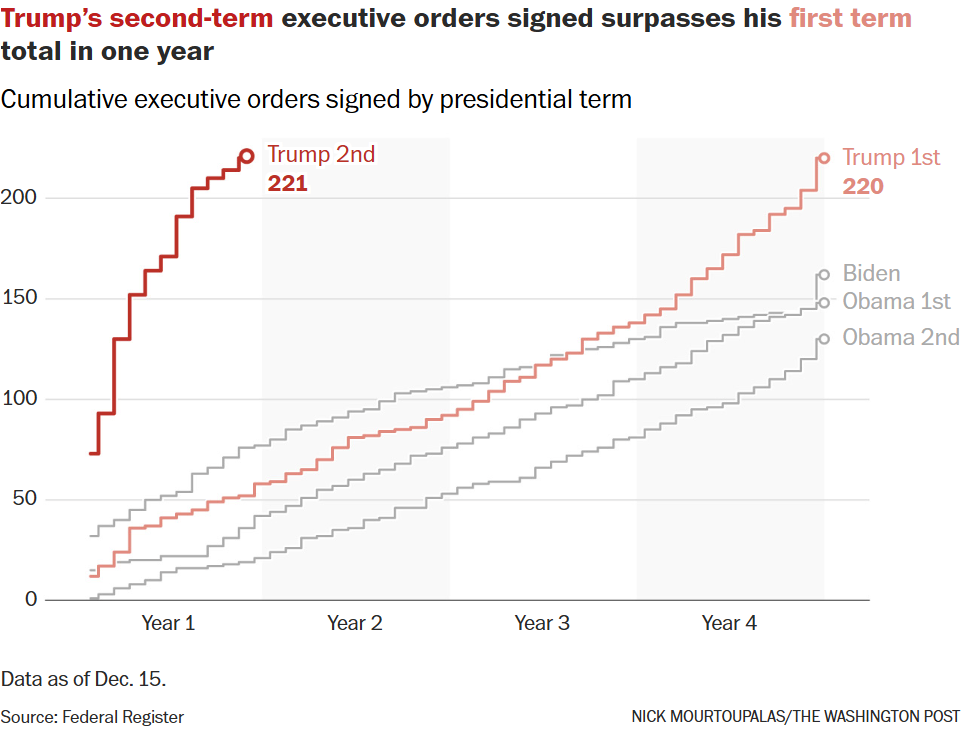
Core Points - President Trump has signed more executive orders in his second term than in his first, with a total of 221 executive orders as of this week [6] - A significant portion of these executive orders, approximately one-third, have faced legal challenges [4] - Trump's approach to governance has increasingly relied on executive orders to bypass Congress, reflecting a trend of expanding executive power in the U.S. [4][9] Group 1: Executive Orders Overview - Trump has issued executive orders on a wide range of topics, including trade (54 orders), government efficiency (30), foreign policy (25), and cultural issues (20) [7] - Nearly 35% of the executive orders related to the economy and trade have been challenged in court, while 45% of those concerning diversity, equity, and inclusion (DEI) and culture have faced legal scrutiny [7] - The rapid issuance of executive orders has raised concerns about the administration's capacity to implement these policies effectively [5] Group 2: Political Context and Implications - Trump's use of executive orders is seen as a response to perceived failures of Congress to legislate effectively, particularly in a polarized political environment [4][9] - The White House spokesperson emphasized that many of Trump's policies are expected to gain formal legislative support from Congress, ensuring their longevity [4] - Historical context shows that U.S. presidents have used executive orders to expand their powers, with Trump’s approach being a continuation of this trend [9][10] Group 3: Public and Media Engagement - Trump has strategically used media events to highlight the signing of executive orders, often inviting journalists to witness the process, which helps shape public perception [8][10] - The ceremonial aspects of signing executive orders have become a platform for Trump to communicate his policy positions and rally support from his base [11][12]

法院叫停特朗普关税,到底是怎么回事?
Hu Xiu· 2025-05-29 10:30
Group 1 - The U.S. International Trade Court ruled that the tariffs imposed by the Trump administration, specifically the "fentanyl tariffs" and "global retaliatory tariffs," exceeded presidential authority and are therefore invalid [1][4] - The "fentanyl tariffs" include a 25% tariff on products from Canada and Mexico (reduced to 10% for Canadian energy products) and a 20% tariff on China [2][4] - The "global retaliatory tariffs" consist of a 10% base tariff on all countries and additional tariffs ranging from 10% to 50% on 57 countries, with tariffs on China peaking at 125% [2][6] Group 2 - The court emphasized that while the president has the authority to manage tariffs under the International Emergency Economic Powers Act (IEEPA), this authority is limited and cannot be used to impose unrestricted tariffs [5][6] - The court rejected the government's argument that tariffs could be used to compel other countries to address the fentanyl crisis, stating that such reasoning would allow the government to act beyond legislative intent [5][6] - The court also noted that the U.S. trade deficit does not justify declaring an emergency under IEEPA to impose unlimited tariffs [6][7] Group 3 - The Trump administration has announced plans to appeal the ruling, but the initial ruling is expected to be executed immediately unless a stay is granted by the court [8][10] - If the Trump administration fails to comply with the ruling, it could lead to a constitutional crisis, as federal courts rely on government enforcement for their rulings [11][12] - Historically, there have been few instances of a president openly defying federal court rulings, and the Trump administration has typically expressed disagreement while respecting court decisions [13][19] Group 4 - The ruling's plaintiffs included small businesses affected by the tariffs and state governments, with a notable political mix among the states involved [17][18] - The ruling was unanimous among the judges, including one appointed by Trump, indicating a complex relationship between the judiciary and the executive [17][18] - Despite the ruling, the Trump administration has a history of issuing numerous executive orders, many of which have faced legal challenges, indicating a pattern of contentious governance [19][20]
特朗普执政百天:签最多的行政令,带来最大的混乱
第一财经· 2025-04-30 09:18
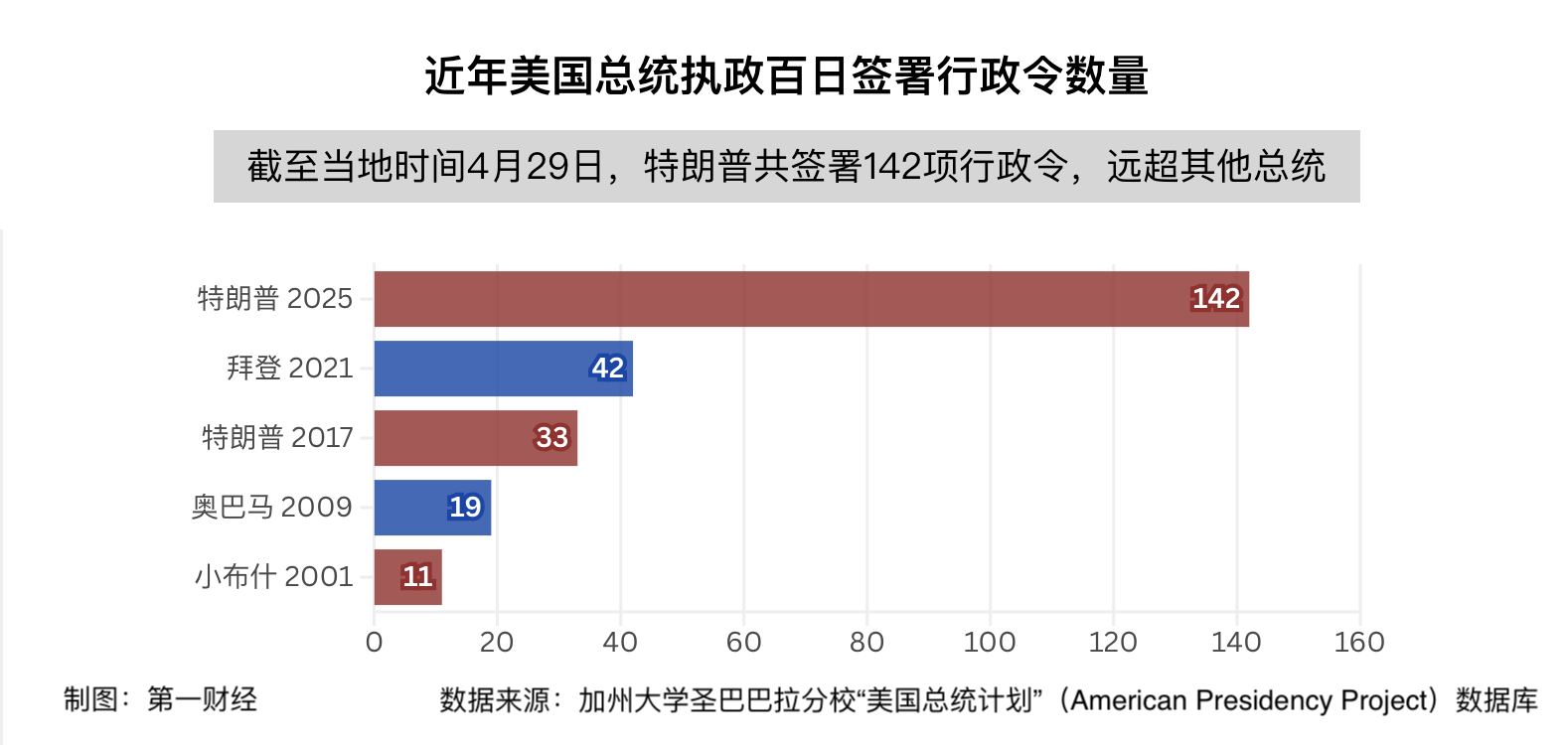
2025.04. 30 本文字数:2203,阅读时长大约4分钟 作者 | 第一财经 程程 执政百日一直被视为衡量美国总统执政初期表现的关键节点,这一阶段中总统的行动力和影响力往往 达到顶峰。然而,细数过去的100天,如何评价特朗普政府的执政效果? 复旦大学国际问题研究院院长、美国研究中心主任吴心伯教授对第一财经记者表示:"总体来说, (特朗普的这100天)不仅没有多少可以拿出手的政绩,反而激起了美国政治和经济上的动荡,加剧 了国家分裂。如果要对这100天打分的话,这是不及格的100天。" 他解释称,特朗普执政百日,对内大刀阔斧,但破多立少;对外雄心勃勃,但乏善可陈。特朗普虽然 改变了拜登政府在清洁能源、气候变化和多元化等诸多问题上的政策,并且对联邦政府进行大规模的 结构调整和裁减雇员,但这些改变并没有取得预期的效果。截至目前,转向传统能源的举措未能直接 降低美国能源价格,对联邦政府的改革也没有实现大规模降低联邦开支的目标,政府赤字仍在增长。 百条行政令引发百条诉讼 行政令是总统向联邦机构发布的指令,具有法律效力,无须国会批准。 加州大学圣巴巴拉分校的"美国总统计划"(American Presidency P ...
特朗普执政百天:签最多的行政令,带来最大的混乱
Di Yi Cai Jing· 2025-04-30 07:09
Group 1: Trump's First 100 Days Performance - Trump's first 100 days are deemed unsatisfactory, with little to show in terms of achievements, leading to increased political and economic turmoil in the U.S. [1] - The administration's focus on traditional energy has not resulted in lower energy prices, and federal reforms have not significantly reduced government spending, with the deficit continuing to grow [1] Group 2: Executive Orders and Legal Challenges - Trump signed 142 executive orders in his first 100 days, surpassing the number signed by previous presidents and approaching the total signed by Biden in four years [2] - The administration's aggressive use of executive orders has led to numerous legal challenges, with Trump facing 220 lawsuits, even excluding those related to the cancellation of international student visas [6][7] Group 3: Public Support and Economic Indicators - Trump's approval rating has dropped to a historic low of 39%, a decline of 6 percentage points since February, marking the lowest approval rating for a president in their first 100 days in the past 80 years [9] - Financial markets have reacted negatively, with the S&P 500 index down over 7% and the Nasdaq down over 11% since Trump's inauguration, alongside a significant depreciation of the dollar [9][10] Group 4: Inflation and Supply Chain Concerns - Inflation expectations in the U.S. have surged, with a one-year inflation rate expectation of 6.7%, the highest since 1981, leading to consumer panic buying [14] - Retail executives have warned that tariff policies are disrupting supply chains, potentially leading to empty supermarket shelves in the coming weeks [14]
美国商务部长卢特尼克:行政令源于与国内汽车制造商的详细对话。
news flash· 2025-04-29 15:40
Core Viewpoint - The U.S. Secretary of Commerce, Gina Raimondo, stated that the executive order is a result of detailed discussions with domestic automakers [1] Group 1 - The executive order aims to address issues related to the automotive industry [1] - The discussions with domestic automakers were comprehensive and aimed at understanding their needs and challenges [1]