
衍生品策略

Search documents
从“锦上添花”到“压舱石”:衍生品策略应如何配置?|策马点金
Qi Huo Ri Bao· 2026-02-25 08:20
Core Insights - The article emphasizes the shift in asset allocation strategies, highlighting the increasing importance of derivative strategies, particularly CTA (Commodity Trading Advisor) strategies, as core components in investment portfolios [2][4][10] Group 1: Derivative Strategies - In mature overseas markets, the trading volume of derivatives surpasses that of stocks, establishing derivatives as a crucial part of asset allocation [4] - Derivative strategies provide diverse sources of returns, including arbitrage, protection, and volatility trading, making them essential for long-term value preservation [4] - CTA strategies are characterized by low correlation, flexibility, and "crisis alpha," offering independent sources of returns that enhance the overall Sharpe ratio of investment portfolios [4][5] Group 2: Market Conditions and Strategy Allocation - In bull markets, equity assets perform best, and maintaining a baseline allocation to CTA strategies is recommended to protect against unexpected market corrections [5][10] - In bear or volatile markets, the "crisis alpha" and diversified return capabilities of CTA strategies become more pronounced, suggesting an increase in their allocation [5][10] - The article advises that a certain percentage of CTA allocation should be held as a long-term core position to fully realize its value [6][9] Group 3: Risk Management and Liquidity - Effective risk management involves controlling the scale of product lines, implementing tail risk protection strategies, and ensuring asset and strategy diversification [8] - The collaboration between derivative strategies and traditional equity and bond assets should be considered in tactical asset allocation, depending on investor expectations of returns and risks [8] Group 4: Investment Recommendations - The current global macro environment is characterized by weak recovery, loose liquidity, and high geopolitical uncertainty, leading to a recommended asset allocation priority of commodities > stocks > bonds > cash [10] - Despite recent volatility in precious metals, the long-term upward trend in gold prices remains intact, indicating ongoing opportunities for CTA strategies [10] - The article concludes that as global economic uncertainty rises, the demand for diversified asset allocation is increasing, with commodities serving as a core choice for risk diversification [10]


“冠军产品”净值从3.4骤降至1.2,筑金投资回应
Zhong Guo Ji Jin Bao· 2026-01-27 10:57
Core Viewpoint - The significant decline in the net value of "Zhujin Xinrui No. 1," a previously high-performing options product managed by Zhujin Investment, has raised market concerns due to its drop from 3.4 yuan to around 1.2 yuan [1][2]. Group 1: Product Performance and Market Reaction - "Zhujin Xinrui No. 1" had previously won national futures (options) trading competition championships and was known for its strong performance [2][5]. - The recent net value drop is attributed to extreme market conditions in the lithium carbonate sector, where prices surged unexpectedly, impacting the product's strategy [4][5]. - The product's strategy is characterized by high volatility, and the recent decline did not trigger any risk control alerts or stop-loss measures as per the product's contract [5]. Group 2: Company Background and Strategy - Zhujin Investment, established in February 2010, is a veteran private equity firm with a management scale between 1 billion to 2 billion yuan, focusing on various investment directions including options and commodities [5]. - "Zhujin Xinrui No. 1," launched in December 2021, employs a mature options selling strategy and has achieved notable success in competitions, including significant profits during trading periods [5][6]. Group 3: Industry Challenges and Risk Management - The high volatility in the commodity market poses ongoing challenges for private equity firms, with instances of significant losses due to sudden market shifts [7]. - Effective risk management in derivative strategies is crucial, requiring a multi-layered approach involving private equity firms, distribution agencies, and custodians to mitigate risks [8]. - The complexity and high-risk nature of derivative products necessitate stringent investor suitability assessments to ensure that products are sold to appropriate investors [9].
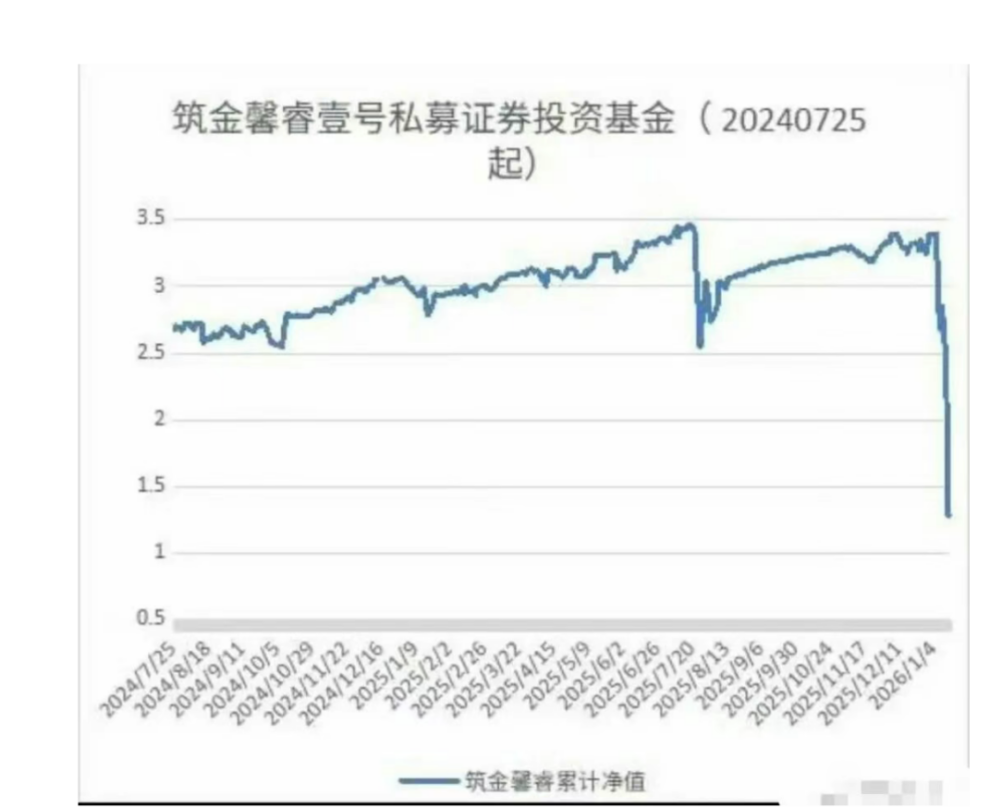
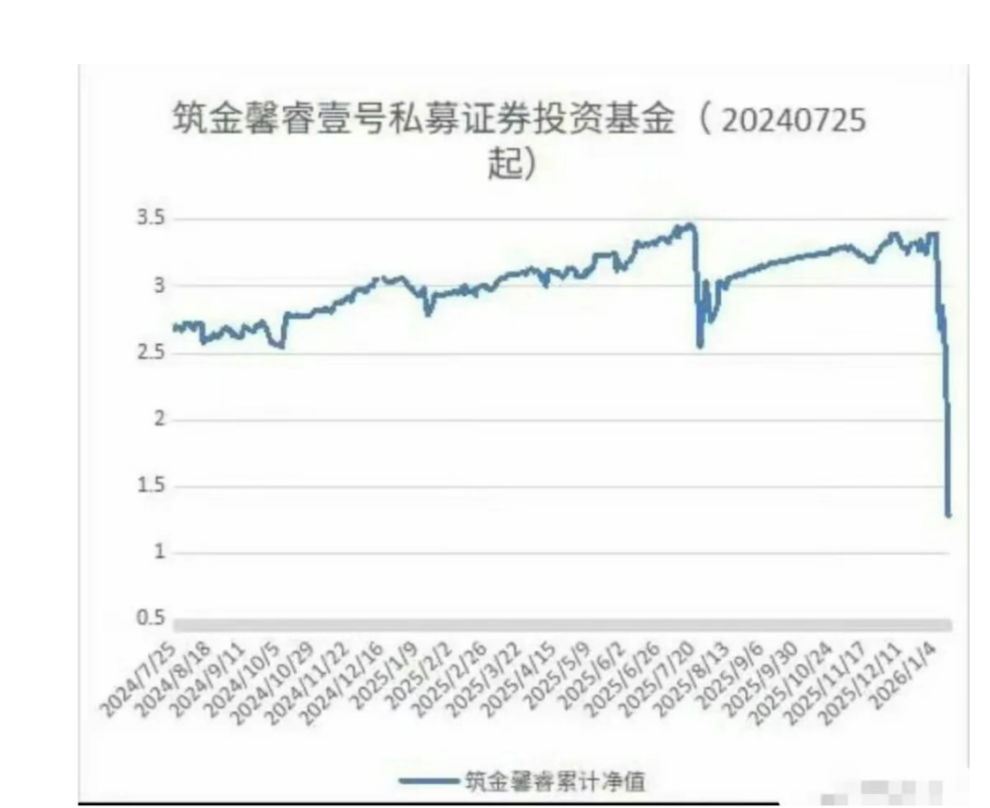
“冠军产品”净值从3.4骤降至1.2,公司独家回应
Zhong Guo Ji Jin Bao· 2026-01-27 10:39
Core Viewpoint - The significant decline in the net value of the "ZhuJin XinRui No.1" options product, which previously reached a peak of 3.4 yuan, has raised market concerns regarding its high volatility strategy and risk management considerations [1][3]. Company Overview - Shanghai ZhuJin Investment Co., Ltd. was established in February 2010 and is among the first batch of qualified investment advisory firms, managing assets between 1 billion to 2 billion yuan, with research directions including black metals, chemicals, agricultural products, options, stocks, and indices [4]. - The "ZhuJin XinRui No.1" product was launched in December 2021 and has achieved notable performance, winning national futures (options) trading competition championships in 2024 and 2025, with a reported profit of over 30 million yuan during the competition period [4]. Product Strategy and Performance - The "ZhuJin XinRui No.1" product primarily employs options strategies, integrating arbitrage hedging and a small amount of directional trading, with a focus on selling options [5]. - The recent net value drop is attributed to extreme market conditions in the lithium carbonate sector, where the price surged from approximately 120,000 yuan/ton to over 170,000 yuan/ton, leading to significant losses for institutions that engaged in contrary trading [3]. Risk Management Challenges - The high volatility in the commodity market has become a norm, posing challenges for risk management in derivative strategies, as evidenced by substantial losses experienced by some private equity managers due to extreme market fluctuations [6]. - The challenges in derivative strategies are concentrated around the "leverage effect" and "strategy opacity," which can amplify the impact of extreme events and create blind spots in risk monitoring [6]. Recommendations for Risk Control - Constructing a multi-layered risk control system is essential, requiring collaboration among private equity firms, distribution agencies, and custodians to enhance real-time monitoring and conduct stress tests for potential extreme scenarios [7]. - It is crucial to set scientific evaluation thresholds for investor suitability, ensuring that investors understand the inherent risks of options strategies and are matched with products that align with their risk tolerance [8].
大类资产周报:资产配置与金融工程指数强势突破,贴水大幅收敛-20250630
Guoyuan Securities· 2025-06-30 07:12
Quantitative Models and Construction Methods 1. Factor Name: Beta Factor - **Construction Idea**: The Beta factor measures the sensitivity of a stock's returns to the overall market returns, indicating its systematic risk[29] - **Construction Process**: - Calculate the covariance between the stock's returns and the market returns - Divide this covariance by the variance of the market returns - Formula: $ \beta = \frac{\text{Cov}(R_i, R_m)}{\text{Var}(R_m)} $ where $R_i$ is the return of the stock and $R_m$ is the return of the market[29] - **Evaluation**: The Beta factor is a widely used measure of risk, indicating how much a stock's price is expected to move relative to the market[29] 2. Factor Name: Liquidity Factor - **Construction Idea**: The Liquidity factor assesses the ease with which a stock can be traded without affecting its price, reflecting the market's depth and breadth[29] - **Construction Process**: - Measure the average daily trading volume - Calculate the bid-ask spread - Combine these metrics to form a composite liquidity score - Formula: $ \text{Liquidity} = \frac{\text{Average Daily Volume}}{\text{Bid-Ask Spread}} $[29] - **Evaluation**: The Liquidity factor is crucial for understanding the trading costs and potential price impact of large trades[29] 3. Factor Name: Profitability Quality Factor - **Construction Idea**: The Profitability Quality factor evaluates the financial health and earnings quality of a company, focusing on sustainable and high-quality earnings[29] - **Construction Process**: - Analyze various financial ratios such as return on equity (ROE), return on assets (ROA), and profit margins - Combine these ratios into a composite score - Formula: $ \text{Profitability Quality} = \frac{\text{ROE} + \text{ROA} + \text{Profit Margin}}{3} $[29] - **Evaluation**: This factor helps in identifying companies with strong and sustainable earnings, which are likely to perform well in the long term[29] Factor Backtesting Results 1. Beta Factor - **IR**: 0.45[29] - **Annualized Return**: 8.5%[29] - **Volatility**: 12.3%[29] 2. Liquidity Factor - **IR**: 0.38[29] - **Annualized Return**: 7.8%[29] - **Volatility**: 11.5%[29] 3. Profitability Quality Factor - **IR**: 0.52[29] - **Annualized Return**: 9.2%[29] - **Volatility**: 10.8%[29] Additional Factors and Their Performance 1. Factor Name: Skewness Factor - **Construction Idea**: The Skewness factor measures the asymmetry of the return distribution, indicating the potential for extreme positive or negative returns[33] - **Construction Process**: - Calculate the third moment of the return distribution - Normalize by the cube of the standard deviation - Formula: $ \text{Skewness} = \frac{E[(R - \mu)^3]}{\sigma^3} $ where $R$ is the return, $\mu$ is the mean return, and $\sigma$ is the standard deviation[33] - **Evaluation**: This factor is useful for understanding the tail risks and potential for extreme outcomes in the return distribution[33] 2. Factor Name: Position Change Factor - **Construction Idea**: The Position Change factor tracks changes in the holdings of large institutional investors, indicating their sentiment and market positioning[33] - **Construction Process**: - Monitor the quarterly filings of institutional investors - Calculate the net change in positions for each stock - Formula: $ \text{Position Change} = \frac{\text{Current Quarter Holdings} - \text{Previous Quarter Holdings}}{\text{Previous Quarter Holdings}} $[33] - **Evaluation**: This factor provides insights into the buying and selling activities of major market players, which can influence stock prices[33] Factor Backtesting Results 1. Skewness Factor - **IR**: 0.42[33] - **Annualized Return**: 8.1%[33] - **Volatility**: 11.9%[33] 2. Position Change Factor - **IR**: 0.47[33] - **Annualized Return**: 8.7%[33] - **Volatility**: 11.2%[33]