
认知

Search documents
丙午年:换运之前,先换人
洞见· 2026-02-27 06:10
Core Viewpoint - The article emphasizes the importance of surrounding oneself with positive, high-energy individuals to enhance personal growth and fortune in the year of Bingwu [4][10][36]. Group 1: Energy and Relationships - The article suggests that the energy between individuals is reciprocal, and being around negative people can lead to feelings of despair and stagnation [6][20]. - It encourages readers to distance themselves from those who drain their energy and to seek out individuals who inspire and uplift them [5][36]. - The narrative includes examples of influential figures, such as Helen Keller and Mark Twain, highlighting how positive relationships can significantly impact one's life [8][9][10]. Group 2: Cognitive Growth - The article advocates for engaging with individuals of higher cognitive levels to expand one's understanding and perspective [13][20]. - It references successful individuals like Nobel laureate Ivar Giaever, who benefited from mentorship and guidance, illustrating the value of learning from those with greater wisdom [17][18]. - The text stresses that surrounding oneself with high-achieving individuals can lead to new insights and opportunities for personal development [20][36]. Group 3: Continuous Improvement - The article highlights the necessity of associating with individuals who are committed to personal growth and continuous learning [22][36]. - It shares a story of Zhang Hongjie, who realized that his social circle was hindering his progress and chose to focus on self-improvement instead [22]. - The narrative encourages readers to seek out those who challenge them to grow and push beyond their comfort zones [22][36]. Group 4: Support and Recognition - The article discusses the importance of being around those who appreciate and recognize one's potential, contrasting them with those who belittle or undermine [27][36]. - It provides an example of Feng Zikai, whose life was positively influenced by a mentor's encouraging words, demonstrating the impact of supportive relationships [27][28]. - The text concludes that surrounding oneself with supportive individuals can lead to greater achievements and fulfillment [36].


小冰之父李笛智能体创业,公司取名Nextie!陆奇是股东
量子位· 2025-12-08 10:53
Core Viewpoint - The article discusses the emergence of a new startup called Nextie, founded by Li Di, who previously created the AI chatbot Xiaobing. The company aims to leverage "collective intelligence" to enhance AI cognition and decision-making processes, moving beyond traditional models. Group 1: Company Overview - Li Di, known for developing Xiaobing, has launched a new company named Nextie, which means "next journey" [4][7] - The core team of Nextie consists of key members from the Xiaobing project, including co-founder Zeng Min and algorithm head Wang Wenlan [4][45] - Nextie is currently planning to raise tens of millions of dollars in funding, with Qiji as one of the investors [5][8] Group 2: Technology and Innovation - Nextie aims to teach AI about "cognition" through a framework of collective intelligence, which allows multiple AI agents to collaborate and debate to reach better conclusions [11][12] - The company has compiled a comprehensive database of human papers from 1800 to 2020 to support its technology development [18] - Nextie's internal product, "Tuanzi," operates in two modes: a sister group for personal issues and a research group for academic inquiries [22][24] Group 3: Product Features - Tuanzi distinguishes itself from traditional AI by showcasing the interactions and debates among AI agents rather than relying on a single reasoning chain [24][30] - The product has achieved state-of-the-art (SOTA) results during internal testing, outperforming existing single large models [31][32] - Nextie plans to adopt a pricing model based on task outcomes rather than token usage, reflecting the varying value of tasks [33][35] Group 4: Future Prospects - The technology testing for Nextie is nearing completion, with a public launch expected on January 7 of the following year [36] - Li Di's transition to Nextie follows his departure from Xiaobing, where he remains a significant shareholder [41][42] - The article draws parallels between Li Di's new venture and Steve Jobs' NeXT, suggesting a potential for significant impact in the AI industry [62][63]

X @Yuyue
Yuyue· 2025-11-25 07:36
Healthcare Awareness & Affordability - The core issue for most families isn't financial capability but rather a lack of awareness regarding affordable healthcare options [1] - Preventative and corrective healthcare, such as dental care (ranging from 100-300 yuan for teeth cleaning and 5,000-60,000 yuan for orthodontics), spinal care (3,000-20,000 yuan for scoliosis correction), and annual check-ups (under 800 yuan in public hospitals), are often financially accessible even for families with an average monthly income of 8,000 yuan [1] - Early intervention in health issues is emphasized as more cost-effective than delayed treatment [1] Cognitive Deficiencies in Healthcare - A primary cognitive gap exists where families lack the awareness that they can afford certain healthcare services [1] - The lack of awareness about affordable healthcare options is more concerning than the actual inability to afford them [1] Societal Influences & Information Asymmetry - Consumerism and promotion of luxury goods overshadow the dissemination of information about cost-effective ways to improve health [1] - Individuals from families with limited financial resources often gain essential health knowledge later in life, such as the need for orthodontic treatment, scoliosis correction, and myopia control [1] AI & Healthcare Knowledge - While AI can assist in resolving "known unknowns," it struggles to address "unknown unknowns," particularly regarding healthcare awareness [1]
场景自带传播基因
Sou Hu Cai Jing· 2025-10-10 01:51
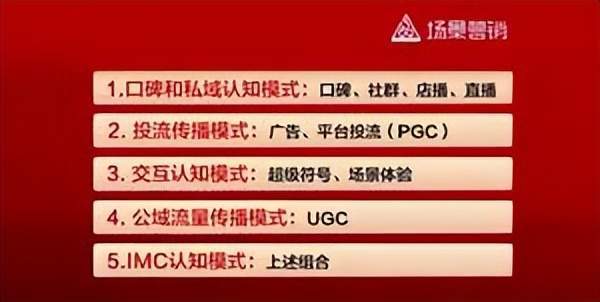
Core Insights - The article emphasizes that in the internet era, having a scene inherently brings traffic, making scene marketing a powerful tool for brands [1][30] - It discusses the importance of brand recognition and how scene marketing can achieve significant results even for lesser-known companies without substantial spending [3][14] - The article outlines a simplified business structure consisting of cognition, transaction, and relationship, highlighting the cyclical nature of these elements in commercial activities [4][14] Summary by Sections Scene Marketing - Scene marketing is described as having a strong inherent ability to generate traffic and is seen as a natural fit for integrated marketing communication (IMC) [5][24] - The article posits that scene marketing can effectively utilize various media and communication modes, including high-intensity and high-density recognition patterns [26][29] Recognition and Communication Models - Five classic cognitive communication models are identified: 1. Word-of-mouth and private domain models, characterized by high recognition intensity but slow dissemination [6][16] 2. Flow advertising model, which relies on high-density recognition through mass media [7][21] 3. Interactive recognition model, which emphasizes the interaction at sales points [9][15] 4. Public domain flow model, which leverages user-generated content (UGC) for mass recognition [19][20] 5. IMC model, which integrates all recognition modes into a cohesive strategy [11][19] The Role of Cognition - Cognition is identified as the starting point of the business structure, leading to transactions and relationships, which in turn feed back into cognition [4][14] - The article highlights that effective marketing begins with cognition, which is initiated through communication [5][30] Scene as a Communication Medium - Scenes are presented as versatile communication materials with natural dissemination capabilities, making them ideal for modern marketing strategies [5][29] - The article concludes that scenes possess a unique ability to evoke emotions, which is crucial for effective communication in the video era [29][31]
庄子《秋水》:一个人的认知,就是他的生活
洞见· 2025-10-09 12:35
Core Viewpoint - The article emphasizes the importance of recognizing and breaking through one's cognitive limitations to understand the broader world and one's true self [5][16][20]. Group 1: Cognitive Limitations - The story of the river god (河伯) illustrates how one's limited perspective can lead to ignorance, as he only understood the vastness of the sea after seeing it [11][12][16]. - The concept of "井底之蛙" (the frog in the well) symbolizes individuals who are confined by their limited experiences and cannot comprehend the vastness of the world beyond their immediate surroundings [18][20][56]. - The article discusses how societal norms and personal experiences reinforce existing beliefs, making it difficult to break free from cognitive constraints [23][32][66]. Group 2: Nature of Existence - The sea god explains that true greatness is not about being the largest but understanding the relative nature of existence, where everything is interconnected and insignificant in the grand scheme [25][28][30]. - The article suggests that individuals should not be overly concerned with societal values of wealth and status, as these are often subjective and can limit one's perspective [37][39][46]. - It highlights the importance of aligning with one's true nature and not succumbing to external pressures that distort personal values [71][73]. Group 3: Self-Understanding - The narrative stresses that true understanding comes from self-awareness and recognizing one's desires and values, rather than conforming to societal expectations [69][74]. - The article concludes that the ultimate form of cognition is understanding oneself, which allows individuals to shape their lives according to their true preferences [72][74].
#马云 #马云语录#认知 #人生感悟 #努力成为更好的自己
Xin Lang Cai Jing· 2025-08-25 18:25
Core Insights - The article emphasizes the importance of self-improvement and personal growth as articulated by Jack Ma, highlighting his philosophy on life and success [1] Group 1 - Jack Ma advocates for continuous effort in becoming a better version of oneself [1]
普通人搞钱最快的方法:卖信息差
3 6 Ke· 2025-08-25 08:10
Core Viewpoint - The article highlights the disparity in earning potential in today's economy, emphasizing that the key difference lies in cognitive awareness and the ability to identify and act on opportunities [1][24]. Group 1: Business Model and Opportunity - A case study is presented about a blogger selling a document containing information on medical beauty clinics in South Korea, which compiles user experiences to help others avoid pitfalls [2][3]. - The document has gathered over 300 clinics and is continuously updated, selling for 18 yuan, with 100,000 copies sold, generating significant revenue [4][5]. - The creation of this document requires minimal startup costs and technical skills, leveraging AI to gather information quickly [9][10]. Group 2: Market Demand and Consumer Behavior - The medical beauty market has substantial demand, but many potential consumers are deterred by the complexities involved, such as language and cultural barriers [10][12]. - The document serves as a valuable resource for consumers, allowing them to make informed decisions at a low cost compared to the potential high risks of poor medical procedures [12]. Group 3: Information Gap and Execution - The article discusses the prevalence of similar information-sharing models across various sectors, indicating that many individuals are quietly profiting from these opportunities [14][24]. - It emphasizes that the primary barrier to entry is often the perceived complexity and effort required, rather than actual technical challenges [21][24]. - The importance of identifying a market need and testing a minimal viable product is highlighted, suggesting that even small-scale efforts can validate market potential [26]. Group 4: Cognitive Awareness and Action - The article concludes that the ability to recognize and act on opportunities is crucial, with a focus on the mindset of individuals who see potential where others see obstacles [24][29]. - It encourages proactive behavior in seeking out information gaps that can be monetized, reinforcing that success is achievable through informed action [27][30].
上班到最后,拼的是一个人的认知
洞见· 2025-08-12 12:35
Core Viewpoint - The article emphasizes that an individual's career advancement is determined more by their level of cognition than by hard work alone, suggesting that higher cognitive awareness leads to greater opportunities and success in the workplace [4][5]. Group 1: Cognition in Career Advancement - The article discusses the phenomenon where some employees advance quickly while others remain stagnant, attributing this to differences in cognitive levels rather than effort [4][5]. - It illustrates the "cow-horse view," where individuals who work hard without strategic thinking end up in low-paying jobs, while those who elevate their cognitive awareness can achieve management positions [7]. - The story of a character named Yanzi highlights the importance of adapting to industry changes, as her lack of foresight led to her marginalization when the company shifted focus to short videos [7]. Group 2: Wealth Cognition - The article presents the idea that mature professionals understand the importance of earning based on value rather than time, equating skill accumulation to interest earned in a bank [12][13]. - It shares an example of a character, Li Mujia, who initially viewed work as a time-for-money exchange but later realized that increasing her value was key to career success [18][19]. - The article quotes Rockefeller, stating that wealth is a compensation for cognition rather than hard work, emphasizing that maintaining valuable skills is crucial for long-term success [21][22]. Group 3: Relationship Cognition - The article categorizes workplace mindsets into three types: the "chicken" mindset (you must lose), the "sparrow" mindset (I must win), and the "eagle" mindset (we all win together), highlighting the importance of collaboration over competition [26][28]. - It recounts a story of two managers who undermined each other, resulting in their dismissal, illustrating the detrimental effects of low cognitive awareness in a team setting [30][35]. - The article concludes that successful individuals understand the value of mutual support and collaboration, which leads to shared success in the workplace [46][48].

查理·芒格的50句忠告,让无数创业者感到无比羞愧
Hu Xiu· 2025-06-04 13:35
Group 1: Business Insights - The essence of business is to acquire barriers [7] - A useful ancient rule in business involves finding a simple principle and strictly adhering to it [8] - Successful businesses can make decisions easily, while struggling businesses face significant difficulties in decision-making [11] Group 2: Work and Personal Conduct - Understanding the limitations of one's own intellect is crucial for effective problem-solving [18] - The importance of simplicity in thought and seriousness in action is emphasized [20] - Avoiding the temptation to conform to the average is essential for achieving exceptional results [22][23] Group 3: Investment Philosophy - The essence of investment is to seek mispriced opportunities [31] - The principle of investing in great companies at fair prices is reiterated multiple times [29] - The focus should be on long-term value rather than short-term gains [41] Group 4: Cognitive Models - Common sense is often misunderstood and is actually quite rare [39] - Self-deception is a significant barrier to personal growth and success [40] - The importance of maintaining integrity and honesty in one's actions is highlighted [49]
