认知红利

Search documents
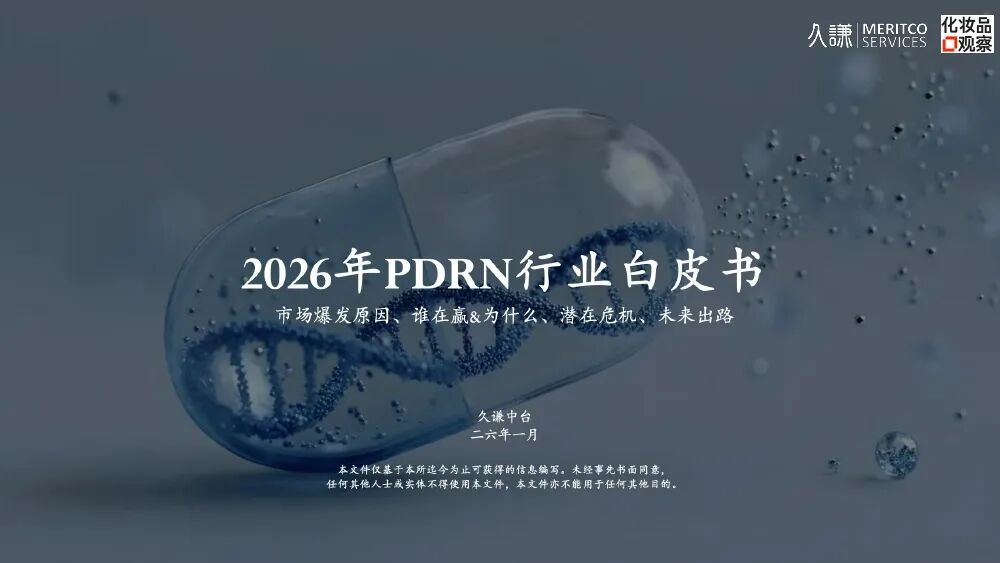
2026年PDRN行业白皮书-久谦中台x品观
Sou Hu Cai Jing· 2026-02-12 13:56
Core Insights - The PDRN skincare market is projected to grow 27 times from 14.59 million yuan to 401 million yuan between 2023 and 2025, transitioning from a niche medical beauty category to a mainstream skincare staple [1][20][22] - The growth is driven by innovative product forms addressing consumer trust issues and urgent skincare needs, with domestic brands outperforming Korean brands, exemplified by Zhenweiya capturing a 33.9% market share compared to 1.6% for brands like Lijulan [1][12][11] Market Dynamics - Douyin accounts for 77.5% of sales, serving as a primary growth engine, while Tmall caters to higher-priced products and repeat purchases [2][27] - The market is shifting from oligopoly to full competition, with the CR3 dropping by 26.7%, indicating a more fragmented landscape [2][32] - The 300-600 yuan price range is identified as a high-growth area, with Zhenweiya dominating, while products under 100 yuan face intense competition [2][35] Product Trends - The next-generation product forms, particularly the "next-throw" format, have seen a staggering growth rate of 13,888%, with facial serums being the core category [2][12] - PDRN is increasingly competing in the light medical beauty and high-efficacy segments, targeting users lost by major brands [2][12] Industry Challenges - There is a significant mismatch between supply and demand, with supply-side focusing on high-end concepts while demand-side prioritizes practical experiences [2][11] - A trust crisis is emerging due to high concentrations leading to negative user experiences, with satisfaction for "heavy feel" dropping to -86% [2][12] Future Outlook - The PDRN industry is expected to enter a phase of differentiation and reshuffling, with a focus on practical applications over grand narratives [3][11] - Brands must optimize user experience, build trust, and develop proprietary technologies to succeed in the evolving market landscape [3][12][11]



久谦:2026年PDRN行业白皮书
Xin Lang Cai Jing· 2026-02-11 10:18
Core Insights - The PDRN market is projected to experience a 27-fold growth from 2023 to 2025, transitioning from a niche medical beauty category to a mainstream consumer product [15][19]. - The market is characterized by a significant supply-demand mismatch, with domestic brands leveraging "form innovation" to gain competitive advantages [5][35]. - The report emphasizes the importance of understanding both consumer needs and marketing claims to accurately identify genuine demand versus superficial concepts [4][6]. Market Dynamics - The PDRN market is expected to see a compound annual growth rate (CAGR) of 424.8% from 2023 to 2025, with average prices stabilizing around 220 yuan, indicating a shift towards mass-market appeal [15][18]. - Sales volume is projected to increase from 11 million units in 2023 to 183 million units by 2025, reflecting a 24-fold rise [16][18]. - The market is currently dominated by content-driven platforms, with Douyin accounting for 77.5% of sales and experiencing a CAGR of 438.4% [20][21]. Competitive Landscape - The market is shifting from oligopoly to full competition, with the top three brands' market share declining by 26.7%, allowing new entrants to gain traction [25][26]. - Domestic brands like Zhanwai Ji have captured 33.9% of the market share, while traditional Korean brands like Lijuzhuan have dropped to 1.6% [39][35]. - The report highlights the need for brands to balance high efficacy with user-friendly experiences to succeed in the evolving market [8][11]. Consumer Behavior - There is a notable consumer preference for products that offer immediate results, such as "emergency relief" solutions for issues like fatigue and skin dullness [6][10]. - The satisfaction rate for products marketed as "quick absorption" is as high as 99%, while dissatisfaction with "heavy feel" products can drop to -86% [6][11]. - The report indicates that consumers are increasingly skeptical of high-priced products without clear efficacy, leading to a demand for transparency in ingredient sourcing and product claims [58][59]. Strategic Recommendations - Brands should focus on creating products that address specific consumer pain points, such as "makeup base" and "fatigue relief," rather than relying on complex scientific narratives [6][8]. - The report suggests that the future winners will be those who can effectively communicate and deliver on practical benefits rather than abstract concepts [6][11]. - Companies are encouraged to adopt a multi-channel strategy, utilizing platforms like Douyin for initial consumer engagement and Tmall for brand loyalty and higher-value transactions [22][24].
穿越周期的早期投资:从赛道思维到认知红利|甲子引力
Sou Hu Cai Jing· 2025-12-16 10:45
Core Insights - The article discusses the shift from "track thinking" to "cognitive dividends" in early-stage investment, emphasizing the need for investors to develop a deep understanding of people, cycles, and non-consensus views in a crowded market [1][2]. Group 1: Investment Strategies - Investors are moving away from simply betting on popular sectors and are focusing on building their own cognitive models and project radars to identify unique opportunities [1][2]. - The importance of maintaining a "feel" for the market and establishing positive feedback loops during industry downturns is highlighted as key to capturing the next big opportunity [1][2]. Group 2: Key Investment Areas - Major investment themes identified include AI applications, AI-driven consumer electronics, embodied intelligence, and energy systems related to AI [8][9]. - The focus on AI hardware and AI for Science is emphasized, with a recognition of the rapid evolution of sectors like quantum technology and biomanufacturing [9][10]. Group 3: Cognitive Differentiation - Investors are encouraged to develop unique cognitive perspectives that differentiate their investment decisions, even when consensus exists around certain sectors [12][21]. - Examples of successful investments based on unique cognitive insights include early support for companies that later gained significant market traction, despite initial skepticism from the broader investment community [14][15]. Group 4: Project Sourcing and Influence - The role of personal influence and brand visibility in attracting quality projects is discussed, with a focus on how public engagement can enhance investment opportunities [25][26]. - The importance of continuous learning and sharing insights through platforms like podcasts and articles is noted as a way to build a network of potential investment opportunities [27][28]. Group 5: Future Outlook - The consensus among investors is to continue focusing heavily on AI-related investments, with specific attention to foundational AI technologies and applications [32][33].
人生变好的开始:远离牛马之交
洞见· 2025-11-19 12:36
Core Viewpoint - The article emphasizes the negative impact of workplace relationships driven by complaints and low energy, suggesting that distancing oneself from such environments is essential for personal growth and success [4][21][69]. Group 1: Workplace Dynamics - The concept of "cow-horse relationships" describes the superficial connections formed in the workplace, often filled with negativity and complaints [4][50]. - Many employees engage in mutual complaints about their jobs, leaders, and colleagues, which does not resolve issues but rather exacerbates negative feelings [5][7]. - Emotional contagion in the workplace can lead to widespread negativity, affecting overall morale and productivity [20][22]. Group 2: Personal Stories and Lessons - A personal account illustrates how constant exposure to a colleague's complaints led to a decline in mental health, highlighting the dangers of negative workplace interactions [8][18]. - The story of Zhang Liyong demonstrates the importance of changing one's social circle to escape a cycle of negativity and to pursue personal development [27][42]. - The article cites that relationships in the workplace are often driven by self-interest, leading to competition and potential betrayal among colleagues [48][50]. Group 3: Recommendations for Improvement - To break free from the cycle of negativity, individuals should distance themselves from low-energy colleagues and seek out more positive influences [25][69]. - The article suggests that recognizing the competitive nature of workplace relationships can help individuals navigate their careers more effectively [49][65]. - It encourages readers to focus on self-improvement rather than engaging in unproductive social interactions, which can trap them in lower social strata [68][69].