
负债行为框架

Search documents
发明“负债行为框架”
Xin Lang Cai Jing· 2026-02-11 07:01
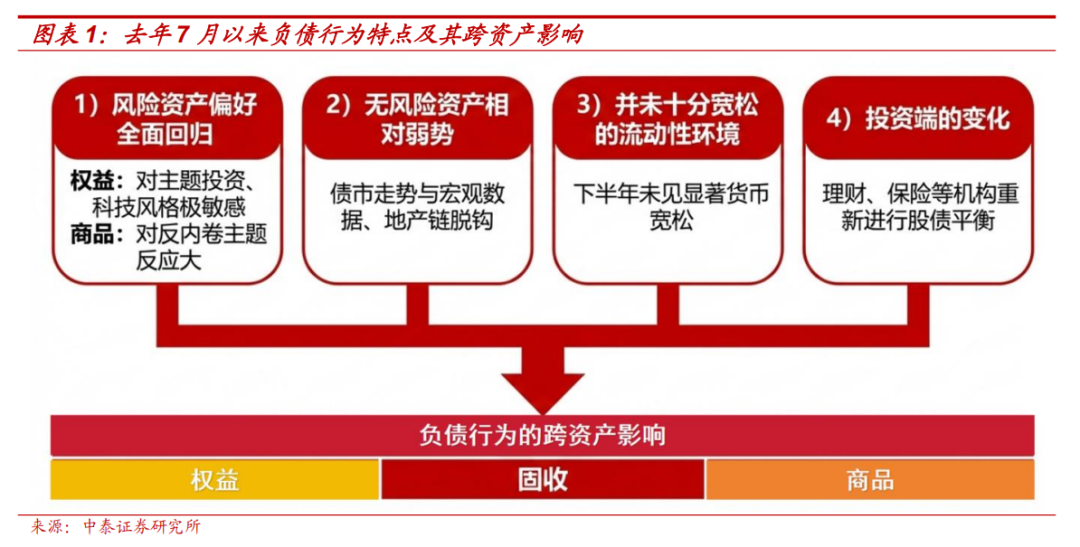
Group 1 - The core argument emphasizes the impact of liability behavior on various asset classes, including equities, fixed income, and commodities, highlighting a trend observed since July of the previous year [1][25]. - The report from July 10, 2025, indicates that the liability side is driving insurance to increase equity allocation, with institutional incremental funds propelling market growth, particularly in technology sectors [2][25]. - Since the New Year, the A-share market has been experiencing a resonance of three factors: changes in liability behavior, asset-side catalysts in technology, and a seasonal shift in bond market dynamics [3][25]. Group 2 - Liability behavior has evolved, with a surge in dividend insurance sales and a shift in wealth management products towards those with embedded rights, influencing investment behaviors across various asset management institutions [3][28]. - The technology sector is witnessing a convergence of three major directions, including commercial aerospace, memory price increases, and AI applications, which are driving upward momentum in related sectors [3][28]. - The traditional seasonal strength of the bond market has largely shifted to equities, continuing a trend observed since March 2024 where bond seasonality has failed to manifest [3][26]. Group 3 - The current environment shows that the equity market is highly sensitive to thematic investments and technology styles, indicating a comprehensive return to risk assets [5][28]. - Despite favorable macro data for the bond market, the bond market's performance has decoupled from high-frequency data and real estate chains since the second half of last year, establishing an independent trend [5][28]. - The liquidity environment remains tight, with minimal incremental monetary easing in the second half of last year, yet stocks and commodities have shown a trend-driven performance [5][28]. Group 4 - The design of financial products is shifting towards capturing "time deposits," with significant reductions in deposit rates since 2022, leading to a reallocation of funds towards more active investments [7][30]. - The attractiveness of rights-embedded wealth management products has increased compared to pure debt products, particularly for 1-3 year investment horizons [9][32]. - Dividend insurance is effectively targeting deposit customers, offering higher guaranteed returns than current deposit rates, thus appealing to those seeking long-term returns with potential upside [9][32]. Group 5 - The transition from traditional fixed income to rights-embedded products is necessary to enhance returns, as reliance solely on bond investments is no longer sufficient [15][38]. - The seasonal patterns of the bond market have not disappeared but have instead shifted towards equities, with funds that would typically flow into bonds now being directed into equity markets [17][41]. - The current financial conditions are fostering a "money-capacity" flywheel effect, reflecting a return of optimism among residents and businesses, which is expected to stimulate real economic changes [20][45].

“负债行为框架”
ZHONGTAI SECURITIES· 2026-02-09 12:46
1. Report Industry Investment Rating - The industry rating is "Overweight", expecting a gain of more than 10% relative to the benchmark index in the next 6 - 12 months [35] 2. Core Viewpoints - Since the New Year's Day, the A-share market has been experiencing the overlapping resonance of three factors: further changes in liability behavior, multi-directional catalysis on the asset side, and the transfer of the bond market's "good start" seasonal market to the equity market [2][8][9] - The bull market's confidence stems from the concentrated maturity of time deposits and the activation of deposits. From "current deposits - wealth management products - dividend - insurance policies - public funds", the attractiveness and the degree of embracing equity assets increase significantly [2] - Dividend - insurance policies can serve as an alternative to high - interest time deposits after maturity. The current time deposit interest rate is lower than the "guaranteed return" part of dividend - insurance policies [2][18] - With the rapid expansion of wealth management scale, relying solely on bond funds is difficult to meet the performance requirements, forcing funds to seek elasticity in equity assets. The structure of wealth management products is moving towards equity - linked ones [2][22] - The seasonality of the bond market has not disappeared but has shifted to the stock market, forming the "good start" of the stock market [2][25] - Forget the "expectation gap", and the flywheel effect of "money - production capacity" is emerging. AI can boost the reinvestment expectations of traditional industries, and the reinflation of products will lead to changes in capital expenditure and production capacity expansion [2] 3. Summary by Relevant Catalog 3.1 Understanding from the Liability - side Perspective - **Deposit Activation and Reinvestment**: Since 2022, time deposit interest rates have been lowered multiple times. The 1 - year deposit rate has dropped from 1.75% to 0.95%, and the 3 - year rate from 2.75% to 1.25%. The re - investment of time deposits shows a "trickle - down effect", with funds flowing to current deposits and equity - linked products. The attractiveness and the degree of embracing equity assets increase step - by - step from "current deposits - wealth management products - dividend - insurance policies - public funds" [11][14][17] - **Dividend - insurance Policies as an Alternative**: Dividend - insurance policies have a "guaranteed return + floating dividend" feature, with a guaranteed return capped at 1.75% and at least 70% of distributable surplus distributed to policyholders. They have higher investment returns, lower rigid costs for insurance companies, and relatively shorter effective durations. Their liability - side characteristics lead to a higher proportion of equity investment and shorter - term fixed - income investment [18][19] - **Equity - linked Fixed - income Products**: The rapid expansion of wealth management scale poses challenges to asset - side returns. Even with an optimistic assumption for the 2026 bond market, the upper limit of the return from bond funds is only 2.1%, so adding equity is needed to increase returns. Equity - linked fixed - income products are shifting from high - dividend to high - volatility and technology sectors [22] - **Impact on Stock - Bond Balance**: The seasonality of the bond market is caused by the maturity of various deposits and the behavior of banks to meet quotas. Due to the strong trend of deposit migration to wealth management and insurance, the funds that should have flowed into bonds have instead entered equity - linked wealth management products or dividend - insurance policies, leading to the transfer of the bond market's seasonality to the stock market [25] - **The Emergence of the Flywheel Effect**: The "expectation gap" thinking is suitable for a static environment of stock - fund games. Currently, at the moment of rapid switching of liability behavior, the institutions where liabilities flow first are more leading. The AI sector has a flywheel effect on traditional industries' reinvestment and employment, and the reinflation of products will drive capital expenditure and production capacity expansion in relevant industries [27][28][31]