货币基金费率改革

Search documents
近百只产品破1%,货币基金还是“宝”吗?
Sou Hu Cai Jing· 2025-12-28 05:15
Core Viewpoint - The article discusses the significant decline in the yields of money market funds in China, highlighting a shift from previously high returns to current low rates, raising concerns about the sustainability of these funds as investment vehicles. Group 1: Yield Decline - As of December 22, the median annualized yield of money market funds is 1.24%, with 93 funds falling below 1% and over 280 funds between 1% and 1.2% [5][6] - The era of 6% yields is over, with historical yields peaking during the "money shortage" in June 2013, where some funds exceeded 6% [3][6] - By late 2024, most money market funds are expected to have yields below 1.5%, with some already dropping below 1% since late last year [3][5] Group 2: Fee Structure and Adjustments - The current market size of money market funds is 14.68 trillion yuan, accounting for 47% of the total public fund market, leading to discussions about whether management fees are too high [6][8] - Some funds have temporarily reduced management fees due to low yields, but these adjustments are often short-lived, raising concerns about the actual benefit to investors [7][8] - Recent regulatory guidance has encouraged the reduction of management and custody fees for money market funds, with some funds announcing fee cuts for the first time in years [8][9] Group 3: Investor Behavior and Market Outlook - Despite low yields, some investors continue to use money market funds for their liquidity and convenience, while others are shifting to short-term bond funds for better returns [9][10] - The total scale of money market funds has seen a slight increase, with expectations for continued growth in the fourth quarter due to high-interest deposits maturing and regulatory changes enhancing liquidity [9][10] - The core value of money market funds remains in liquidity management rather than yield, suggesting that they will continue to attract funds seeking safety and liquidity [10]

部分货币基金上调管理费
21世纪经济报道· 2025-11-21 15:15
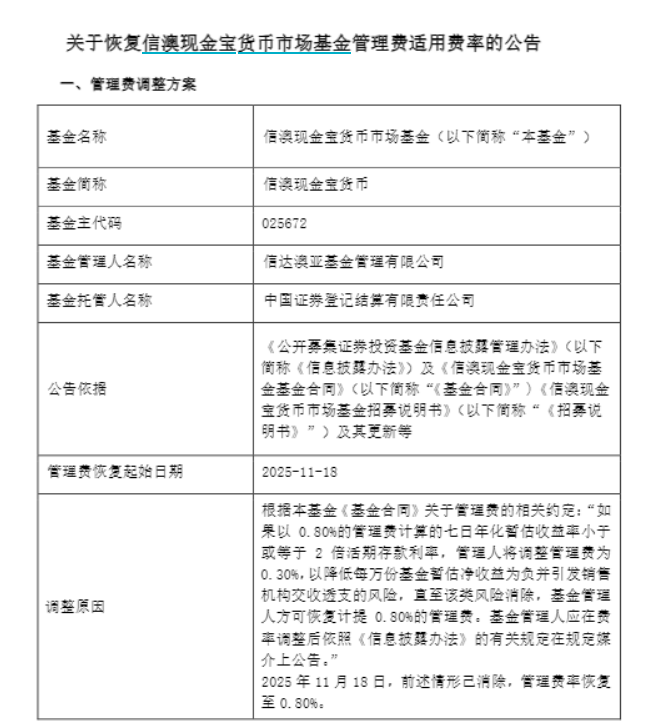
Core Viewpoint - The article discusses the recent trend of some money market funds increasing their management fees despite a broader trend of fee reductions in the industry, highlighting the complexities and implications of fee structures in the current low-yield environment [1][5][10]. Group 1: Fee Adjustments and Trends - On November 20, two money market funds, Xin'ao Cash Treasure and Fuanda Shenzhou Tiantili, announced the restoration of their management fees to 0.80% and 0.55% respectively, after temporarily lowering them to 0.30% due to low estimated annualized returns [1][2]. - The fee adjustment mechanism in these funds is designed to prevent negative net returns per ten thousand units, allowing for temporary fee reductions when returns fall below a certain threshold [4][5]. - The average seven-day annualized yield of money market funds has decreased from 1.25% mid-year to 1.1% by November 20, with 69 funds yielding below 1% [5][8]. Group 2: Impact of High Fees - The average management fee across the market is currently 0.26%, with some funds charging as high as 0.9%, which significantly impacts net returns, especially as overall yields decline [7][12]. - Funds with higher comprehensive fees (management, custody, and service fees) have shown lower average annualized yields, with those exceeding 0.7% yielding only 0.785% compared to the market average of 1.23% [7][12]. - The high fee structures are increasingly seen as a hidden cost that erodes investor returns, particularly in a low-yield environment [6][10]. Group 3: Regulatory and Market Context - Regulatory signals have indicated a push towards reducing fees for money market funds, with recent guidelines suggesting a cap on sales service fees and encouraging fund companies to lower management fees [10][11]. - Despite the downward pressure on yields, the overall scale and number of money market fund investors have continued to grow, indicating a persistent demand for these investment vehicles [12][13]. - The article emphasizes the importance of ongoing fee reforms to protect the interests of small and medium investors, as larger funds benefit from economies of scale that can facilitate lower fees [13].

货币基金的降费“假动作”
2 1 Shi Ji Jing Ji Bao Dao· 2025-11-21 14:21
Core Viewpoint - Recent adjustments in management fees for certain money market funds have raised concerns about the alignment of fee structures with investor interests, particularly as the market experiences declining yields and increased fee variability [1][4][7]. Group 1: Fee Adjustments and Mechanisms - Two money market funds, Xin'ao Cash Treasure and Fuanda Shenzhou Tiantili, have recently restored their management fees to 0.80% and 0.55% respectively, after temporarily lowering them to 0.30% due to low estimated annualized returns [1][2]. - The fee adjustment mechanism is designed to prevent negative net returns for investors, automatically lowering fees when estimated returns fall below a certain threshold [3][6]. - This mechanism is not uncommon in money market funds, but it does not fundamentally address the alignment of fee structures with investor interests [1][3]. Group 2: Market Trends and Yield Decline - The average seven-day annualized yield for money market funds has decreased from 1.25% mid-year to 1.1% by November 20, with 69 funds yielding below 1% [4][8]. - High management fees are becoming a significant concern as they can erode investor returns, especially in a low-yield environment where fees consume a large portion of the returns [7][8]. - Funds with higher fees have shown significantly lower average yields compared to the market average, indicating that high fees are detrimental to investor returns [8][9]. Group 3: Regulatory and Industry Responses - Regulatory bodies have indicated a push towards reducing management fees for money market funds, with recent guidelines suggesting lower caps on sales service fees and encouraging fund companies to lower management fees [12][14]. - Some large funds have begun to lower their fees, but the overall progress in fee reduction remains slow compared to equity funds [14][15]. - Despite declining yields, the overall scale and number of investors in money market funds have continued to grow, indicating their importance as a cash management tool for individual investors [15][16].
余额宝10年来首次降费,意味着什么?
3 6 Ke· 2025-09-23 11:52
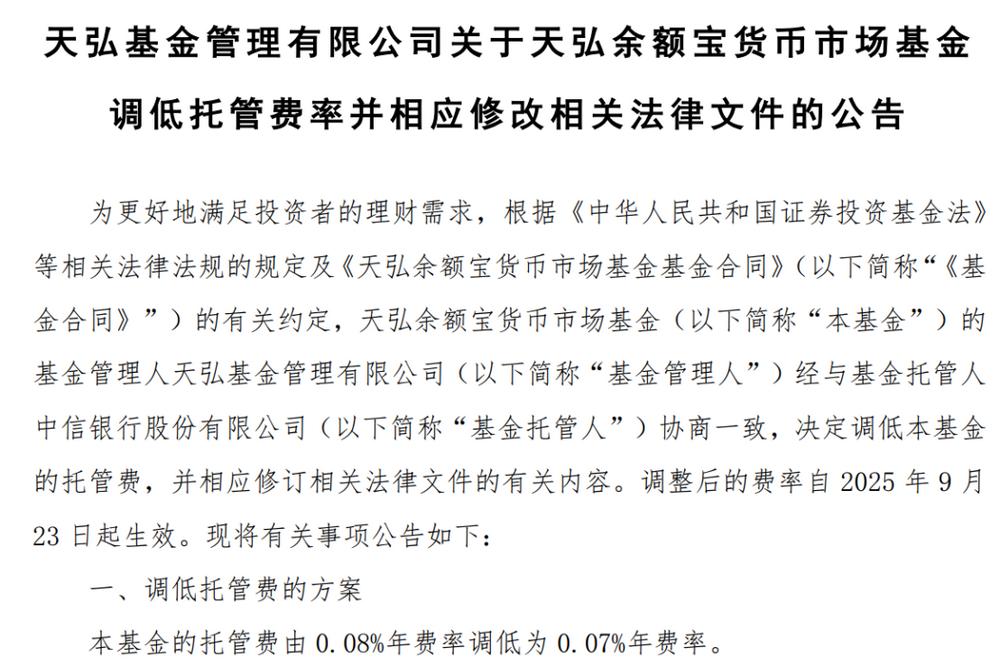
Core Viewpoint - Tianhong Fund announced a reduction in the custody fee rate for its Tianhong Yu'ebao money market fund, lowering the annual fee rate from 0.08% to 0.07%, marking the first fee reduction since the fund's inception over 10 years ago [1][9]. Fee Adjustments - The adjusted comprehensive operating fee rate for Tianhong Yu'ebao is now 0.62%, with a management fee of 0.3% and a sales service fee of 0.25% [3]. - Other funds, such as Guoxin Guozheng Cash Growth and E Fund Margin, also announced fee reductions, with total fee reductions of 0.13% and 0.08% respectively [3][10]. Market Context - As of June 30, Tianhong Yu'ebao's scale was 793.219 billion, and prior to the fee reduction, the fund incurred a custody fee of 315 million in the first half of the year [9]. - The reduction in fees is seen as a response to declining yields and regulatory policies, indicating a potential beginning of a fee reform in the money market fund sector [3][11]. Yield Trends - The seven-day annualized yield for Tianhong Yu'ebao has decreased to 1.02%, while other funds like Guoxin Guozheng Cash Growth and E Fund Margin have yields of 0.82% and 1.16% respectively [12]. - Recent data shows that over 10% of money market funds have yields below 1%, with some even below 0.5% [12]. Regulatory Influence - The China Securities Regulatory Commission (CSRC) has encouraged the reduction of management and custody fees for large-scale index and money market funds as part of its initiative for high-quality development in the public fund industry [13]. - The CSRC's recent draft regulations suggest that the sales service fee for money market funds should not exceed 0.15% per year, further supporting the trend of fee reductions [13]. Investor Impact - Lower fees directly reduce investment costs for investors, enhancing actual returns and making money market funds more attractive to low-risk investors [14]. - The fee reductions are expected to drive fund companies to improve management efficiency and research capabilities, ultimately raising the overall professional standards in the public fund industry [14].