
国新国证现金增利货币基金

Search documents
公告速递:国新国证现金增利货币基金2026年春节前暂停代销渠道申购、转换转入及定期定额投资业务
Sou Hu Cai Jing· 2026-02-10 01:43
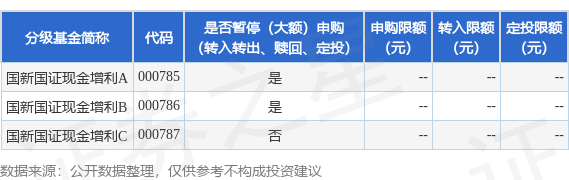
Group 1 - The core announcement is that Guoxin Guozheng Fund Management Co., Ltd. will suspend subscription, conversion, and regular investment business for the Guoxin Guozheng Cash Increase Money Market Fund before the 2026 Spring Festival, effective from February 12, 2026, to protect the interests of fund shareholders [1] - The announcement includes details about the suspension of large-scale subscriptions for specific sub-funds, indicating that Guoxin Guozheng Xianquan Increase A (code: 000785) and Guoxin Guozheng Xianquan Increase B (code: 000786) will have restrictions, while Guoxin Guozheng Xianpei Increase C (code: 000787) will have a high subscription limit [1] - The decision is based on public information and aims to ensure the stability and integrity of the fund's operations during the specified period [1]

87只货币基金收益率跌破1%
21世纪经济报道· 2025-12-25 16:08
Core Viewpoint - The yield of money market funds is rapidly declining, with a significant number of funds now yielding below 1%, indicating a historical low in the market [1][3]. Group 1: Current Yield Trends - As of December 24, 2023, 87 money market funds have seen their seven-day annualized yields drop below 1%, with some funds like Minsheng Jia Yin Cash Growth B and others falling below 0.5% [3]. - Tianhong Yu'ebao, the largest money market fund, has a current yield of 1.04%, having briefly dipped to 1.001% on December 4, 2023 [3][4]. Group 2: Factors Influencing Yield Decline - The continuous decline in money market fund yields is attributed to a systemic decrease in interest rates and abundant market liquidity, leading to a phenomenon of "asset scarcity" [5]. - The central bank's maintenance of a loose monetary policy has driven down short-term interest rates, affecting the yields of underlying assets such as interbank certificates of deposit and short-term bonds [5]. Group 3: Management Fee Adjustments - Due to insufficient yields, many funds have triggered management fee adjustments, with 134 announcements made in December alone regarding fee changes [7]. - For example, the Guangda Baodexin Sunshine Cash Treasure Fund adjusted its management fee down to 0.25% when its yield fell below a certain threshold, only to revert back to the original rate shortly after [7]. Group 4: Fund Size and Market Dynamics - Despite the declining yields, the total share of money market funds reached 15.05 trillion units by the end of October 2023, showing a growth of over 38 million units compared to September [9]. - Analysts predict that the trend of expanding money market fund sizes will continue into the fourth quarter, supported by the maturity of high-yield fixed deposits and the liquidity advantages of money market funds [9].

货币基金的降费“假动作”
2 1 Shi Ji Jing Ji Bao Dao· 2025-11-21 14:21
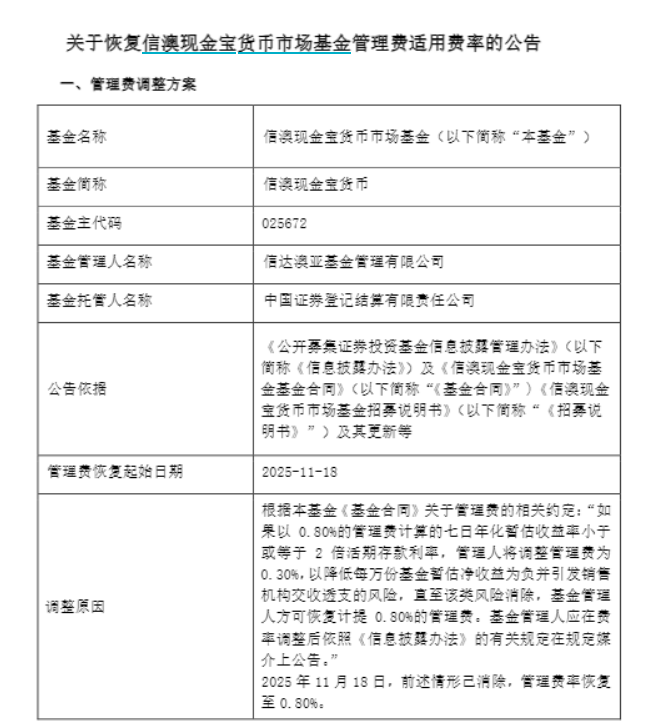
Core Viewpoint - Recent adjustments in management fees for certain money market funds have raised concerns about the alignment of fee structures with investor interests, particularly as the market experiences declining yields and increased fee variability [1][4][7]. Group 1: Fee Adjustments and Mechanisms - Two money market funds, Xin'ao Cash Treasure and Fuanda Shenzhou Tiantili, have recently restored their management fees to 0.80% and 0.55% respectively, after temporarily lowering them to 0.30% due to low estimated annualized returns [1][2]. - The fee adjustment mechanism is designed to prevent negative net returns for investors, automatically lowering fees when estimated returns fall below a certain threshold [3][6]. - This mechanism is not uncommon in money market funds, but it does not fundamentally address the alignment of fee structures with investor interests [1][3]. Group 2: Market Trends and Yield Decline - The average seven-day annualized yield for money market funds has decreased from 1.25% mid-year to 1.1% by November 20, with 69 funds yielding below 1% [4][8]. - High management fees are becoming a significant concern as they can erode investor returns, especially in a low-yield environment where fees consume a large portion of the returns [7][8]. - Funds with higher fees have shown significantly lower average yields compared to the market average, indicating that high fees are detrimental to investor returns [8][9]. Group 3: Regulatory and Industry Responses - Regulatory bodies have indicated a push towards reducing management fees for money market funds, with recent guidelines suggesting lower caps on sales service fees and encouraging fund companies to lower management fees [12][14]. - Some large funds have begun to lower their fees, but the overall progress in fee reduction remains slow compared to equity funds [14][15]. - Despite declining yields, the overall scale and number of investors in money market funds have continued to grow, indicating their importance as a cash management tool for individual investors [15][16].
公募费率改革全面推进 货币基金成为降费新焦点
Shang Hai Zheng Quan Bao· 2025-09-28 15:12
Core Viewpoint - The public fund fee reform is advancing comprehensively, with money market funds becoming a new focus for fee reductions, which is expected to lower investor costs and promote high-quality industry development [1][4]. Group 1: Fee Reduction Announcements - Multiple money market funds have announced fee reductions, including Tianhong's Yu'ebao, which lowered its custody fee from 0.08% to 0.07%, effective September 23 [2]. - Other funds, such as Guoxin Guozheng and E Fund, have also reduced their management and custody fees, indicating a trend in the industry [2][3]. - The recent fee reductions are seen as a response from leading products to the ongoing fee reform, potentially encouraging more similar products to follow suit [2][3]. Group 2: Regulatory and Market Context - The surge in fee reductions among money market funds is attributed to regulatory guidance, industry development needs, and investor demands, with expectations for more funds to follow [4]. - The China Securities Regulatory Commission (CSRC) has been actively promoting fee reductions, with new regulations suggesting that sales service fees for money market funds should not exceed 0.15% per year [4]. - Current weighted average sales service fees for money market funds are around 0.17%, slightly above the proposed regulatory cap, indicating a need for further adjustments [4]. Group 3: Broader Fee Reform Trends - The public fund fee reform has shown a diverse and widespread trend, with leading fund companies reducing fees across various fund types, including active equity funds and ETFs [5]. - Analysts suggest that the fee reform is a significant step in improving the capital market system, aiming not only to lower fees for investors but also to enhance institutional business models and service capabilities [5].