
易方达保证金收益货币基金

Search documents
87只货币基金收益率跌破1%
21世纪经济报道· 2025-12-25 16:08
Core Viewpoint - The yield of money market funds is rapidly declining, with a significant number of funds now yielding below 1%, indicating a historical low in the market [1][3]. Group 1: Current Yield Trends - As of December 24, 2023, 87 money market funds have seen their seven-day annualized yields drop below 1%, with some funds like Minsheng Jia Yin Cash Growth B and others falling below 0.5% [3]. - Tianhong Yu'ebao, the largest money market fund, has a current yield of 1.04%, having briefly dipped to 1.001% on December 4, 2023 [3][4]. Group 2: Factors Influencing Yield Decline - The continuous decline in money market fund yields is attributed to a systemic decrease in interest rates and abundant market liquidity, leading to a phenomenon of "asset scarcity" [5]. - The central bank's maintenance of a loose monetary policy has driven down short-term interest rates, affecting the yields of underlying assets such as interbank certificates of deposit and short-term bonds [5]. Group 3: Management Fee Adjustments - Due to insufficient yields, many funds have triggered management fee adjustments, with 134 announcements made in December alone regarding fee changes [7]. - For example, the Guangda Baodexin Sunshine Cash Treasure Fund adjusted its management fee down to 0.25% when its yield fell below a certain threshold, only to revert back to the original rate shortly after [7]. Group 4: Fund Size and Market Dynamics - Despite the declining yields, the total share of money market funds reached 15.05 trillion units by the end of October 2023, showing a growth of over 38 million units compared to September [9]. - Analysts predict that the trend of expanding money market fund sizes will continue into the fourth quarter, supported by the maturity of high-yield fixed deposits and the liquidity advantages of money market funds [9].


货币基金的降费“假动作”
2 1 Shi Ji Jing Ji Bao Dao· 2025-11-21 14:21
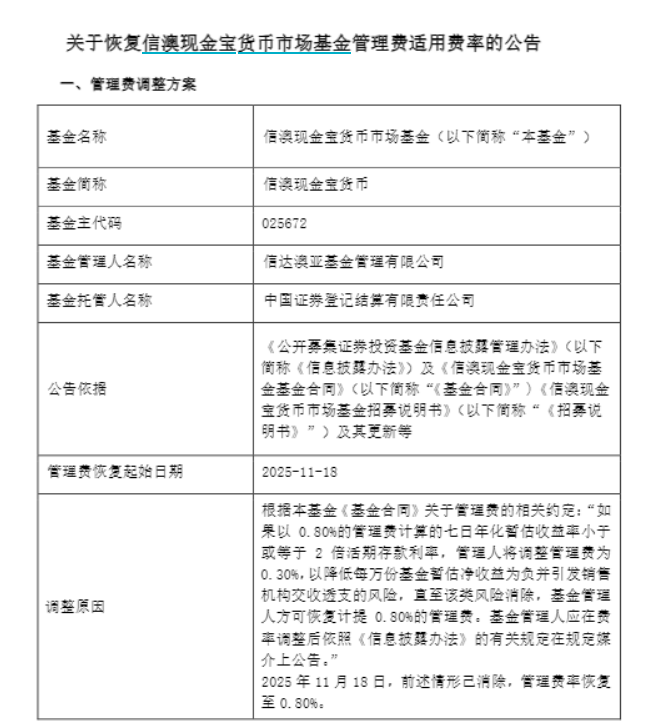
Core Viewpoint - Recent adjustments in management fees for certain money market funds have raised concerns about the alignment of fee structures with investor interests, particularly as the market experiences declining yields and increased fee variability [1][4][7]. Group 1: Fee Adjustments and Mechanisms - Two money market funds, Xin'ao Cash Treasure and Fuanda Shenzhou Tiantili, have recently restored their management fees to 0.80% and 0.55% respectively, after temporarily lowering them to 0.30% due to low estimated annualized returns [1][2]. - The fee adjustment mechanism is designed to prevent negative net returns for investors, automatically lowering fees when estimated returns fall below a certain threshold [3][6]. - This mechanism is not uncommon in money market funds, but it does not fundamentally address the alignment of fee structures with investor interests [1][3]. Group 2: Market Trends and Yield Decline - The average seven-day annualized yield for money market funds has decreased from 1.25% mid-year to 1.1% by November 20, with 69 funds yielding below 1% [4][8]. - High management fees are becoming a significant concern as they can erode investor returns, especially in a low-yield environment where fees consume a large portion of the returns [7][8]. - Funds with higher fees have shown significantly lower average yields compared to the market average, indicating that high fees are detrimental to investor returns [8][9]. Group 3: Regulatory and Industry Responses - Regulatory bodies have indicated a push towards reducing management fees for money market funds, with recent guidelines suggesting lower caps on sales service fees and encouraging fund companies to lower management fees [12][14]. - Some large funds have begun to lower their fees, but the overall progress in fee reduction remains slow compared to equity funds [14][15]. - Despite declining yields, the overall scale and number of investors in money market funds have continued to grow, indicating their importance as a cash management tool for individual investors [15][16].
公募费率改革全面推进 货币基金成为降费新焦点
Shang Hai Zheng Quan Bao· 2025-09-28 15:12
Core Viewpoint - The public fund fee reform is advancing comprehensively, with money market funds becoming a new focus for fee reductions, which is expected to lower investor costs and promote high-quality industry development [1][4]. Group 1: Fee Reduction Announcements - Multiple money market funds have announced fee reductions, including Tianhong's Yu'ebao, which lowered its custody fee from 0.08% to 0.07%, effective September 23 [2]. - Other funds, such as Guoxin Guozheng and E Fund, have also reduced their management and custody fees, indicating a trend in the industry [2][3]. - The recent fee reductions are seen as a response from leading products to the ongoing fee reform, potentially encouraging more similar products to follow suit [2][3]. Group 2: Regulatory and Market Context - The surge in fee reductions among money market funds is attributed to regulatory guidance, industry development needs, and investor demands, with expectations for more funds to follow [4]. - The China Securities Regulatory Commission (CSRC) has been actively promoting fee reductions, with new regulations suggesting that sales service fees for money market funds should not exceed 0.15% per year [4]. - Current weighted average sales service fees for money market funds are around 0.17%, slightly above the proposed regulatory cap, indicating a need for further adjustments [4]. Group 3: Broader Fee Reform Trends - The public fund fee reform has shown a diverse and widespread trend, with leading fund companies reducing fees across various fund types, including active equity funds and ETFs [5]. - Analysts suggest that the fee reform is a significant step in improving the capital market system, aiming not only to lower fees for investors but also to enhance institutional business models and service capabilities [5].
宝城期货资讯早班车-20250924
Bao Cheng Qi Huo· 2025-09-24 02:04
Macroeconomic Data Overview - The GDP growth rate for the second quarter of 2025 is reported at 5.20%, a decrease from 5.40% in the previous quarter and an increase from 4.70% in the same period last year [1] - The Manufacturing PMI for August 2025 is at 49.40, slightly up from 49.30 in July and up from 49.10 year-on-year [1] - The Non-Manufacturing PMI for August 2025 is at 50.30, showing a slight increase from 50.10 in July and unchanged from the previous year [1] - The total social financing scale for August 2025 is reported at 25,668 billion yuan, a significant increase from 11,307 million yuan in July and a decrease from 30,323 million yuan year-on-year [1] - The CPI for August 2025 shows a year-on-year decrease of 0.40%, compared to 0.00% in July and 0.60% last year [1] - The PPI for August 2025 shows a year-on-year decrease of 2.90%, an improvement from a decrease of 3.60% in July and a decrease of 1.80% last year [1] Commodity Investment Reference - Federal Reserve Chairman Jerome Powell indicated that stock prices are currently overvalued but stated that financial stability risks are not high at this time [2] - The U.S. White House's cryptocurrency committee executive director expects the cryptocurrency market structure bill to pass by the end of the year, which aims to consolidate various legislative efforts [2] - The SEC chairman expressed hopes for a new "innovation exemption" rule to be introduced by the end of the year, allowing cryptocurrency companies to launch products more easily [2] Metals - As of September 23, the SPDR Gold Trust holds 32,169,273.34 ounces (1,000.57 tons) of gold, unchanged from the previous trading day [4] - International precious metal futures saw a general increase, with COMEX gold futures rising by 0.58% to $3,796.9 per ounce and COMEX silver futures increasing by 0.12% to $44.265 per ounce [4] Steel Industry - A notice from five departments outlines a growth stabilization plan for the steel industry for 2025-2026, emphasizing the acceleration of key iron ore projects and supporting compliant mining enterprises [6] - The steel industry aims for an average annual growth rate of 4% over the next two years, with a strict prohibition on new capacity [7] Energy and Chemicals - International oil prices have risen sharply, with U.S. crude oil main contract up by 2.20% to $63.65 per barrel and Brent crude oil main contract up by 1.85% to $67.19 per barrel [8] - The Russian government is discussing extending the export ban on gasoline producers until October and is considering a possible ban on diesel exports [8] - Kuwait's oil minister noted a recovery in global oil demand as oil inventories fall below the five-year average [8] Agricultural Products - The Malaysian Palm Oil Council indicates that upward price potential is limited due to weak demand, while uncertainties in export supply provide some support [10] - Brazil's agriculture ministry announced the reopening of the EU market for Brazilian chicken following an outbreak of avian influenza [10] Financial Market Overview - The central bank conducted a reverse repurchase operation of 276.1 billion yuan on September 23, with a net withdrawal of 10.9 billion yuan for the day [11] - The People's Bank of China governor met with Ray Dalio to discuss international economic conditions and financial market dynamics [12] - Concerns over local government special bond risks have drawn attention from the National People's Congress, highlighting the rapid growth of government debt [13] Stock Market News - The A-share market experienced wide fluctuations, with major banks showing stability and significant gains in semiconductor equipment and photolithography concepts [27] - The Hong Kong Hang Seng Index closed down 0.7%, with declines in consumer, real estate, and healthcare sectors [27] - Since the release of the "merger and acquisition six guidelines," over 2,800 A-share companies have disclosed M&A activities, with a notable increase in transactions in the semiconductor sector [27]