购买力K型分化

Search documents
A股新概念来了!何为“犒赏经济”?消费ETF(159928)再获1400万份净申购!港股通消费50ETF(159268)回调超1%,2026新消费如何看?
Xin Lang Cai Jing· 2025-12-18 09:50
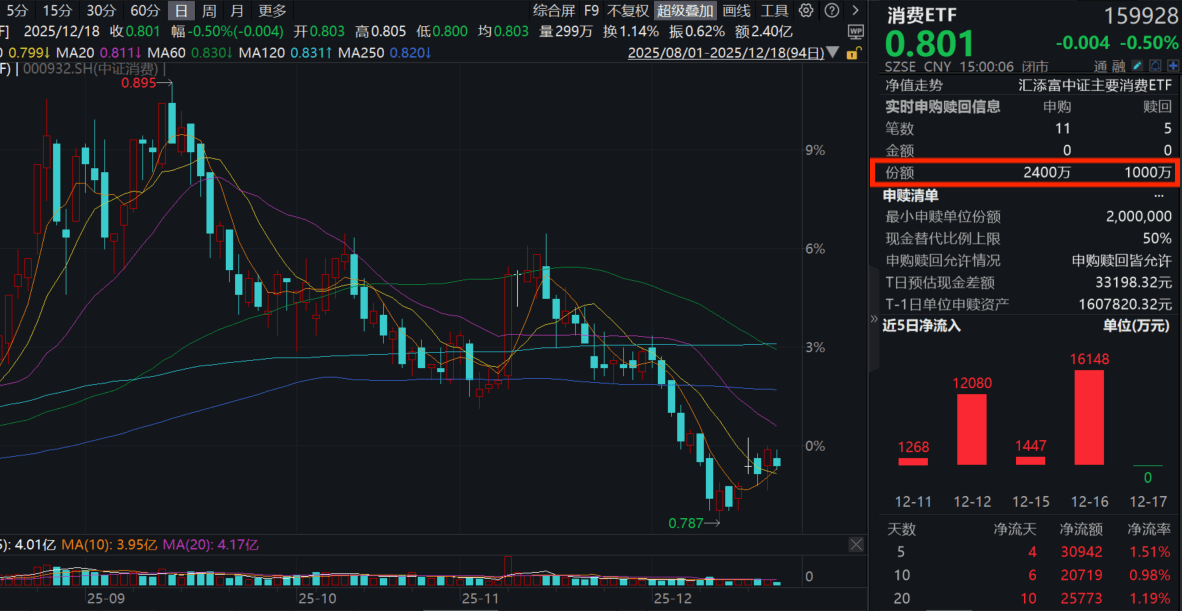
Group 1: Consumer Sector Performance - The consumer sector experienced a pullback, with the Consumer ETF (159928) declining by 0.5% and a total trading volume of 240 million yuan, while it saw a net subscription of 14 million shares, accumulating over 300 million yuan in the last five days [1] - The "Reward Economy" concept gained traction, indicating that consumers are increasingly purchasing non-essential items or experiences to alleviate stress and fulfill psychological needs, reflecting the vitality and resilience of the current consumer market [3] - The valuation of the Consumer ETF (159928) remains attractive, with a TTM price-to-earnings ratio of 19.4, placing it in the 3.17% percentile over the past decade, indicating it is cheaper than 97% of the historical time frame [4] Group 2: Market Trends and Insights - Seasonal patterns in Q4 suggest a tendency for market style shifts, particularly in December, where low valuation stocks may gain favor among investors [5] - The new consumption upgrade is driven by quality supply, with a focus on innovation and user-centric approaches, indicating a shift from previous consumption upgrades that were investment-driven [7] - The trend of "external expansion" in quality consumer supply is emerging, with opportunities for Chinese manufacturing to expand globally, particularly in personal care and textile sectors [8] Group 3: Future Opportunities in Consumption - AI applications are expected to enhance consumer products, with AI smart glasses anticipated to enter the market, presenting significant growth potential [10] - The K-shaped recovery in purchasing power highlights the resilience of luxury consumption, with a shift towards high-end experiences and services becoming more prominent [11] - Moutai's strategy to control product supply and focus on high-quality development aims to stabilize its distribution channels and enhance profitability for distributors [12][15]


2026年轻纺新消费年度策略:立足优质供给,强则不败
ZHONGTAI SECURITIES· 2025-12-16 13:23
Core Insights - The report emphasizes the optimism surrounding new consumption opportunities driven by quality supply, indicating that the "new consumption upgrade" will extend beyond 2025, focusing on innovative and user-centric supply rather than just cost reduction [3][4] - The report highlights the shift from "internal competition" to "external expansion," noting that Chinese manufacturing capabilities are now positioned to explore global supply chain opportunities, particularly in personal care and home goods [4] - The integration of AI in consumer products is identified as a significant growth area, with AI-powered devices like smart glasses expected to gain traction in 2025 and beyond [5] - The report discusses the K-shaped recovery in purchasing power, suggesting that luxury and experiential consumption will remain resilient as consumers continue to seek status through their purchases [6] Group 1: New Consumption Trends - The essence of new consumption is a supply-driven upgrade, focusing on innovative products that meet previously unmet consumer needs, such as ergonomic furniture and outdoor sports equipment [3] - The report anticipates that the alignment of quality supply and demand will continue to evolve, with new categories emerging beyond those already recognized in the market [3] Group 2: Global Expansion of Quality Supply - Chinese manufacturers are expected to capitalize on their competitive advantages in efficiency and innovation to expand into international markets, particularly through e-commerce [4] - The report notes that the personal care supply chain in China is significantly stronger than in Western markets, presenting a threefold expansion opportunity for Chinese brands abroad [4] Group 3: AI and Consumer Products - AI applications are projected to enhance consumer products, with smart glasses expected to enter mass production and drive new market dynamics [5] - The report suggests that 3D printing will also play a crucial role in the future of AI-enabled consumer goods [5] Group 4: Luxury and Experiential Consumption - The report identifies a persistent demand for symbolic consumption, particularly in luxury goods, as consumers continue to compete for status [6] - The luxury market is shifting towards services and experiences, with brands like Hermes and private jet companies expected to benefit from this trend [6] Group 5: Market Dynamics and Company Performance - The report outlines the competitive landscape for companies in the IP-driven consumer goods sector, emphasizing the importance of a diversified IP portfolio and localized marketing strategies for success [52][58] - Companies like Pop Mart are highlighted for their successful global strategies and the ability to create emotional connections with consumers through their IP offerings [58]