购房贷款贴息政策

Search documents
利好再续!换房退个税政策延至2027年底,交易成本下降
Bei Ke Cai Jing· 2026-01-14 14:57
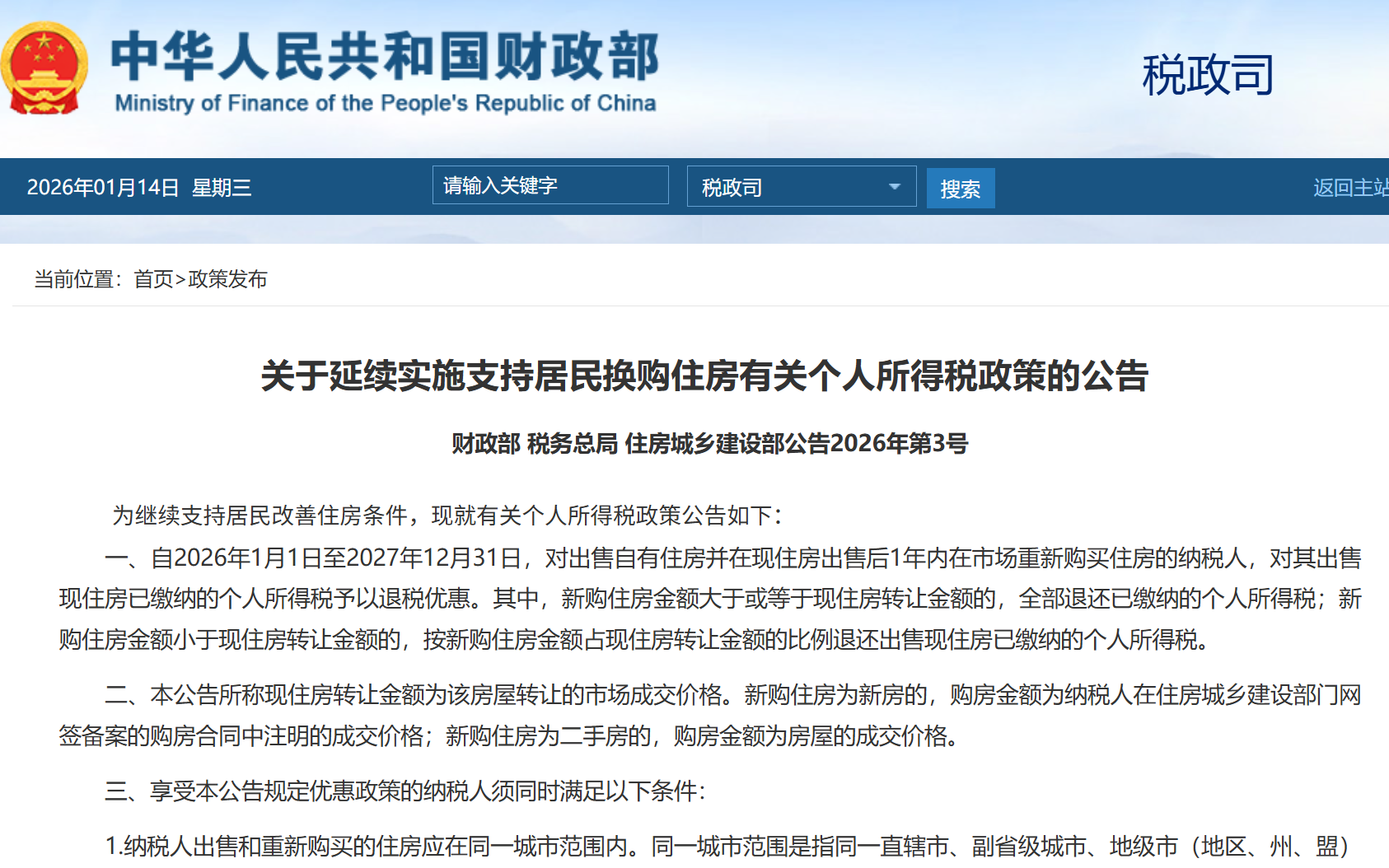
Core Viewpoint - The policy for tax refunds on housing exchanges has been extended again, reflecting ongoing efforts to alleviate market pressures and stimulate housing transactions [1][5]. Group 1: Policy Details - The new policy will be effective from January 1, 2026, to December 31, 2027, allowing taxpayers who sell their own homes and purchase new ones within one year to receive a tax refund on the personal income tax already paid [2]. - If the purchase price of the new home is greater than or equal to the selling price of the current home, the entire amount of personal income tax paid will be refunded. If the new home purchase price is less, the refund will be proportional to the new home's price relative to the selling price [5]. Group 2: Market Implications - The continuous extension of this tax refund policy indicates a strong commitment to support the housing market, as it aims to reduce transaction costs and enhance market activity, ultimately stabilizing overall tax revenue [5]. - The current housing market is experiencing significant stagnation, particularly in the secondary housing market, where transaction prices are declining, hindering the "sell one buy one" cycle. The tax exemption on housing exchanges is expected to lower transaction costs and release pent-up demand [5]. - The government is also implementing other measures to reduce transaction costs, such as interest subsidies on housing loans in certain cities, especially in light of weakening employment and income expectations [6].

换房退个税政策延续实施 专家:体现对今年着力稳住房地产市场的支持
Sou Hu Cai Jing· 2026-01-14 12:28
Core Viewpoint - The announcement from the Ministry of Finance, State Taxation Administration, and Ministry of Housing and Urban-Rural Development extends the personal income tax refund policy for residents who sell their homes and purchase new ones within a year, aiming to stimulate housing demand and stabilize market expectations [1][2]. Group 1: Policy Details - The tax refund policy will be effective from January 1, 2026, to December 31, 2027, allowing taxpayers to receive a refund on the personal income tax paid on the sale of their current home if they purchase a new home within one year [1]. - If the purchase price of the new home is equal to or greater than the selling price of the current home, the entire amount of personal income tax paid will be refunded; if less, the refund will be proportional to the new home's purchase price relative to the selling price [1]. Group 2: Market Implications - The extension of the tax refund policy is seen as a continuation of previous measures aimed at reducing transaction costs, which is expected to enhance market activity and support housing demand, particularly for families looking to upgrade their homes [2][3]. - The combination of this policy with other measures, such as reduced VAT on homes sold within two years, is anticipated to accelerate transaction flows and improve market expectations, potentially leading to further extensions of beneficial policies [2]. Group 3: Expert Opinions - Analysts believe that the ongoing support for housing improvement and exchange demand reflects a commitment to stabilizing the real estate market, with expectations of robust demand for home exchanges in many cities [3]. - The expansion of second-hand home transactions is expected to positively impact the new home market and other improvement markets, suggesting that local governments should effectively utilize these policies to enhance market activity [3].
房地产周三午后异动
Xin Lang Cai Jing· 2025-12-11 04:11
Market Review - The Shanghai Composite Index fell by 0.23% to 3900.50 points, while the Shenzhen Component Index rose by 0.29% to 13316.42 points, and the ChiNext Index decreased by 0.02% to 309.00 points, indicating mixed performance in the market [3][8] - Total trading volume across both markets was 1.78 trillion, a decrease of 125.4 billion compared to the previous trading day [3][8] - Real estate, retail, and social services sectors showed the highest gains, while banking, power equipment, and computer sectors experienced the largest declines [3][8] Market Insights - Real estate sector showed significant movement in the afternoon, with Vanke A and several other stocks hitting the daily limit up [4][9] - The recent surge in Vanke's domestic bonds, which rose over 30% and triggered trading halts, is linked to ongoing debt restructuring and support measures [4][9] - Various cities, including Nanjing, Changchun, Yuncheng, and Wuhan, have introduced housing loan interest subsidy policies in 2023, which are expected to stabilize housing price expectations and stimulate demand [4][9] - The current fiscal space is ample, with the expansion of long-term special government bonds and central bank bond purchases providing financial support for policy implementation [4][9] - The subsidy policies are aimed at first-time and improved housing demand, avoiding speculative excesses, and banks are actively participating, which may alleviate interest margin pressures and improve asset quality [4][9] Technical Analysis - The market is currently in a daily level consolidation phase, with a mid-term trend expected to remain in a range-bound state [10] - The core operational range for the Shanghai Composite Index this month is likely to be between 3850 and 3950 points [10] - From a configuration perspective, sectors such as real estate, finance, and consumer goods are recommended for focused attention [10]