个人销售住房增值税政策调整

Search documents
利好再续!换房退个税政策延至2027年底,交易成本下降
Bei Ke Cai Jing· 2026-01-14 14:57
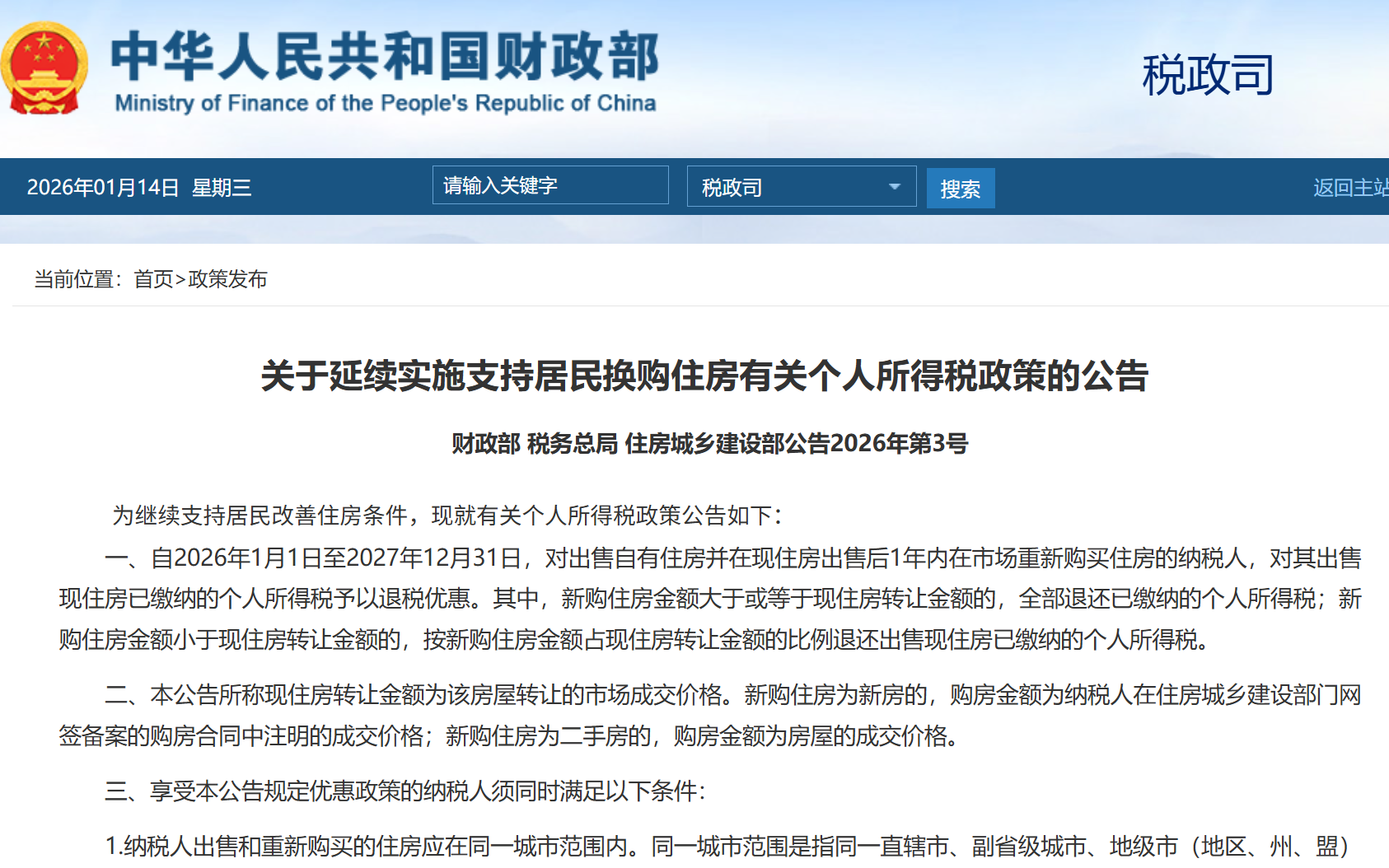
Core Viewpoint - The policy for tax refunds on housing exchanges has been extended again, reflecting ongoing efforts to alleviate market pressures and stimulate housing transactions [1][5]. Group 1: Policy Details - The new policy will be effective from January 1, 2026, to December 31, 2027, allowing taxpayers who sell their own homes and purchase new ones within one year to receive a tax refund on the personal income tax already paid [2]. - If the purchase price of the new home is greater than or equal to the selling price of the current home, the entire amount of personal income tax paid will be refunded. If the new home purchase price is less, the refund will be proportional to the new home's price relative to the selling price [5]. Group 2: Market Implications - The continuous extension of this tax refund policy indicates a strong commitment to support the housing market, as it aims to reduce transaction costs and enhance market activity, ultimately stabilizing overall tax revenue [5]. - The current housing market is experiencing significant stagnation, particularly in the secondary housing market, where transaction prices are declining, hindering the "sell one buy one" cycle. The tax exemption on housing exchanges is expected to lower transaction costs and release pent-up demand [5]. - The government is also implementing other measures to reduce transaction costs, such as interest subsidies on housing loans in certain cities, especially in light of weakening employment and income expectations [6].

热点追踪丨专家解读个人销售住房增值税调整
Sou Hu Cai Jing· 2026-01-07 09:19
Core Viewpoint - The new tax policy on personal housing sales, effective from January 1, 2026, aims to reduce the tax burden on sellers and stimulate the real estate market by lowering the VAT rate for properties held for less than two years from 5% to 3% and exempting properties held for two years or more from VAT [1][4][5]. Group 1: Policy Changes - The VAT rate for personal sales of properties held for less than two years is reduced from 5% to 3% [4]. - The policy eliminates distinctions between ordinary and non-ordinary residential properties and unifies the VAT policy across different regions in China [4]. - The adjustment aligns with the simplified VAT calculation method stipulated in the new VAT law, emphasizing the importance of legal tax collection and simplification of tax policies [4]. Group 2: Market Impact - For a property sold at 5 million yuan, the VAT payable decreases from 238,100 yuan to 145,600 yuan, resulting in a reduction of 92,500 yuan, benefiting both sellers and buyers [5]. - The policy is expected to lower transaction costs for second-hand homes, enhancing market stability and increasing demand, thereby improving the supply-demand relationship in the real estate market [5]. - The adjustment is part of a broader trend of easing real estate tax policies to support housing consumption and respond to residents' housing needs [9]. Group 3: Broader Context - The recent adjustments in real estate tax policies, including VAT, deed tax, and personal income tax, reflect ongoing efforts to support housing consumption and lower transaction costs [9]. - The changes are consistent with the central government's economic work meeting directives aimed at enhancing policy foresight, targeting, and coordination to expand domestic demand and optimize supply [9].
2026年“国补”政策来了;两部门明确个人销售住房增值税政策……盘前重要消息一览
证券时报· 2025-12-31 00:34
Key Points - The article discusses the implementation of the "Two New" policy for 2026, which aims to optimize the scope, standards, and mechanisms for supporting consumption and equipment updates in various sectors [2] - The new VAT regulations will take effect from January 1, 2026, detailing taxpayer classifications, tax rates, and management measures [7] - The announcement regarding personal housing sales and VAT indicates a 3% tax for properties sold within two years and exemption for those sold after two years, effective from January 1, 2026 [7] Group 1 - The National Development and Reform Commission and the Ministry of Finance have allocated 62.5 billion yuan for the first batch of special government bonds to support the consumption of old goods [6] - The policy will support equipment updates in various sectors, including industrial, transportation, and healthcare, while also expanding support to include old residential areas and commercial facilities [6] - The application process for equipment updates will be optimized to lower investment thresholds and increase support for small and medium-sized enterprises [6] Group 2 - The Ministry of Industry and Information Technology has set goals for the automotive industry's digital transformation by 2027, including significant improvements in manufacturing capabilities and productivity [8] - The Ministry of Education plans to advance artificial intelligence in education, with policies expected to be released next year to enhance AI education across different educational stages [8] - Beijing's health commission aims to develop a comprehensive AI support system in the healthcare sector by 2027, focusing on efficient data flow and technology application [9] Group 3 - Companies like Tianpu Co. have seen significant stock price increases, with a rise of 718.39% from August 22 to December 30, leading to a stock suspension for verification [11] - Zijin Mining anticipates a net profit increase of approximately 59% to 62% for 2025 [14] - Pingtan Development reports no significant changes in its main business fundamentals [15]