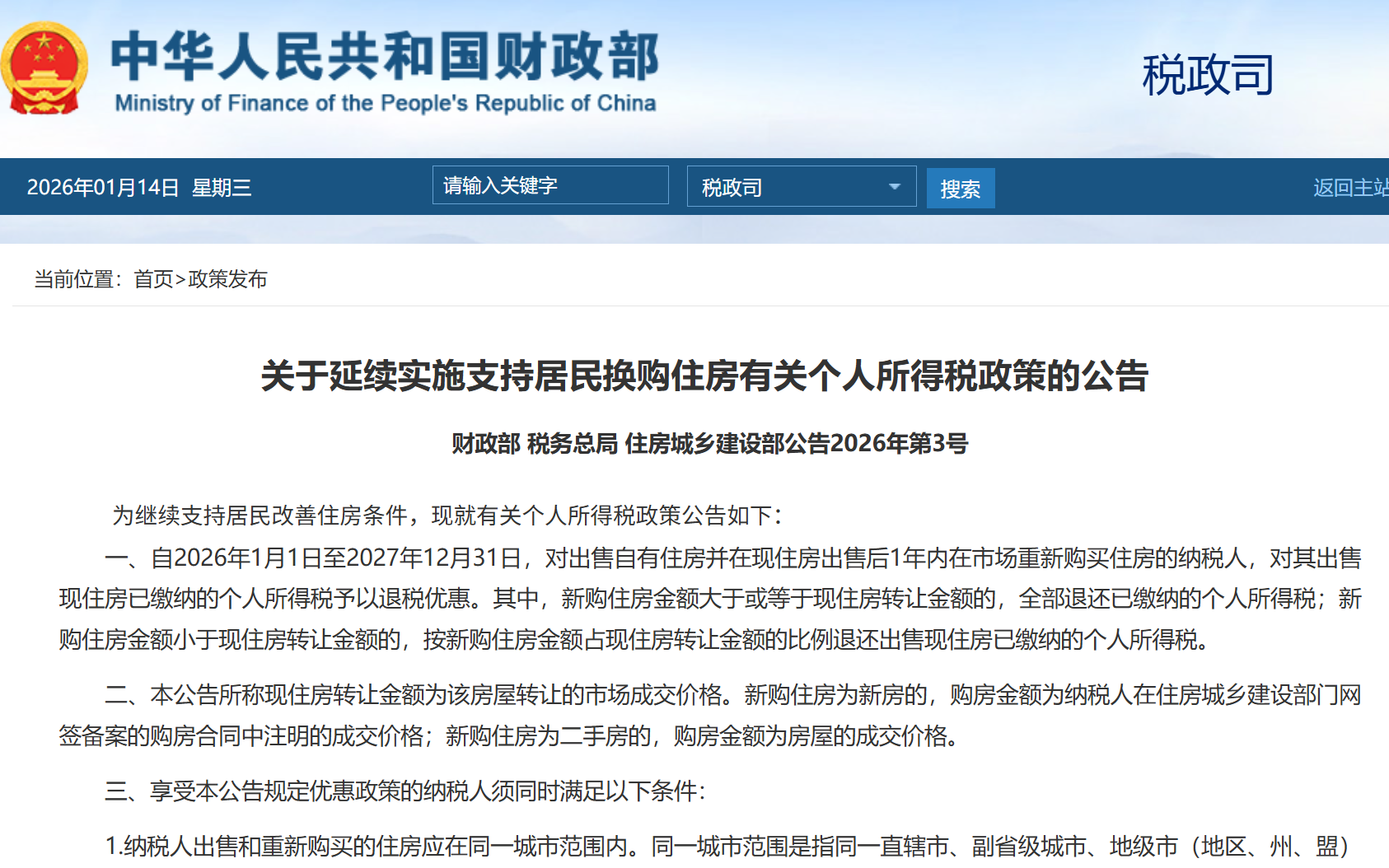
换房退税政策

Search documents
多维度降低换房成本 守护住有宜居民生期待
Zhong Guo Jing Ji Wang· 2026-01-23 01:19
Core Viewpoint - The Ministry of Finance, the State Taxation Administration, and the Ministry of Housing and Urban-Rural Development have extended the personal income tax refund policy for residents purchasing new homes until December 31, 2027, as part of a comprehensive strategy to lower housing costs and stabilize the real estate market [1][2]. Policy Extension and Impact - The policy allows taxpayers who sell their own homes and purchase new ones within one year to receive a personal income tax refund, with full refunds for new home purchases equal to or greater than the sale price of the old home, and proportional refunds for lower amounts [2]. - This policy aims to address genuine housing needs while preventing potential exploitation of the tax benefits, maintaining the principle of "housing is for living, not for speculation" [2][8]. - The extension of this policy has already benefited millions of families by reducing their housing burdens [2]. Multi-Dimensional Cost Reduction - Recent policies from central to local governments have continuously reduced housing costs across various aspects, including tax, credit, and transaction processes [3]. - A new VAT policy effective January 1, 2026, reduces the VAT rate on personal sales of homes under two years from 5% to 3%, a 40% decrease, while homes over two years remain exempt from VAT [3]. - Financial policies have also eased the monthly payment pressures for families, with significant reductions in public housing loan interest rates [3]. Loan Support and Transaction Efficiency - Loan limits for first-time homebuyers have been increased, with specific provisions for families with multiple children and veterans, enhancing accessibility to housing finance [4]. - Transaction processes have been streamlined, with the "transfer with mortgage" policy improving efficiency by over 50% in certain areas [4]. Anticipated Future Policies - The series of supportive measures has instilled confidence in families looking to purchase homes, with many expressing satisfaction with the benefits of the policies [5]. - Experts suggest that the recent policies are targeted responses to the current real estate market's challenges, particularly addressing the bottlenecks in the "sell old to buy new" process [7]. - The focus on reducing transaction costs is expected to enhance market activity and foster a positive interaction between supply and demand in the real estate sector [7][8].
换房退税政策延期!有专家认为,将刺激购房者奔向“核心区”
Sou Hu Cai Jing· 2026-01-15 04:14
Core Viewpoint - The Ministry of Finance, the State Taxation Administration, and the Ministry of Housing and Urban-Rural Development announced an extension of the personal income tax refund policy for residents purchasing new homes, effective from January 1, 2026, to December 31, 2027, which is expected to stimulate housing demand and market activity [1][2]. Group 1: Policy Details - The policy allows taxpayers who sell their own homes and purchase new ones within one year to receive a refund on the personal income tax paid on the sale of their current home [1]. - If the purchase price of the new home is greater than or equal to the selling price of the current home, the entire personal income tax paid will be refunded; if less, the refund will be proportional to the new home's purchase price [1][2]. Group 2: Market Impact - The extension of the tax refund policy is expected to enhance the demand for improved housing, particularly in core urban areas, and is seen as a measure to stabilize market expectations [2]. - Experts believe that the policy will lower the cost of purchasing for families looking to upgrade their homes, thereby promoting the release of demand for improved housing [2]. - The policy is anticipated to positively influence ongoing initiatives in cities like Shenzhen, which are aimed at stimulating market activity and encouraging a healthy market cycle [2].
利好再续!换房退个税政策延至2027年底,交易成本下降 焦点热议
Xin Jing Bao· 2026-01-15 03:37
Core Viewpoint - The extension of the housing tax refund policy aims to alleviate market pressures and stimulate housing transactions by reducing transaction costs for taxpayers selling and purchasing homes [2][3]. Group 1: Policy Details - The tax refund policy will be effective from January 1, 2026, to December 31, 2027, allowing taxpayers to receive a refund on personal income tax paid when selling their homes if they purchase a new home within one year [2]. - If the purchase price of the new home is equal to or greater than the selling price of the current home, the entire amount of personal income tax paid will be refunded; if less, the refund will be proportional to the new home's purchase price [3]. Group 2: Market Implications - The policy reflects ongoing efforts to support the housing market, as indicated by its second extension since its initial introduction in September 2022 [3]. - The reduction in transaction costs is expected to enhance market activity and stabilize overall tax revenue, addressing the sluggishness in the housing market, particularly in the secondary housing sector [3][4]. - The current market shows a significant slowdown in the "sell one buy one" cycle, with decreasing total prices in secondary housing transactions, which the tax refund policy aims to alleviate [3]. Group 3: Related Tax Adjustments - Recent adjustments to the value-added tax on housing sales have also contributed to lowering transaction costs, with the tax rate for properties sold within two years reduced from 5% to 3% [4].

利好再续!换房退个税政策延至2027年底,交易成本下降
Bei Ke Cai Jing· 2026-01-14 14:57
Core Viewpoint - The policy for tax refunds on housing exchanges has been extended again, reflecting ongoing efforts to alleviate market pressures and stimulate housing transactions [1][5]. Group 1: Policy Details - The new policy will be effective from January 1, 2026, to December 31, 2027, allowing taxpayers who sell their own homes and purchase new ones within one year to receive a tax refund on the personal income tax already paid [2]. - If the purchase price of the new home is greater than or equal to the selling price of the current home, the entire amount of personal income tax paid will be refunded. If the new home purchase price is less, the refund will be proportional to the new home's price relative to the selling price [5]. Group 2: Market Implications - The continuous extension of this tax refund policy indicates a strong commitment to support the housing market, as it aims to reduce transaction costs and enhance market activity, ultimately stabilizing overall tax revenue [5]. - The current housing market is experiencing significant stagnation, particularly in the secondary housing market, where transaction prices are declining, hindering the "sell one buy one" cycle. The tax exemption on housing exchanges is expected to lower transaction costs and release pent-up demand [5]. - The government is also implementing other measures to reduce transaction costs, such as interest subsidies on housing loans in certain cities, especially in light of weakening employment and income expectations [6].