
赛道轮动

Search documents
中金:港股近期跑输A股 结构缺亮点及资金面暂处弱势
Zhi Tong Cai Jing· 2026-01-13 02:09
Group 1 - The core viewpoint of the report is that while A-shares have experienced a strong start to 2026 with a "16 consecutive days of gains," Hong Kong stocks have been notably absent from this rally, primarily due to a lack of attractive sectors and a weak liquidity environment [1][2] - The driving force behind the A-share market's performance is the "excess liquidity" chasing "scarce return assets," with small-cap stocks outperforming larger ones, and valuation expansion being the main contributor to the gains [2][3] - The report identifies four key sectors in Hong Kong stocks—dividends, internet, innovative pharmaceuticals, and new consumption—that are unique and irreplaceable compared to A-shares, despite their current lack of market attention [1][6] Group 2 - The underperformance of Hong Kong stocks is attributed to three main factors: the lack of market focus on its unique structural advantages, a weak liquidity environment, and a reflection of a weakening fundamental backdrop [3][4] - The report highlights that the liquidity environment for Hong Kong stocks faces multiple constraints, including uncertainty regarding the strength of southbound capital flows and an increasing demand for IPO financing, which could exceed HKD 400 billion in 2026 [4][5] - Despite the overall market outlook favoring A-shares, Hong Kong stocks still present unique structural opportunities that could attract long-term investment, particularly in sectors like innovative pharmaceuticals and high-dividend stocks [6]
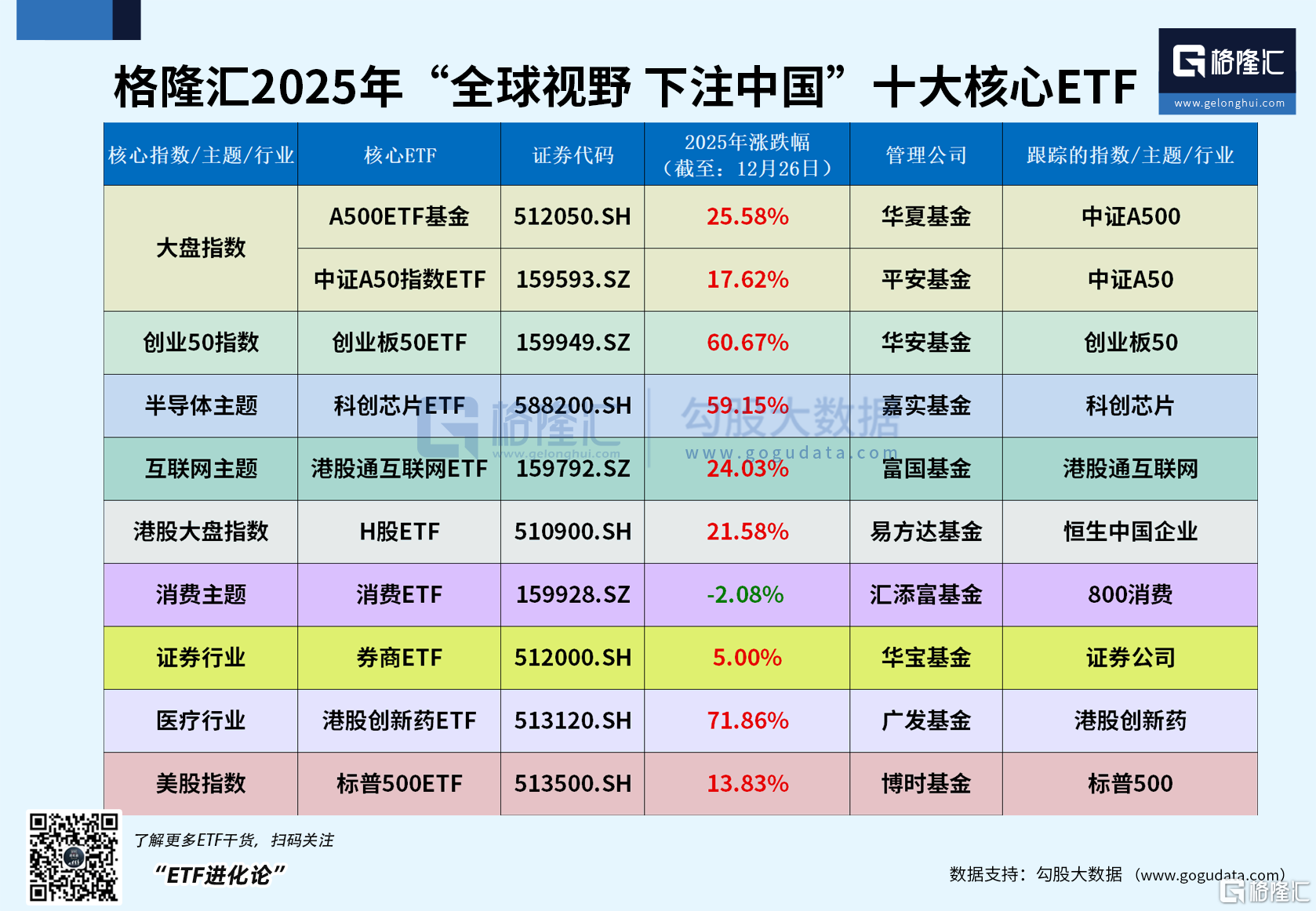
格隆汇2025年十大核心ETF年终盘点①| 港股创新药ETF(513120)、创业板50ETF领涨
Ge Long Hui· 2025-12-26 09:37
Core Insights - The article emphasizes the collective intelligence of investors, highlighting that the "Top Ten Core Asset Portfolio" launched by the company in 2019 has achieved a cumulative return of 274.61% by December 15, significantly outperforming the Shanghai and Shenzhen 300 Index and the Hang Seng Index [1] - In 2023, the company launched another portfolio called "Global Vision: Betting on China," which has recorded a 15.16% increase in 2024, outperforming the Wind All A Index by 5.16% [1] - As of December 26, 2025, the "Global Vision: Betting on China" portfolio has achieved a 29.72% increase, surpassing the Shanghai and Shenzhen 300 Index by 11.36 percentage points [1] ETF Performance Summary - The A500 ETF Fund (512050.SH) recorded a 25.58% increase in 2025 [2] - The ChiNext 50 ETF (159949.SZ) saw a remarkable increase of 60.67% [2] - The Hong Kong Innovation Drug ETF (513120) led the performance with a 71.86% increase [2] - The Semiconductor Theme ETF (588200.SH) experienced a decline of 59.15% [2] - The Internet Theme ETF (159792.SZ) increased by 24.033% [2] - The H-share ETF (510900.SH) rose by 21.58% [2] - The Consumption ETF (159928.SZ) decreased by 2.08% [2] - The Broker ETF (512000.SH) increased by 5.00% [2] - The S&P 500 ETF (513500.SH) recorded a 13.83% increase [2] Industry Highlights - The pharmaceutical sector has transformed from one of the worst-performing sectors to one of the strongest, with innovative drug companies frequently achieving record-breaking sales [3] - The total transaction volume for innovative drug license-out deals is expected to exceed $100 billion, accounting for nearly half of the global pharmaceutical business development transaction volume [4] - The Hong Kong Innovation Drug ETF (513120) tracks the China Hong Kong Innovation Drug Index, focusing on high-quality biotech companies in the Hong Kong market [4] - The ETF has a current scale of 24.1 billion yuan, with an average daily trading volume exceeding 5.3 billion yuan, making it the largest and most liquid thematic index fund in the market [4] - The ChiNext 50 ETF (159949) has also performed well, with a year-to-date increase of 59.86% and a significant increase of 129.61% since the "924" period [5][7] Market Trends - The ChiNext 50 Index employs a unique "liquidity-first, scale-second" strategy, selecting the 50 largest and most liquid stocks from the ChiNext 100, representing the core strengths of the ChiNext market [9] - The ETF's performance benefits from the dual advantages of leading stocks and sector rotation, particularly in the information technology and new energy sectors [9] - Looking ahead to 2026, the market is expected to benefit from continued overseas liquidity easing and domestic policies aimed at expanding domestic demand, which may improve the corporate profit environment [10]


中信建投:后续市场走势或将延续中期慢牛格局
Xin Lang Cai Jing· 2025-08-25 00:01
Core Viewpoint - Citic Securities indicates that there are no significant negative factors in the internal and external fundamentals and liquidity conditions, suggesting that the market sentiment and funding situation have not reached a point of overheating, and the conditions for a bearish outlook are not yet met. The market trend may continue to exhibit a medium-term slow bull pattern [1] Group 1 - The most prominent market characteristic currently is sector rotation, indicating that investors should focus on finding new low-position directions within the prosperous sectors, which may offer better short-term value [1]

中信建投:科创引领加速上涨 关注新赛道轮动
Zhi Tong Cai Jing· 2025-08-24 10:59
Core Viewpoint - Market sentiment is heating up, with some indicators reaching high levels, suggesting potential risks if the slow bull market accelerates towards a peak [1][2] Market Sentiment and Indicators - The investor sentiment index broke above 90, entering an exuberant zone, with the index nearing 95, indicating an accelerated upward trend [2] - Some indicators, such as the MA5 turnover rate exceeding 2% warning line and overbought/oversold indicators approaching 20%, suggest short-term overheating [2] - Financing buy-in ratio has reached the highest level since July 2020, indicating strong market momentum despite short-term overheating signals [2] Industry Performance and Trading Structure - The TMT sector's trading volume has increased to 37%, still below the 45% historical high, indicating room for growth [3] - The relative turnover rate in the TMT sector remains moderate, suggesting no significant deterioration in market trading structure [3] Fund Flow and Investor Behavior - Margin financing has been a significant source of market liquidity, with a net inflow of approximately 330 billion since late June, and 82.8 billion in the first four trading days of the week [3] - Stock ETFs are experiencing net redemptions, indicating that retail investors have not yet fully embraced the current market rally [3] Investment Strategy - The overall market conditions do not present significant bearish signals, suggesting a continuation of the mid-term slow bull market [4] - The strategy of sector rotation remains prominent, with a focus on finding low-position new directions in thriving sectors for better short-term value [4]
本轮慢牛行情的节奏与后续演绎路径
2025-08-20 14:49
Summary of Conference Call Records Industry or Company Involved - The discussion primarily revolves around the A-share market and various sectors including beauty care, electronics, non-banking financials, and consumer goods. Core Points and Arguments 1. **Market Characteristics**: The current A-share market is characterized by structural prosperity, with a significant recovery in specific sectors such as beauty care, electronics, non-banking financials, and non-ferrous metals, despite an overall modest profit recovery. The mid-year earnings forecast shows a 27.51% increase, a slight year-on-year decline of 1.21% [3][4] 2. **External and Internal Uncertainties**: Short-term capital inflow is limited due to external factors like restricted foreign investment and macroeconomic uncertainties, which dampen overall economic expectations [3][4] 3. **Market Sentiment**: Investor sentiment has surged, with the sentiment index exceeding 90, indicating a state of euphoria that may lead to a rapid increase in stock prices as short positions are covered [5][8] 4. **Trading Patterns**: The market exhibits a "three up, two down" pattern, with stronger performance in the first half of the week compared to the latter half, necessitating caution regarding potential pullbacks [3][6] 5. **Potential for Market Correction**: Overheated market conditions, indicated by a five-day average turnover rate exceeding 2%, could lead to corrections back to the 20-day moving average, and rates above 3% may result in deeper adjustments towards the 60-day line [6][8] 6. **Future Market Outlook**: The mid-term outlook remains optimistic for the A-share market, provided that the pace of increases is controlled to avoid significant corrections. Attention should be paid to external factors such as U.S. Federal Reserve interest rate expectations and the performance of U.S. tech stocks [8][14] 7. **Sector Rotation and Investment Opportunities**: Emphasis on sector rotation is crucial, with a focus on strong trends in AI, humanoid robots, and semiconductor sectors, as well as opportunities in the beauty industry within the new consumption space [9][10][11] 8. **Dividend Sectors**: Apart from traditional banking, sectors such as insurance, petrochemicals, food and beverage, and white goods are highlighted for their high dividend yields and stable returns, with the liquor sector showing potential for investment as pessimistic expectations have been largely priced in [2][13] 9. **Risks and Strategies**: The market may face minor pullback risks in the short term, but maintaining a slow bull market rhythm can facilitate continued upward movement. Attention should be given to the performance of U.S. tech stocks, as their downturn could impact domestic tech sectors [14][15] Other Important but Possibly Overlooked Content 1. **Market Dynamics**: The discussion notes that the recent upward acceleration in the market is influenced by external factors such as the easing of the Russia-Ukraine conflict and rising expectations for interest rate cuts by the Federal Reserve, which have positively impacted global and A-share markets [4][5] 2. **Sector-Specific Trends**: The call emphasizes the importance of identifying low-position sector rotation opportunities, particularly in the new consumption space, which has begun to show signs of recovery despite previous underperformance [10][11] 3. **Regulatory Environment**: The ongoing discussions among regulatory bodies regarding the photovoltaic industry and battery components indicate that the "anti-involution" theme, while currently less popular, may still have potential for future development [12]