超宽带(UWB)技术

Search documents
康希通信:公司超宽带产品核心应用方向聚焦于跟随定位、雷达、高速数传三大领域
Zheng Quan Ri Bao· 2026-02-11 12:37
Core Viewpoint - The article discusses the growing application and regulatory framework of Ultra-Wideband (UWB) technology, highlighting its diverse uses and the recent guidelines issued by the Ministry of Industry and Information Technology in China [2]. Group 1: UWB Technology Applications - UWB technology has a wide range of applications including air mice, foot radar, car key locks, tag tracking, live presence detection, and audio data transmission [2]. - The core application areas for the company's UWB products focus on tracking and positioning, radar, and high-speed data transmission, catering to various demands in consumer electronics, industrial IoT, and smart terminals [2]. Group 2: Regulatory Framework - In April 2024, the Ministry of Industry and Information Technology released interim regulations for UWB device radio management, defining UWB devices as those with a transmission signal bandwidth of at least 500 MHz [2]. - The regulations specify the operational frequency range for UWB devices as 7163-8812 MHz, considering the industry's need for high-precision networking using three consecutive channels [2].

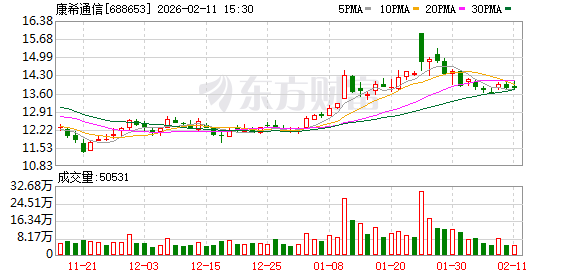
康希通信:公司目前已布局多款具备市场前景的超宽带产品
Zheng Quan Ri Bao· 2026-02-10 13:12
Group 1 - The core viewpoint of the article highlights the rapid growth and potential of the Ultra-Wideband (UWB) technology market in China, with projections indicating that the market value will exceed 10 billion yuan by 2026 and reach around 20 billion yuan by 2028 [2] - UWB technology is characterized by its nanosecond-level narrow pulse wireless communication capabilities, offering centimeter-level positioning accuracy, high-speed data transmission, low power consumption, and strong anti-interference abilities, making it suitable for various applications such as indoor positioning, smart transportation, IoT, and radar detection [2] - The company has developed multiple UWB products with promising market prospects and is collaborating with invested enterprises to advance the research and development of UWB-related products, with steady progress in market promotion expected to contribute to the company's revenue by 2026 [2]

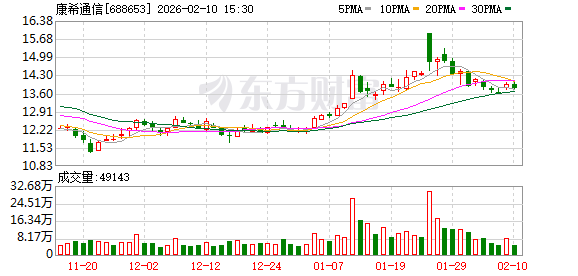
康希通信(688653.SH):目前已布局多款具备市场前景的超宽带产品
Ge Long Hui A P P· 2026-02-10 07:53
Core Viewpoint - The company is actively involved in the development and promotion of Ultra-Wideband (UWB) technology, which is expected to significantly contribute to its revenue by 2026 due to the rapid growth of the UWB market in China [1] Industry Summary - UWB technology is characterized by its nanosecond-level narrow pulse wireless communication capabilities, offering centimeter-level positioning accuracy, high-speed data transmission, low power consumption, and strong anti-interference abilities [1] - The UWB market in China is projected to grow rapidly, with an expected market value exceeding 10 billion yuan by 2026 and potentially reaching around 20 billion yuan by 2028, indicating a strong growth trend and significant industry development potential [1] Company Summary - The company has laid out multiple UWB products with promising market prospects and is collaborating with invested enterprises to advance the research and development of UWB-related products, with steady progress in market promotion [1]
下一代UWB
半导体行业观察· 2026-01-08 02:13
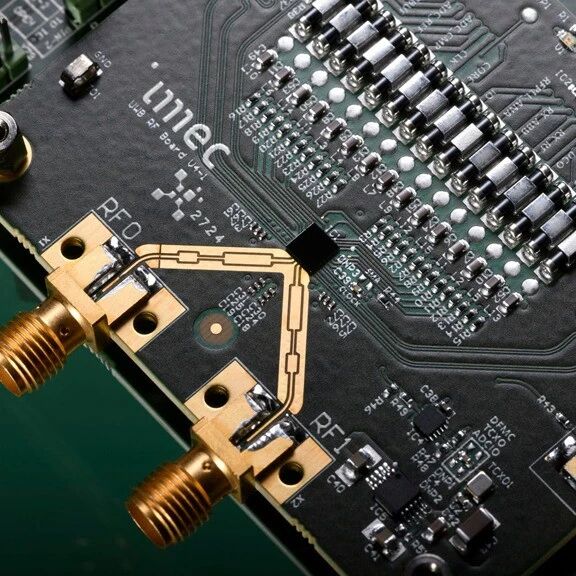
Core Viewpoint - Ultra-Wideband (UWB) technology has been increasingly applied in various commercial fields requiring secure and precise distance measurement capabilities since the early 2000s, with applications in contactless access systems, asset tracking, and navigation support in large venues [1][4]. Group 1: UWB Technology Characteristics - UWB technology utilizes extremely short pulses in wireless signal transmission, allowing for a bandwidth significantly greater than narrowband technologies like Wi-Fi and Bluetooth [1]. - The operational frequency range of UWB typically spans from 6 to 10 GHz, with channel bandwidths around 500 MHz or higher, enabling centimeter to millimeter-level positioning accuracy [1]. - Enhanced physical layer features of UWB, as part of the IEEE 802.15.4z standard, play a crucial role in achieving secure distance measurement capabilities [1]. Group 2: Advancements by imec - imec has made significant contributions to UWB technology by reducing power consumption, increasing bit rates, and enhancing distance measurement accuracy while ensuring resistance to interference from other wireless technologies [3]. - The development of multiple generations of UWB radio chips compliant with the IEEE 802.15.4z standard has been achieved, featuring innovative pulse shaping and modulation techniques [3]. Group 3: Applications and Future Potential - Experts believe UWB's potential extends beyond precise distance measurement to radar-like applications, detecting passive objects through the analysis of reflected signals [4]. - UWB technology can enhance safety in automotive applications by detecting the presence of occupants and monitoring gestures and vital signs [4]. - The upcoming IEEE 802.15.4ab standard, expected to be released in early 2026, will facilitate the realization of such UWB applications by introducing radar capabilities [4]. Group 4: Performance Metrics - imec's fourth-generation UWB transceiver, showcased at VLSI 2025, supports enhanced modulation and high data rates, achieving up to 124.8 Mb/s, integrated within a system-on-chip (SoC) [5]. - The UWB radar sensing technology demonstrates unique capabilities, such as extended detection ranges and high data rates, which are approximately 20 times higher than current applications [14]. Group 5: MIMO Architecture - imec's infrared UWB radar sensing system features a 2x2 MIMO architecture, allowing simultaneous operation in both transmission and reception modes without the need for RF switches [7]. - This configuration significantly reduces the effective working distance limitations previously imposed by mode-switching times, enabling operation within a range of 30 cm to 3 m [8]. Group 6: Market Opportunities - The high data rate and low power consumption of UWB technology open new application areas, including audio and video data streaming for next-generation smart glasses or VR/AR devices [14][16]. - The advanced ranging capabilities introduced by the fifth-generation UWB technology can enhance user experiences in automotive and smart building applications, potentially increasing effective working distances and improving performance in complex environments [15][16].
康希通信(688653.SH):今年已开始蜂窝类射频前端产品的研发,目前正处客户送样验证阶段
Ge Long Hui· 2025-11-13 08:06
Core Viewpoint - The company is actively developing RF front-end products for cellular applications and exploring opportunities in satellite communication, which is expected to contribute to revenue growth in the future [1] Group 1: Cellular RF Front-End Development - The company has initiated the research and development of cellular RF front-end products this year, currently in the customer sample verification phase [1] - There is potential for these products to generate revenue, aiding in the company's overall revenue growth [1] Group 2: Ultra-Wideband (UWB) Technology - UWB technology is recognized as a key wireless communication technology with advantages such as centimeter-level positioning accuracy, high-speed data transmission, low power consumption, and strong anti-interference capabilities [1] - The company is collaborating with invested enterprises to develop UWB products, with several products already in the promotion stage [1] - The primary application directions for UWB technology include tracking, radar, and data transmission [1]
苹果或于9月推出第二代AirTag,支持更远距离的“精确查找”
Huan Qiu Wang· 2025-06-25 02:19
Core Insights - Apple plans to launch the second-generation AirTag tracker in the fall, likely in September alongside the iPhone 17 series, marking the first major update since the initial release in 2021 [1][3] - The second-generation AirTag will feature enhancements such as improved ultra-wideband (UWB) technology, extended battery life, design tweaks, and upgraded privacy and security measures [3][4] Group 1: Product Launch and Timing - The second-generation AirTag is expected to be unveiled at the fall product launch event, aligning with the release of the iPhone 17 series [1] - The launch was initially planned for May or June 2025 but was postponed due to technical adjustments and supply chain issues [3] Group 2: Technical Enhancements - The new AirTag is anticipated to incorporate the second-generation U1 chip, enhancing indoor location accuracy to centimeter-level and supporting longer-range "Precision Finding" capabilities [3] - Battery life is projected to double from one year to two years, with improved signal transmission efficiency in low-power mode [3] Group 3: Design and Compatibility - The design is expected to maintain the original round shape but may include a more durable lanyard hole and additional third-party accessory options [3][4] - Compatibility with existing Apple devices is confirmed, as the second-generation AirTag will work with iOS 18.6 without requiring an iOS 26 update [1] Group 4: Market Position and Competition - Since its launch, AirTag has dominated the high-end tracker market but faces competition from products like Samsung's Galaxy SmartTag 2 and Tile's Pro series [4] - The initial production run for the second-generation AirTag is estimated at 20 million units, with pricing likely to remain similar to the first generation [4]