轻奢

Search documents
德基广场都进不去,潘多拉不想给中国市场花钱了
Sou Hu Cai Jing· 2025-12-12 07:13
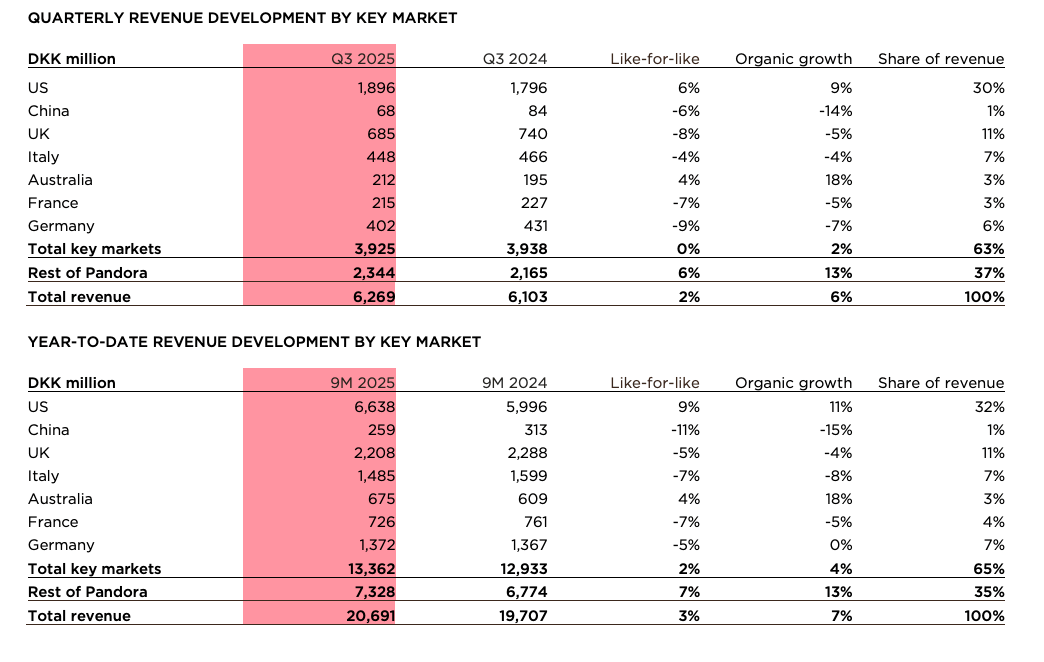
Core Insights - Pandora is restructuring its operations in the Asia-Pacific region, merging the Greater China market into this area, with Singapore as the new headquarters, indicating a strategic retreat from the Chinese market [1] - The company has faced significant challenges in China, including a decline in revenue and store closures, leading to a decision to cease independent reporting for the Greater China region [1][5] Group 1: Market Performance - In Q3 2025, Pandora's total revenue reached 6.269 billion Danish Krone, with organic growth of 1% [2][5] - The revenue from China accounted for only 1% of total revenue, with a decline of 14% year-on-year [3][4] - For the first nine months of 2025, revenue from China was 259 million Danish Krone, down 15% compared to the previous year [4] Group 2: Competitive Landscape - The Chinese jewelry market has been growing, with retail sales expected to reach 778.8 billion yuan by 2024, but Pandora's product offerings in silver and zircon have not resonated with local consumers [10] - Competitors like APM and HEFANG are gaining traction in the light luxury segment, with APM achieving a 57% revenue share from China [18][19] - The brand's marketing efforts in China have been ineffective, with lower investment and less impactful collaborations compared to successful campaigns in the U.S. and Europe [5][15] Group 3: Strategic Decisions - Pandora plans to close 100 stores in China while aiming to open 400-500 new stores globally, indicating a shift in focus away from the Chinese market [5] - The company has acknowledged that the closure of stores in China will have minimal impact on its overall organic growth [5] - The brand's failure to penetrate high-end shopping areas in major cities has contributed to its declining market presence [6][7]

施华洛世奇将裁员400人 轻奢饰品不“灵”了?
2 1 Shi Ji Jing Ji Bao Dao· 2025-11-12 13:05
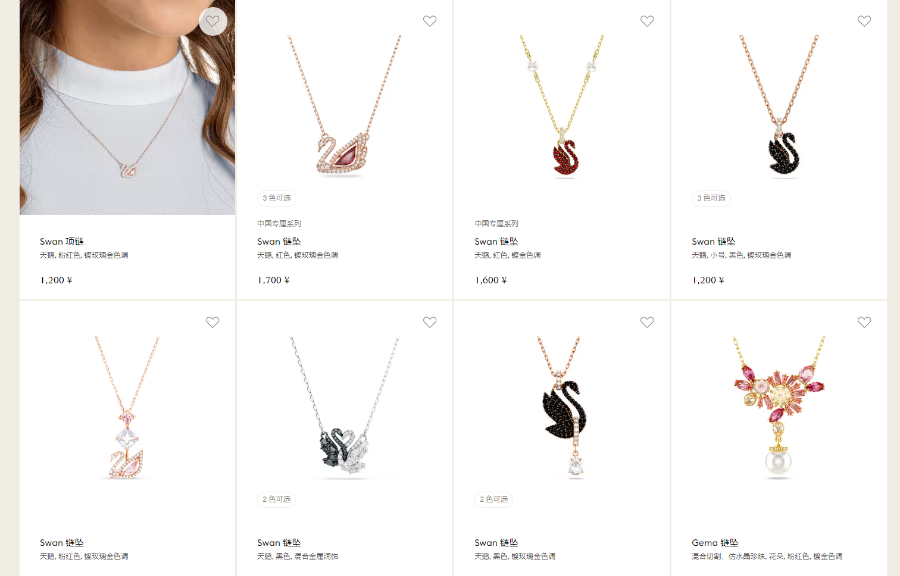
Core Viewpoint - Swarovski is facing significant challenges, including a large-scale restructuring plan that will reduce its workforce at the headquarters in Austria from approximately 2,480 to 2,100 employees by the end of 2026, involving around 400 job cuts through various means [1][4]. Group 1: Company Performance and Restructuring - The company recorded its best performance in a decade in 2017, with revenues reaching €3.5 billion [1]. - In response to declining sales, Swarovski has previously announced layoffs, including a reported 6,000 job cuts in 2020, and is now reducing working hours by 10% and shifting from a three-shift to a two-shift production system [4]. - Despite some improvement in 2023, the company is again announcing layoffs and cost-cutting measures, indicating ongoing operational challenges [4]. Group 2: Consumer Sentiment and Market Trends - Consumer preferences have shifted towards value and quality, leading to a decline in the appeal of luxury jewelry brands like Swarovski, with many consumers expressing dissatisfaction with product quality and price [2][4]. - A survey by Accenture in 2025 indicates that over half of Chinese consumers frequently compare brands, showing a clear understanding of their needs and a willingness to pay for value, which diminishes the brand halo effect [5]. - The current market environment is challenging for Swarovski, particularly in the Chinese market and the luxury goods sector, as consumers are increasingly favoring local alternatives and more rational purchasing decisions [4].
10月中越纺服出口承压,LystQ3榜单显示轻奢向好势头持续
Haitong Securities International· 2025-11-10 07:32
Investment Rating - Investment advice: Short-term pressure on October export data, Q4 overseas consumption needs observation. By 2026, export manufacturing sector recovery is clearer due to several factors [39]. Core Insights - October 2025, China's textile/apparel exports down 9.0%/16.0% YoY, slower than September. The decline is attributed to a high base from last year's brand restocking [39][18]. - The Lyst Q3 list shows a preference for affordable luxury brands, with YSL, Miu Miu, COS, THE ROW, and COACH dominating the top five positions [39]. - COACH's growth accelerates, with FY26Q1 revenue of $1.70 billion, up 13.1% YoY, driven by strong performance in North America and Greater China [39]. Summary by Sections 1. Market Review - The textile and apparel sector saw a 0.80% increase in A-share market performance, with the textile manufacturing sector up 0.96% and apparel/home textiles up 2.23% [6]. - PE valuation for the textile and apparel sector is currently at 20.11 times, below the historical average of 24.76 times [10]. 2. Industry Data Tracking - In September 2025, China's clothing retail grew by 3.6%, while textile exports in October fell by 12.6% [16][18]. - October 2025 textile exports amounted to approximately $22.26 billion, with a year-on-year decline of 12.64% [18]. 3. Key Announcements and News - Tapestry's FY26Q1 revenue was $1.70 billion, exceeding expectations, with a significant contribution from COACH [39]. - Canada Goose reported a revenue of C$273 million for FY25Q2, down 1.8% YoY, primarily due to increased expenses [39].


「北美土特产」COACH是如何翻身的?
36氪未来消费· 2025-08-15 08:47
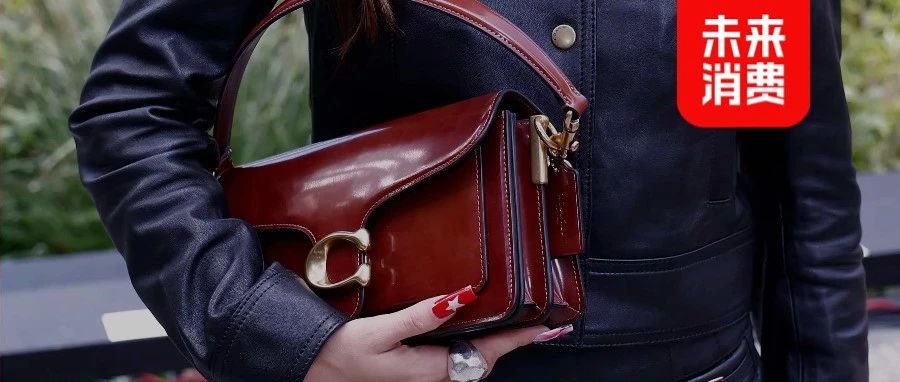
Core Insights - COACH has successfully repositioned itself in the luxury market, particularly appealing to the younger Generation Z demographic despite initial skepticism about its fashion appeal [4][7][14] Group 1: Brand Performance - COACH's revenue reached nearly $1.3 billion, accounting for 82% of the company's total income, with a year-on-year growth of 13%, contributing to a 7% overall company growth [7] - COACH entered the top five in the Lyst's fourth-quarter popular brand rankings, with its Brooklyn bag and Cherry bag charm ranking first and fourth respectively [7][8] Group 2: Product Strategy - COACH has adopted a strategy of maintaining product continuity by introducing new designs and creative variations, rather than relying on artificial scarcity [9][12] - The Tabby bag has evolved into various styles and colors, becoming a significant part of COACH's product lineup, with over 34.2 million TikTok posts related to it [11][12] - COACH's approach to product customization aligns with current trends, allowing consumers to personalize their bags affordably, enhancing appeal among younger consumers [15][17] Group 3: Market Positioning - COACH has shifted its branding from "accessible luxury" to "Expressive Luxury," targeting the desires of Generation Z for unique and expressive products [14] - The brand's pricing strategy remains competitive, with most products priced between 4,000 to 5,000 yuan, making it attractive compared to other luxury brands [17] Group 4: Marketing and Social Media - COACH's marketing strategy leverages social media and celebrity endorsements to enhance brand visibility and appeal to younger consumers [19] - Despite growth in China, COACH faces challenges as younger consumers prefer brands with higher social value, such as Miu Miu and Ralph Lauren, which saw a 30% increase in the last quarter [24]
从「购买羞耻」到销售额狂飙,Coach 如何摆脱危机?
声动活泼· 2025-03-12 06:48
Core Viewpoint - Coach has successfully revitalized its brand and regained consumer interest through strategic product diversification, effective marketing, and a focus on appealing to younger generations, particularly Gen Z. Group 1: Sales Performance and Market Position - Coach's average bag price is around $400, with only a 10% year-over-year sales increase, while Kate Spade and MK experienced declines of 10% and over 15%, respectively [1] - Coach's stock hit its lowest point since the 2009 financial crisis in 2020, prompting a leadership change with Todd Kahn as CEO [1][2] - The brand's previous reliance on classic products led to market saturation and a decline in brand image, necessitating a strategic shift [2][3] Group 2: Product Strategy and Innovation - Coach has diversified its product offerings, ensuring no single product line exceeds 10% of total sales [3] - The introduction of the Tabby bag series in 2019 helped modernize Coach's image, positioning it as an alternative to high-end brands [4] - Coach's pricing strategy has evolved, with main product prices now ranging from $3000 to $5000, reflecting a shift towards higher-end offerings [8] Group 3: Marketing and Consumer Engagement - Coach has tripled its marketing spending in recent years, focusing on brand image and consumer connection rather than just immediate sales [6] - The brand has diversified its ambassador lineup to attract a broader consumer base, including Gen Z [6][7] - Social media has played a crucial role in Coach's resurgence, with significant engagement driven by influencers and celebrities [7] Group 4: Expansion and Future Outlook - Coach plans to expand its physical presence in China, targeting third- and fourth-tier cities to tap into market potential [9] - The company is exploring new product categories, particularly footwear, to reduce reliance on women's bags [10]