
违约率

Search documents
——2025年信用债违约年鉴:违约率持续走低,关注地产产业链
Huachuang Securities· 2026-02-25 07:11
1. Report Industry Investment Rating No information provided in the given content. 2. Core Views of the Report - In 2025, the number of newly - defaulted credit bond issuers and the scale of defaulted bonds decreased significantly. The default of state - owned enterprises came to an end, while the risks of broad - sense private enterprises continued to be exposed. The scale of default repayment increased, but most real - estate enterprises only paid interest without repaying the principal [1][6][7]. - The overall, non - state - owned marginal and cumulative default rates of credit bonds in 2025 decreased slightly. The net financing scale of non - state - owned enterprises turned positive for the first time since 2018. Industries such as electrical equipment, textile and clothing, real estate, and commercial trade had a cumulative default rate of over 5% [3][19][20]. - Looking forward to 2026, the policy bottom - line is to prevent systemic risks. The overall credit risk is relatively controllable, but the operating pressure of some tail - end entities in certain industries remains, and default risks are still worthy of attention [3][8]. 3. Summary According to the Directory 3.1 2025 Credit Bond Market Default Feature Summary - **Newly - defaulted issuers and bond scale**: The number of newly - defaulted credit bond issuers in 2025 decreased to 4, with 3 from the real - estate industry and its upstream and downstream chains. The scale of defaulted bonds continued to decline, and the extended - term part due to the continuous exposure of default risks from 2022 - 2023 ended by the end of 2024 [1][6]. - **Enterprise nature**: State - owned enterprise defaults ended in 2025, while the risks of broad - sense private enterprises continued to be exposed, especially those in the real - estate industry chain that had not defaulted during the previous strict regulatory period [7]. - **Default repayment**: In 2025, there were 118 cases of default bond repayments, with a total principal repayment of 14.3 billion yuan and interest of 639 million yuan. The real - estate industry repaid 12.1 billion yuan in principal, and 11 out of 17 real - estate enterprises only paid interest without repaying the principal [7]. 3.2 Default Analysis: Continuous Exposure of Broad - sense Private Enterprises and Slight Decline in Cumulative Default Rate 3.2.1 Default Overview - The number of newly - defaulted credit bond issuers decreased to 4 in 2025, all non - state - owned. The total outstanding bonds of defaulted issuers increased significantly year - on - year, mainly due to the extension of Vanke's large - scale bonds. The scale of defaulted bonds decreased by 67% year - on - year [11]. - Industry - wide, since 2014, credit bond default issuers have been widely distributed across 29 Shenwan industries, and in 2025, they were mainly in real estate, building decoration, and power equipment. Regionally, since 2014, default issuers have covered most provinces, and in 2025, they were in Guangdong and Zhejiang [14]. 3.2.2 Default Rate - The overall, non - state - owned marginal and cumulative default rates of credit bonds in 2025 decreased slightly. The non - state - owned net financing scale turned positive for the first time since 2018 to 24.3 billion yuan [19]. - Industries such as electrical equipment, textile and clothing, real estate, and commercial trade had a cumulative default rate of over 5%, with real estate and commercial trade having relatively high default scales, and electrical equipment and textile and clothing having relatively low total bond - issuing scales [20]. 3.2.3 Default Reasons - Macroeconomic policies and market environment continuously affected the credit risks of entities. Entities like Xinjie Holdings, Zhengxinglong Real Estate, and Vanke were greatly affected by the previous strict real - estate regulatory policies, while Shanshan Group's poor performance was due to industry cycle changes [3][25]. 3.3 Default Recovery Situation - The cumulative recovery rate and recovery time of defaulted credit bonds have been decreasing year by year. Since 2020, the annual default recovery rate has been less than 20%, and the average recovery time is within two years, with the decline narrowing in 2025 [30]. - As of 2025, the cumulative default recovery rate of state - owned enterprises was 25.12%, 13 percentage points higher than that of non - state - owned enterprises, and the gap remained basically the same as the previous year [33]. - In 2025, real - estate bond repayments still dominated. The total principal repayment of defaulted bonds was 14.3 billion yuan, with the real - estate industry repaying 12.1 billion yuan. Sunac repaid 9.5 billion yuan in principal, and Shanshan Group among the newly - defaulted issuers in 2025 repaid 267 million yuan in principal [37].

年内12家发行人首次违约!涉16只信用债规模150亿元
Sou Hu Cai Jing· 2025-12-15 10:26
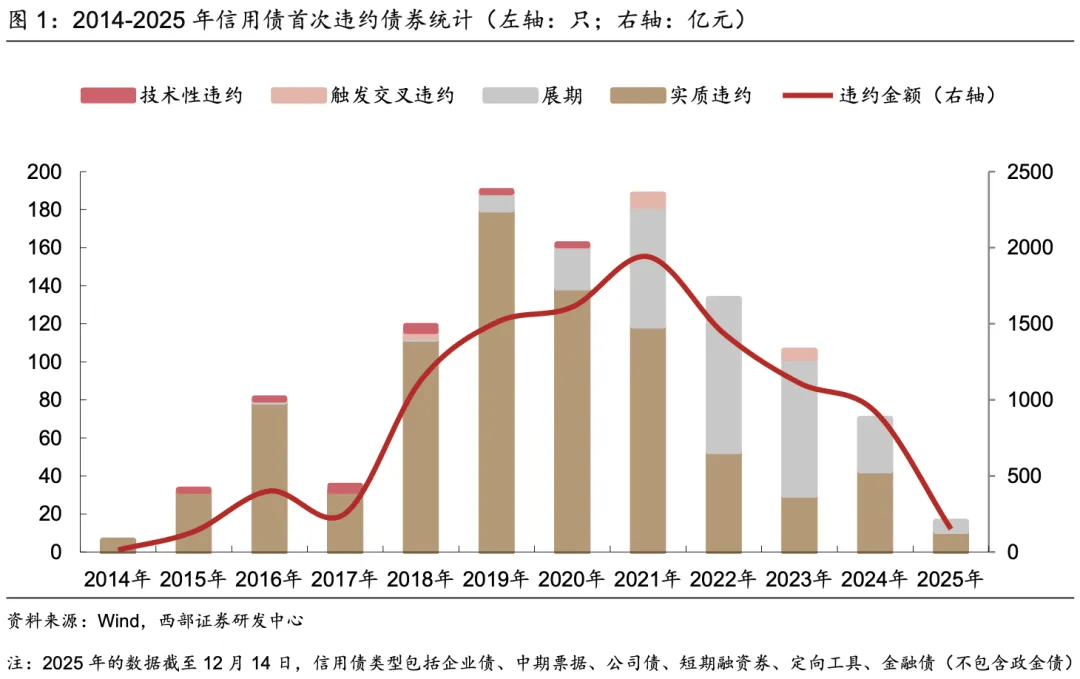
Core Insights - The analysis by Western Fixed Income indicates a significant decline in credit bond defaults for 2025, suggesting an improvement in the credit environment [1] Group 1: Default Trends - The number and amount of credit bond defaults have continued to decrease, with 16 defaults totaling 15.084 billion yuan in 2025, representing a reduction of 54 defaults and 77.145 billion yuan compared to 2024 [2] - The historical peak of default amounts occurred in 2021, with a steady decline observed since then, indicating an improving credit environment [2] - Among the defaults, 11 were substantial defaults, while 5 were extensions, with substantial defaults making up 73.4% of the total from 2014 to 2025 [2] Group 2: Defaulting Entities - All 16 defaulting bonds in 2025 were issued by non-state-owned enterprises, with the real estate sector having the highest number of defaults (4 entities), followed by non-bank financials (3 entities) [4] - The total number of defaulting entities from 2014 to 2025 shows a significant predominance of non-state-owned enterprises, with 265 defaults compared to 46 from state-owned enterprises, indicating higher stability and risk resistance in state-owned enterprises [5] Group 3: Industry Distribution - Defaulting entities span across 30 primary industries, with real estate (57 entities), comprehensive (36 entities), and basic chemicals (18 entities) being the most affected [6] - The real estate sector experienced a peak in defaults from 2022 to 2023, but the number has decreased to 4 in 2025, although it remains a primary risk area in the credit bond market [6] Group 4: Default Rates and Recovery - The marginal default rate for 2025 is 0.22%, the second lowest since 2014, with a total of 5,568 effective issuers at the beginning of the year [9] - The overall recovery rate for defaults since 2014 is 13.76%, with state-owned enterprises achieving a recovery rate of 27.12%, significantly higher than the 10.28% for non-state-owned enterprises [9][11]

美联储理事库克:如果收入受到足够大的冲击,可能会推高违约率,并导致贷款机构出现损失。低收入和中等收入家庭中出现了一些压力迹象。
news flash· 2025-05-23 16:05
Core Viewpoint - The Federal Reserve Governor Cook indicated that significant income shocks could lead to increased default rates and losses for lending institutions, with signs of pressure emerging among low- and middle-income households [1] Group 1 - The potential for rising default rates is linked to income shocks affecting households [1] - There are observable signs of financial pressure among low-income and middle-income families [1]