
信用债违约

Search documents
【立方债市通】河南AAA主体拟发债25亿元/首单港口公募REITs申报至证监会/机构称节后债市关注三方面因素
Sou Hu Cai Jing· 2026-02-25 12:56
Fiscal Revenue Targets - In 2026, 31 provinces in China have set fiscal revenue growth targets, with expected growth rates ranging from 0.5% to 10% for general public budget revenue [1] - The weighted average growth target for general public budget revenue across these provinces is estimated at 2.7%, remaining stable compared to 2025 [1] Monetary Policy - The central bank conducted a reverse repurchase operation of 4,095 billion yuan with a net injection of 95 billion yuan, maintaining the operation rate at 1.40% [3] Regional Financial Developments - Guangdong province has been allocated a new debt limit of 341.2 billion yuan for 2026, which includes 19.2 billion yuan in general debt and 322 billion yuan in special debt [4] - Anhui province plans to issue over 150 billion yuan in special bonds for project construction, alongside a credit scale of over 100 billion yuan from policy-oriented financial institutions [5] - Sichuan province aims to promote the issuance of technology innovation and green bonds by eligible enterprises, expanding financing channels in the bond market [7] Corporate Bond Issuances - Tai Long Pharmaceutical plans to issue 400 million yuan in technology innovation bonds to repay existing debts [8] - Xuchang City Investment Group has submitted a plan to issue 1 billion yuan in asset-backed securities, which has been accepted by the Shanghai Stock Exchange [10] - Henan Water Investment Group intends to issue 2.5 billion yuan in corporate bonds, with registration already submitted [12] - Shandong Highway Infrastructure Construction Company plans to issue 3 billion yuan in bonds for rural revitalization, which has also been accepted by the Shanghai Stock Exchange [14] - Hebei Steel Group is set to issue 10 billion yuan in public bonds, with the funds aimed at refinancing maturing debts [15] Market Sentiment and Trends - The bond market is currently facing a situation with limited positive factors and potential negative pressures, with upcoming policy expectations from the Two Sessions being a key focus [21] - The market anticipates that stock market performance may influence bond market sentiment, particularly if stock indices show significant upward movement [22] - The credit bond default rate has continued to decline, with a notable reduction in defaults among non-state-owned enterprises, particularly in the real estate sector [23][24]


2025年第四季度信用债违约分析:民企新增债券违约率环比下降,新增两家企业违约
Yuan Dong Zi Xin· 2026-01-30 13:50
1. Report Industry Investment Rating No relevant content provided. 2. Core Viewpoints of the Report - In Q4 2025, the number of newly defaulted bonds and the corresponding bond balances decreased compared to the previous quarter and the same period last year. The new issuer default rate and new bond default rate also declined. The new bond default rate of private enterprises dropped significantly, and no new bond defaults occurred among state - owned enterprises [2][6][9]. - The bond default of Huaming Intelligence in Q4 was caused by poor operating conditions, high short - term debt ratio, increased liquidity pressure, risk warnings from regulatory authorities, and high refinancing pressure [22]. - Since 2020, the default rates of state - owned enterprises and private enterprises in the bond market have been significantly different. The default rate of private enterprises is relatively high, which weakens their attractiveness to investors, increases financing difficulties and costs, and there is a large gap in net financing ability between state - owned and private enterprises [23][25][30]. - From 2020 to Q4 2025, the default rates of bond issuers in different industries varied. Industries such as real estate, transportation, and automobile had relatively more newly defaulted issuers, while industries like public utilities, banks, and petroleum and petrochemicals had no defaulting issuers. Industries such as communication, automobile, textile and apparel, media, and real estate had relatively high default rates [25][32]. 3. Summary by Relevant Catalogs 3.1 Fourth - Quarter Credit Bond Default Overall Situation - In Q4 2025, 3 new bonds defaulted, with a total default balance of 2.414 billion yuan, involving 3 defaulting issuers, 2 of which were first - time defaulters. The number of newly defaulted bonds and the default balance decreased compared to the previous quarter and the same period last year [6]. - The new issuer default rate (by number of issuers) in Q4 was 0.04%, lower than the previous quarter (0.07%). The new issuer default rate of private enterprises was 0.17%, significantly lower than the previous quarter (0.44%), and no new issuer defaults occurred among state - owned enterprises. The new bond default rate (by balance) was 0.01%, lower than the previous quarter (0.02%). The new bond default rate of private enterprises was 0.04%, significantly lower than the previous quarter (0.19%), and no new bond defaults occurred among state - owned enterprises [9]. 3.2 Fourth - Quarter Credit Bond Default Case Analysis - Huaming Intelligence, a company engaged in the R & D, manufacturing, and sales of automatic fare collection system terminal equipment, had its convertible bond "Huaming Dingzhuan" default on December 24, 2025. After paying part of the funds, 15.8513 million yuan was postponed for payment [11]. - Since 2019, due to changes in the market environment, the company has been in a state of continuous losses. From 2021 to 2024, the cumulative loss reached 307 million yuan. The company's asset - liability ratio has decreased steadily, but the conservative quick ratio has declined, indicating weakened liquidity. The scale of interest - bearing debt has decreased, but the proportion of interest - bearing debt in total debt has increased, and interest expenses have eroded profits. The debt structure is dominated by short - term debt, and the coverage of short - term debt by operating cash flow has fluctuated significantly [12][14][17]. - The company has exposed internal governance and financial compliance issues, triggering risk warnings. It has also faced many new lawsuits and arbitrations, with a large amount involved. Since 2020, the company's financing cash flow has been in a continuous net outflow state, resulting in high refinancing pressure [19][20][22]. 3.3 Recent Bond Market Default Changes - Since 2020, the new issuer default rate of state - owned enterprises has remained below 0.3%, while that of private enterprises has generally declined, reaching a maximum of nearly 2.5%. In 2025, the new issuer default rate of private enterprises was 1.31%, lower than the previous year (1.37%). In Q4 2025, it was 0.17%, significantly lower than the previous quarter (0.44%) [23]. - The relatively high default rate and frequent default events of private enterprises have weakened their attractiveness to bond market investors, increasing their bond financing difficulties and costs. In 2024, the net bond financing of private enterprises was - 3.9912 billion yuan, and that of state - owned enterprises was 339.04509 billion yuan. In 2025, the net bond financing of private enterprises was 3.2873 billion yuan, and that of state - owned enterprises was 37.07585 billion yuan. In Q4 2025, the net bond financing of private enterprises was 273.6 million yuan, and that of state - owned enterprises was 12.34815 billion yuan [25]. - From 2020 to Q4 2025, in terms of the number of newly defaulted issuers, industries such as real estate, transportation, and automobile had relatively more newly defaulted issuers, while industries like public utilities, banks, and petroleum and petrochemicals had no defaulting issuers. In terms of the marginal default rate of issuers over the years, industries such as communication, automobile, textile and apparel, media, and real estate had relatively high default rates [25][32]. 3.4 Summary - In Q4 2025, 3 new bonds defaulted, with a total default balance of 2.414 billion yuan, involving 3 defaulting issuers, 2 of which were first - time defaulters. The number of newly defaulted bonds and the default balance decreased compared to the previous quarter and the same period last year [30]. - The first - time defaulters in this quarter were Huaming Intelligence and Tianan Life Insurance. Huaming Intelligence had poor profitability and high refinancing pressure [30]. - Since 2020, the default rate of state - owned enterprises has remained low, while that of private enterprises has declined but is still significantly higher. There is a large gap in net financing ability between state - owned and private enterprises [30]. - From 2020 to 2025, the default rates of bond issuers in different industries varied. In Q4 2025, there was 1 new defaulting issuer in the computer industry and 1 in the non - banking financial industry, and no first - time defaults occurred among bond issuers in other industries [32].

西部证券晨会纪要-20251216
Western Securities· 2025-12-16 01:32
Group 1: Banking Sector - The report anticipates that banks will maintain a certain demand for bond allocation in 2026, with an estimated bond allocation amount of 9.19 trillion yuan, reflecting a year-on-year growth rate of 5.4% [1][8] - In 2025, the bond allocation scale of banks increased significantly, with a cumulative bond allocation of 8.2 trillion yuan from January to October, representing a 24% increase compared to the same period in 2024 [7] - The report highlights a structural differentiation in bond allocation, with state-owned banks and city commercial banks increasing their allocation due to relatively sufficient funds, while rural commercial banks showed weaker allocation due to higher deposit pressure [7] Group 2: Defense and Military Industry - The defense industry is expected to focus on domestic demand and military trade breakthroughs, with a projected defense budget of 1.78 trillion yuan for 2025, a year-on-year increase of 7.15% [12] - Key investment areas include the military aircraft engine supply chain, infrared technology for dual-use, and laser weapons with high application prospects in anti-drone fields, with specific companies recommended for investment [2][13] - The report notes that the military-civilian integration will provide long-term alpha for military enterprises, emphasizing the importance of transitioning from scale expansion to high-quality development [2][13] Group 3: Macroeconomic Overview - The report indicates that economic growth momentum remains weak, particularly in domestic demand, with industrial and service sector growth rates continuing to decline [3][15] - November data shows a significant drop in fixed asset investment, with a cumulative decline of 2.6% from January to November, and a 30.3% year-on-year decrease in real estate development investment [16] - The central economic work conference emphasizes the need to expand domestic demand and implement more proactive fiscal policies to address the supply-demand imbalance [17] Group 4: Home Appliance Industry - The home appliance sector is advised to focus on leading companies with strong configuration value, particularly in the white goods segment, with recommendations for Haier and Midea [4][24] - The report highlights the importance of innovation in smart terminals and suggests monitoring companies like Anker Innovation and Roborock for potential growth opportunities [4][24] - The impact of subsidy policies and market sentiment is noted, with expectations for a stable domestic market for home appliances if subsidy policies continue [19][20]
年内12家发行人首次违约!涉16只信用债规模150亿元
Sou Hu Cai Jing· 2025-12-15 10:26
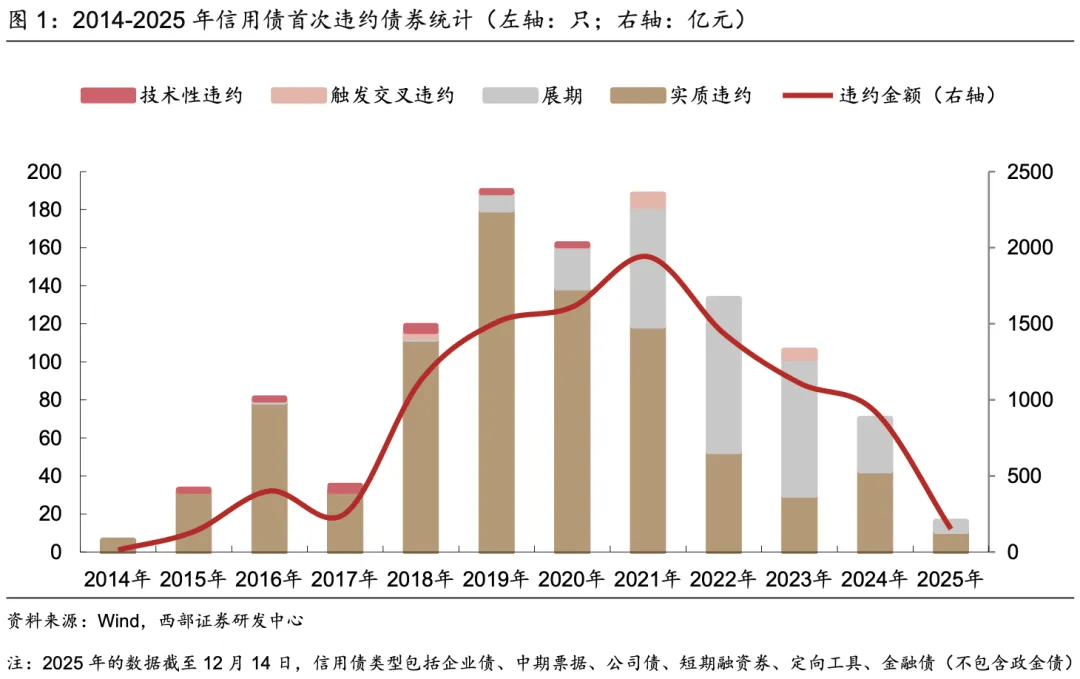
Core Insights - The analysis by Western Fixed Income indicates a significant decline in credit bond defaults for 2025, suggesting an improvement in the credit environment [1] Group 1: Default Trends - The number and amount of credit bond defaults have continued to decrease, with 16 defaults totaling 15.084 billion yuan in 2025, representing a reduction of 54 defaults and 77.145 billion yuan compared to 2024 [2] - The historical peak of default amounts occurred in 2021, with a steady decline observed since then, indicating an improving credit environment [2] - Among the defaults, 11 were substantial defaults, while 5 were extensions, with substantial defaults making up 73.4% of the total from 2014 to 2025 [2] Group 2: Defaulting Entities - All 16 defaulting bonds in 2025 were issued by non-state-owned enterprises, with the real estate sector having the highest number of defaults (4 entities), followed by non-bank financials (3 entities) [4] - The total number of defaulting entities from 2014 to 2025 shows a significant predominance of non-state-owned enterprises, with 265 defaults compared to 46 from state-owned enterprises, indicating higher stability and risk resistance in state-owned enterprises [5] Group 3: Industry Distribution - Defaulting entities span across 30 primary industries, with real estate (57 entities), comprehensive (36 entities), and basic chemicals (18 entities) being the most affected [6] - The real estate sector experienced a peak in defaults from 2022 to 2023, but the number has decreased to 4 in 2025, although it remains a primary risk area in the credit bond market [6] Group 4: Default Rates and Recovery - The marginal default rate for 2025 is 0.22%, the second lowest since 2014, with a total of 5,568 effective issuers at the beginning of the year [9] - The overall recovery rate for defaults since 2014 is 13.76%, with state-owned enterprises achieving a recovery rate of 27.12%, significantly higher than the 10.28% for non-state-owned enterprises [9][11]
信用周报20251214:2025年信用债市场违约特征总结-20251215
Western Securities· 2025-12-15 07:56
1. Report Industry Investment Rating No relevant content provided. 2. Core Viewpoints of the Report - In 2025, the number and scale of credit bond defaults decreased significantly, and the credit environment improved. The number of defaulted bonds was 16, with a total default amount of 15.084 billion yuan, a year-on-year decrease of 54 bonds and 77.145 billion yuan respectively [1][11]. - All first - time defaulting entities in 2025 were non - state - owned enterprises, and the number of defaults in the real estate industry decreased. Looking ahead to 2026, real estate may still be the main risk point in the credit bond market, and local risks of some weak - qualified small and medium - sized financial institutions should be vigilant, but the probability of a systemic impact on the market is low [1][13]. - The default rate dropped to a historically low level. In 2025, the marginal default rate was 0.22%, the second - lowest since 2014 [1][22]. - Last week, after an important meeting released a signal of monetary easing, credit bond yields turned downward in the second half of the week but the repair momentum was weak. Looking forward, due to the impact of wealth management funds returning to the balance sheet at the end of the quarter, incremental funds may be limited, and there is insufficient impetus to compress credit spreads. It is recommended to focus on the coupon strategy [2]. 3. Summary According to the Directory 3.1 2025 Credit Bond Market Default Feature Summary - **Default Quantity and Scale Decreased Significantly, Credit Environment Improved**: In 2025, the number and amount of defaulted credit bonds continued the downward trend of the previous year. There were 16 defaulted bonds with a total amount of 15.084 billion yuan, a year - on - year decrease of 54 bonds and 77.145 billion yuan respectively. From 2014 - 2025, substantial defaults were the main type in the credit bond market (73.4%), and in 2025, there were 11 substantial defaults and 5 extensions [11]. - **First - time Defaulting Entities were All Non - state - owned Enterprises, Real Estate Industry Default Quantity Decreased**: The 16 first - time defaulted bonds in 2025 came from 12 non - state - owned enterprise issuers, covering 6 industries such as real estate and non - bank finance. Historically, non - state - owned enterprises had significantly more defaults than state - owned enterprises. The real estate industry was still the main risk point in 2026, and local risks of some small and medium - sized financial institutions should be watched out for [13][17]. - **Default Rate Dropped to a Historically Low Level**: In 2025, the marginal default rate was 0.22%, the second - lowest since 2014. The overall recovery rate from 2014 to 2025 was 13.76%, with state - owned enterprises having a higher recovery rate of 27.12% than non - state - owned enterprises at 10.28% [22]. 3.2 Credit Bond Yield Overview - Last week, after an important meeting released a signal of monetary easing, credit bond yields turned downward in the second half of the week but the repair momentum was weak. Overall, credit bond yields showed mixed trends, with financial bonds performing better than non - financial credit bonds, and the 3 - year non - financial credit bonds performing better [27]. - Wealth management scale and the proportion of broken - net products decreased. The average yield of wealth management products had been declining for 6 consecutive weeks since early November. Looking forward, due to the impact of wealth management funds returning to the balance sheet at the end of the quarter, incremental funds may be limited, and there is insufficient impetus to compress credit spreads. It is recommended to focus on the coupon strategy. Institutions with stable liability ends can moderately participate in 3 - year medium - and high - grade bank secondary and perpetual bonds and securities firm subordinated bonds with relatively high spreads [29][36]. 3.3 Primary Market - **Issuance Volume**: Last week, the issuance scale of credit bonds increased both month - on - month and year - on - year, while the net financing scale decreased month - on - month and increased year - on - year. The net financing scale of urban investment bonds and financial bonds decreased month - on - month, while that of industrial bonds increased [37]. - **Issuance Cost**: The average issuance interest rate of credit bonds increased slightly. The average issuance interest rate of urban investment bonds increased month - on - month, while that of industrial and financial bonds decreased [45]. - **Issuance Term**: The average issuance term of credit bonds decreased month - on - month. The issuance terms of industrial and financial bonds decreased, while that of urban investment bonds increased [47]. - **Cancellation of Issuance**: The number and scale of cancelled credit bond issuances decreased last week [53]. 3.4 Secondary Market - **Trading Volume**: Except for the trading volume of securities firm subordinated bonds, the trading volume of other types of credit bonds rebounded last week, with the trading volume of bank secondary capital bonds increasing by over 13 billion yuan. The trading terms of different types of bonds showed different trends in terms of remaining maturity and implied rating [57][58]. - **Trading Liquidity**: The turnover rates of urban investment bonds, industrial bonds, and financial bonds increased last week. The turnover rates of different terms of each type of bond also showed different trends [59]. - **Spread Tracking**: Last week, most urban investment bond spreads widened, with the 10 - year AA + grade urban investment bond spreads widening the most. Most industrial bond spreads also widened, with the real estate industry having the largest spread widening for both AAA and AA grades. Most bank secondary and perpetual bond spreads narrowed, while the spreads of securities firm subordinated bonds widened across the board, and most insurance subordinated bond spreads narrowed [65][73][76]. 3.5 Weekly Hot Bonds Overview Based on qeubee's bond liquidity scoring, the top 20 urban investment bonds, industrial bonds, and financial bonds in terms of liquidity scores were selected for investors' reference [80]. 3.6 Credit Rating Adjustment Review Last week, 3 bonds had their debt ratings downgraded, and there were no upgrades [84].