违规经商办企业

Search documents
金融反腐再出重拳
母基金研究中心· 2026-03-30 09:08
Core Viewpoint - The article discusses the ongoing investigations and regulatory changes regarding corruption and misconduct among officials in financial and state-owned enterprises, highlighting the need for stricter compliance and oversight in these sectors [2][3][5]. Group 1: Investigations and Cases - Guo Xudong, former chairman of the China Securities Regulatory Commission's issuance review committee, is under investigation for serious violations, including accepting gifts and engaging in favoritism in stock issuance [2]. - Zhou Liang, a senior official at the National Financial Supervision Administration, is also under investigation for serious disciplinary violations [3]. - The case of economist Ba Shusong is being handled by the Shanghai police for alleged economic crimes involving significant amounts [3]. Group 2: Regulatory Changes - The revised "Regulations on the Integrity of State-Owned Enterprise Leaders" has been issued, updating standards for integrity and compliance after 17 years since the last version [3][4]. - The new regulations outline seven prohibitive areas, including 58 specific behaviors that are forbidden, emphasizing the need for stricter governance in state-owned enterprises [4]. Group 3: Corruption Trends - The Supreme People's Court is focusing on new trends in corruption, particularly in finance, state-owned enterprises, and public sectors, aiming to enhance the effectiveness of anti-corruption measures [5]. - Recent cases highlight the issue of officials engaging in business activities, which is seen as a significant risk to integrity and governance [6][7]. Group 4: Investment Regulations - The article emphasizes that party officials are prohibited from investing in private equity funds, as such actions are considered akin to engaging in business activities [11][12]. - There is a growing concern about officials using their positions to gain insider information and indirectly hold shares in non-listed companies through private equity investments [11][12]. Group 5: Historical Context - The article references historical regulations dating back to 1986 that prohibit government officials from engaging in business, underscoring a long-standing commitment to maintaining integrity in public service [8][9].


国企廉洁新规落地,这些投资行为被画红线
母基金研究中心· 2026-03-23 09:00
Core Viewpoint - The revised regulations for the integrity of state-owned enterprise leaders, issued after 17 years, aim to enhance supervision and set higher standards for ethical conduct in line with the new requirements of strict governance by the Communist Party of China [2] Summary by Sections Prohibited Conduct - The new regulations outline seven areas of prohibited conduct, explicitly listing 58 types of behaviors in a "negative list" format [3] - Notably, it prohibits using one's position to seek personal benefits, including behaviors such as entrusting others to invest in securities or funds without actual capital contribution, or engaging in hidden equity transactions [3] Corruption Trends - The Supreme People's Court emphasizes the need to address new trends in corruption, including hidden and evolving forms, and aims to enhance the analysis and judgment of such issues [3] - The court will impose strict penalties for corruption in key sectors like finance, state-owned enterprises, and education, maintaining a high-pressure stance against corruption [3] Case Studies - Recent cases highlight the misuse of power for personal gain, such as the expulsion of senior officials for engaging in corrupt practices under the guise of financial investment [4][6] - The Central Commission for Discipline Inspection has noted a rise in cases where officials hold shares in unlisted companies, which is considered a violation of integrity regulations [4][6] Investment Regulations - The regulations clarify that party members and leaders are prohibited from investing in private equity funds, as such actions are deemed equivalent to engaging in business activities [9][10] - The potential for conflicts of interest arises when officials use their positions to gain insider knowledge about non-listed companies, leading to significant personal financial benefits [9][10] Leadership Conduct - The guidelines stress that leaders must avoid dual roles as both officials and businesspeople, warning against the risks of corruption associated with such duality [7] - The regulations also extend to the family members of leaders, imposing stricter rules on their business engagements to prevent conflicts of interest [10] Definition of Party Leaders - The definition of "party leaders" includes various levels of leadership across government and state-owned enterprises, ensuring comprehensive coverage of those subject to these integrity regulations [11]

三堂会审丨违规经商办企业还是贪污
Zhong Yang Ji Wei Guo Jia Jian Wei Wang Zhan· 2025-07-09 00:07
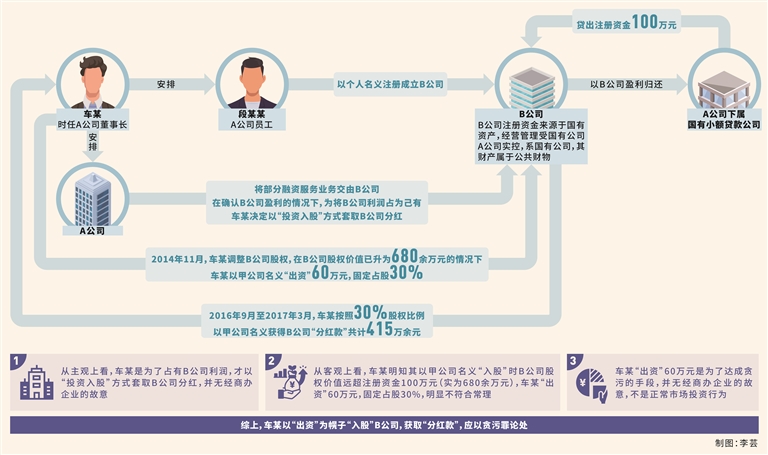
Core Viewpoint - The case revolves around the actions of Che, who used Company A's name to "invest" in Company B, ultimately obtaining over 4.15 million yuan in "dividends," raising questions about whether this constitutes a violation of business regulations or embezzlement [2][18]. Summary by Sections Basic Case Facts - Che joined the Communist Party in June 1994 and served as the chairman and general manager of Company A, a state-owned enterprise, until his retirement in October 2021 [3]. Embezzlement Details - In October 2013, Che arranged for an employee to register Company B under his name, with a registered capital of 1 million yuan, which was loaned from a state-owned small loan company [4]. - Company B was managed by Company A's asset management department and was used as a tool for external business operations [4][5]. - In 2014, Che manipulated the financing service contracts to benefit Company B, which he knew was profitable and low-risk, and decided to "invest" in Company B to extract its profits [5]. Financial Transactions and Control - From March to December 2015, Che facilitated the transfer of 50% of Company B's shares to Company A and its management team without any payment, maintaining control over the company [6]. - Between September 2016 and March 2017, Che received over 4.15 million yuan in dividends from Company B based on a 30% shareholding [6]. Investigation and Legal Proceedings - The investigation into Che's actions began on June 27, 2023, leading to his detention and subsequent legal actions, including a public prosecution for embezzlement [8][9][10]. - On January 11, 2024, the court sentenced Che to 11 years and 6 months in prison for embezzlement, along with a fine of 1.3 million yuan [11]. Company Nature and Legal Implications - There are differing opinions on whether Company B is a state-owned enterprise or a private company, but evidence suggests it is controlled by Company A, thus qualifying as a state-owned entity [13][14][17]. - Che's actions, including undervaluing Company B's shares and using its funds for personal gain, are classified as embezzlement under the law [22][25]. Conclusion on Che's Actions - Che's investment in Company B was deemed a means to unlawfully acquire state-owned assets, constituting embezzlement rather than a legitimate business activity [21][25].
“天价耳环事件”最新消息!官方通报:黄杨钿甜父亲被立案调查
21世纪经济报道· 2025-05-22 10:03
Core Viewpoint - The article discusses the investigation into Yang's involvement in a high-profile case related to a "sky-high earring" incident, highlighting the scrutiny of his professional conduct and potential violations during his tenure in public service [1][2]. Group 1: Background and Employment History - Yang participated in the public servant recruitment exam in October 2010 and was hired in April 2011 by the Urban Management Law Enforcement Team of Ya'an City, where he worked until September 2014 [1]. - From September 2014 to March 2017, Yang was employed at the Ya'an Investment Promotion Bureau and its subordinate unit, primarily managing investment promotion platforms and coordinating activities, without involvement in post-disaster reconstruction projects [2]. Group 2: Investigation Findings - The investigation revealed that Yang did not handle bidding for post-disaster reconstruction projects or manage funds related to these projects during his employment [2]. - Yang is under investigation for potential violations, including engaging in business activities while in public service and allegedly concealing information regarding the illegal birth of a second child during his recruitment process [2].