通用机器人技术

Search documents
宇树科技王兴兴:通用机器人技术路线差异大,已经制约了发展速度
3 6 Ke· 2025-09-24 08:36
Core Insights - The ultimate goal of general robotics is to achieve versatile capabilities in both household and industrial settings, with a focus on real-time action execution based on human commands [2][5] - Current advancements indicate that the first phase of development has been achieved, with robots capable of performing complex fixed actions, while the next phase aims for real-time response to arbitrary commands by the end of this year or early next year [2][5] - A significant challenge in the robotics industry is the reliance on cables, which account for 60%-70% of failures in industrial robots, necessitating a reduction in cable quantity and the development of new communication protocols [3][4] Key Developments - The transition from fixed actions to real-time action generation is a critical breakthrough, with expectations for robots to autonomously perform tasks in unknown environments by the second half of next year [2] - Achieving a success rate of 99.9% in robotic operations is essential for practical applications, particularly for complex tasks like disassembling a smartphone [2] - The current limitations of terminal AI chips in robots are due to power consumption and space constraints, with a target to keep peak power under 100 watts and average power at 20-30 watts [5] Industry Collaboration - The robotics industry is still in its early stages, facing challenges due to diverse technological approaches among companies, which hinders overall progress [6] - Open-source initiatives, such as sharing models and datasets, are encouraged to foster collaboration and accelerate advancements in the field [6] - There is a call for industry-wide cooperation to address various challenges, including safety protocols and the security of operating systems, to establish industry standards [7]



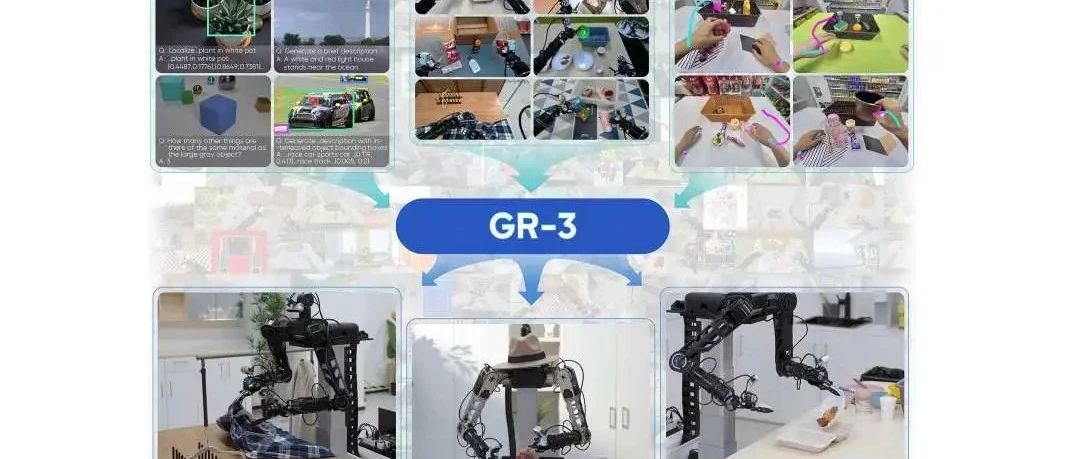
各类任务上超越π0!字节跳动推出大型VLA模型GR-3,推动通用机器人策略发展
具身智能之心· 2025-07-22 04:10
Core Viewpoint - GR-3, developed by ByteDance, is a large-scale visual-language-action (VLA) model designed to advance general robotics strategies, demonstrating exceptional capabilities in generalization, efficient fine-tuning, and execution of complex tasks [2][7]. Group 1: Performance and Advantages - GR-3 excels in generating action sequences for dual-arm mobile robots based on natural language instructions and environmental observations, outperforming current advanced baseline methods [2][7]. - The model's architecture includes a total of 4 billion parameters, balancing performance and efficiency by optimizing the action generation module [10][12]. Group 2: Core Capabilities and Innovations - GR-3 addresses three major pain points of traditional robots: inability to fully recognize, learn quickly, and perform tasks effectively [7]. - It features a dual-path design combining data-driven approaches with architectural optimization, enabling it to understand abstract instructions and perform precise operations [7][12]. - Key innovations include enhanced generalization capabilities, efficient adaptation with minimal human demonstration data, and stable performance in long-duration and intricate tasks [12][14]. Group 3: Training Methodology - The training strategy employs a "trinity" approach, integrating robot trajectories, visual-language data, and human demonstrations for progressive learning [15][19]. - The model's ability to recognize new objects improved by approximately 40% through joint training with vast internet visual-language datasets [19][23]. Group 4: Hardware Integration - The ByteMini robot, designed for GR-3, features a flexible 7-degree-of-freedom arm and a stable omnidirectional base, enhancing its operational capabilities in various environments [25][26]. - The robot can autonomously generate task combinations and control environmental variables, ensuring effective task execution [21][25]. Group 5: Experimental Validation - GR-3 was tested in three challenging tasks, demonstrating strong adaptability to new environments and abstract instructions with a success rate of 77.1% for understanding new directives [30][38]. - In a long-duration task, GR-3 maintained a success rate of 89% in executing multi-step actions, significantly outperforming previous models [42].
深度|SemiAnalysis万字长文:中国机器人已经遥遥领先,美国若错失机器人革命恐全盘皆输,制造业回流再无可能
Z Finance· 2025-03-12 10:21
Core Viewpoint - The article emphasizes the critical juncture the U.S. and the Western world face in the ongoing robotics technology revolution, highlighting the potential for China to dominate this field if the U.S. fails to keep pace with advancements in automation and robotics [1][2]. Group 1: China's Manufacturing Leadership - China has established itself as a global leader in manufacturing, demonstrating competitive advantages in scale economies and engineering quality across key industries, including batteries, solar energy, and electric vehicles [2]. - The impact of robotics technology is expected to grow exponentially, with the production of robots leading to continuous cost reductions and quality improvements, making it increasingly difficult for other countries to compete [2][3]. - Currently, Chinese companies hold nearly 50% of the global robotics market share, up from 30% in 2020, indicating a significant shift towards domestic manufacturers taking over high-end markets [3]. Group 2: Cost Disparities in Robotics - The cost of manufacturing a robotic arm similar to the Universal Robots UR5e model in the U.S. is approximately 2.2 times higher than in China, highlighting the significant cost advantage China holds in this sector [4][5]. - A detailed cost comparison shows that the total cost of a full light payload robot arm in the U.S. is $24,420, compared to $11,155 in China, representing a 118.9% cost increase for U.S. manufacturers [5]. Group 3: Supply Chain and Component Dependency - The U.S. manufacturing sector heavily relies on components sourced from China, even for products labeled as "Made in America," which complicates the narrative of domestic manufacturing independence [4][43]. - The supply chain for industrial robots is complex and often disrupted, as seen during the COVID-19 pandemic, which highlighted the vulnerabilities of Western economies compared to China's rapid adjustments and increases in robot installations [44]. Group 4: Robotics Technology Development - The article discusses the challenges in developing general-purpose robots capable of operating in unstructured environments, emphasizing the need for significant advancements in both hardware and software to achieve this goal [18][20]. - China has made remarkable progress in creating fully automated factories, exemplified by the operation of "unmanned factories" that can produce smartphones without human intervention, showcasing the potential for future advancements in automation [21][23]. Group 5: Types of Robots and Their Applications - The article categorizes various types of industrial robots, including articulated arms, SCARA robots, and collaborative robots (cobots), each designed for specific tasks and environments [24][28]. - Collaborative robots are increasingly being adopted in industrial settings due to their ability to work alongside humans and perform tasks that require flexibility and precision [30]. Group 6: Future of Robotics and AI Integration - The integration of AI and robotics is expected to revolutionize industries by enabling robots to perform complex tasks autonomously, thereby addressing labor shortages and enhancing operational efficiency in various sectors [20][21]. - The article concludes with a vision of a future where general-purpose robots can seamlessly operate in diverse environments, significantly transforming labor dynamics and productivity across industries [18][20].