避险和抗通胀

Search documents
帮主郑重:原油铜金齐飞,市场在打什么算盘?
Sou Hu Cai Jing· 2026-01-10 05:01
Core Viewpoint - The recent rise in oil, copper, and gold prices reflects different underlying factors, with oil experiencing geopolitical tensions, copper driven by supply concerns and tariff fears, and gold acting as a safe haven amid economic uncertainty [3][4][5]. Oil Market - Oil prices have increased for three consecutive weeks, reaching around $59 per barrel, marking the longest streak since June of the previous year [3]. - The rise is influenced by geopolitical issues in Iran and Venezuela, but there are concerns about increasing global inventories and potential oversupply [3]. - Goldman Sachs indicates that client bearish sentiment towards oil is at a ten-year high, suggesting that the current price increase may not be sustainable [3]. Copper and Industrial Metals - Copper prices have surged, nearing $13,000 per ton, with many industrial metals experiencing a four-week price increase [4]. - The primary concern driving this surge is supply tightness and fears of potential U.S. tariffs, leading to increased shipments to the U.S. and creating a temporary "scarcity premium" [4]. - Analysts warn that price levels driven by policy expectations and stockpiling behaviors may reverse quickly if those expectations change [4]. Gold Market - Gold prices are also rising, driven by its appeal as a hedge against uncertainty and inflation [4]. - The mixed economic data from the U.S. suggests that the Federal Reserve may not take aggressive actions in January, maintaining a status quo that supports gold's safe-haven status [4]. - Unlike oil and copper, gold's price movements are less influenced by immediate supply-demand dynamics and more reflective of global monetary policy and market sentiment [4]. Investment Strategy - For cyclical commodities like oil and copper, investors are advised to avoid chasing prices amid mixed signals and to wait for clearer supply-demand indicators [5]. - Gold can serve as a stabilizing asset in investment portfolios to manage uncertainty, although expectations for short-term price surges should be tempered [5]. - The market's apparent excitement should not obscure the distinct narratives each commodity presents regarding economic conditions [5].


深夜突发,黄金大跳水!
Sou Hu Cai Jing· 2025-05-15 04:17
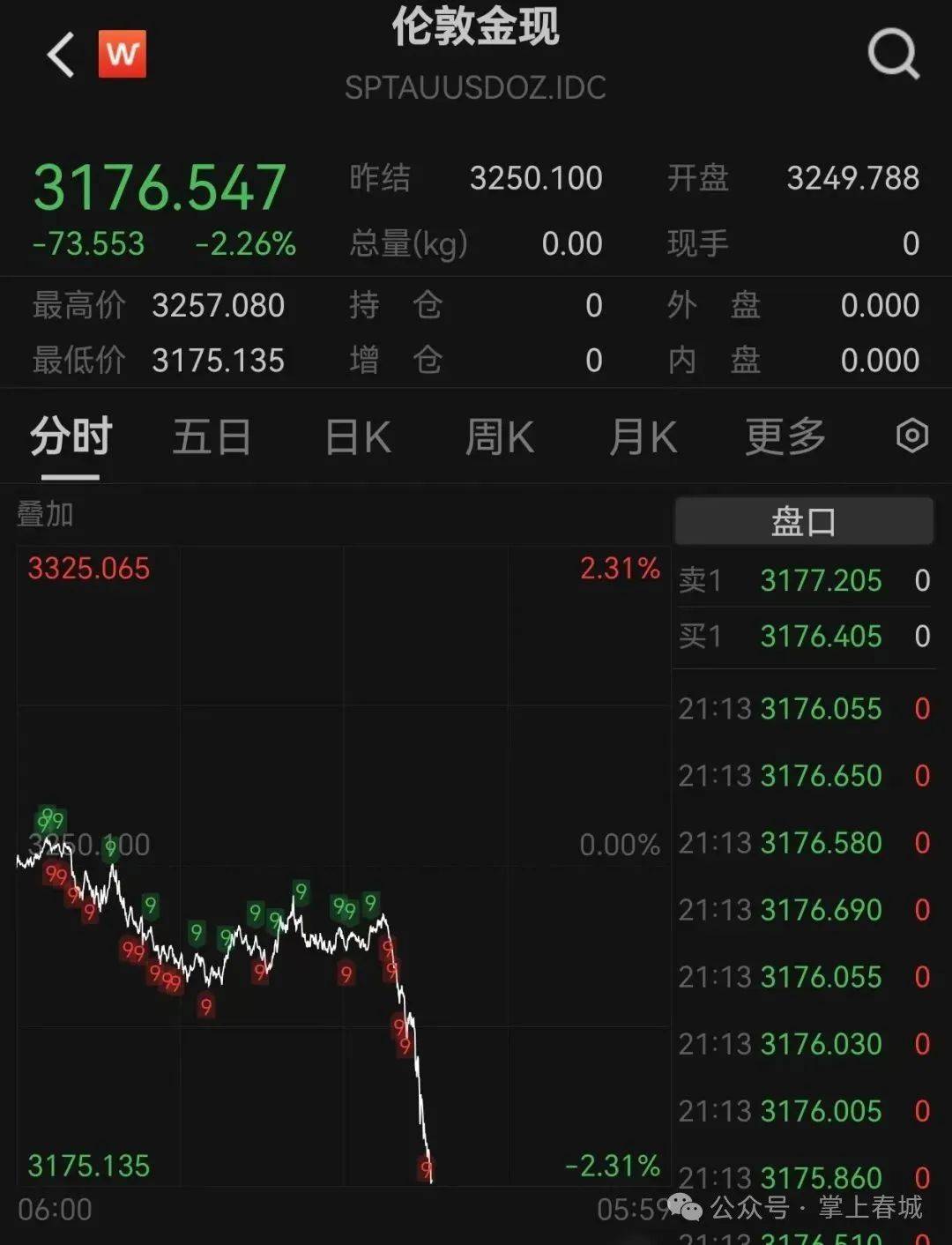
Core Viewpoint - The international gold market has experienced a downward trend, with spot gold prices dropping below $3180 per ounce, marking a new low since April 15 [1][3]. Price Movements - On May 14, spot gold prices fell to $3176.547, down $73.553 or 2.26% from the previous close of $3250.100 [2]. - The highest price recorded on May 14 was $3257.080, while the lowest was $3175.135 [2]. Domestic Gold Prices - As of May 14, several domestic gold retailers have adjusted their prices for gold jewelry, with prices falling below 1000 yuan per gram. For instance, Chow Sang Sang's gold jewelry was priced at 992 yuan per gram, up 1 yuan from the previous day, while Lao Feng Xiang's price dropped by 5 yuan to 990 yuan per gram [3]. - Compared to May 11, Chow Sang Sang's price has decreased by 29 yuan per gram, and Chow Tai Fook's price has dropped by 30 yuan per gram [3]. Market Outlook - According to Wang Youxin from the Bank of China Research Institute, short-term gold prices may continue to fluctuate due to high market risk appetite and ongoing adjustments in trade conditions. However, there may be resistance and support levels that could lead to price volatility [4]. - In the medium to long term, there is potential for gold prices to rebound as the safe-haven and anti-inflation attributes of gold become more prominent, especially as major central banks remain in a loose monetary policy cycle [4].