
黄金价格走势

Search documents
Global investors flee gold ETFs in March
BusinessLine· 2026-03-31 08:23
Core Insights - Gold ETFs experienced significant outflows in March, with $21.35 billion withdrawn against $9.12 billion in inflows, indicating a negative sentiment towards gold investments [1][2] - The price of gold has declined by 15% over the past month, currently trading at $4,551.08 per ounce, down from a peak of $5,608 per ounce on January 30 [3] - The outlook for gold remains bearish due to factors such as rising crude oil prices, a strengthening dollar, and concerns over global inflation, which may lead to increased interest rates [5] Investment Trends - Year-to-date data shows that gold is primarily being held by Asian investors, particularly in India and China, with net inflows into gold ETFs in Asia amounting to $13.29 billion, while North America and Europe saw net outflows [7] - China and India are leading in gold ETF investments, with inflows of $7.93 billion and $3.13 billion respectively, while Japan also contributed positively with $1.02 billion [9] - The Nippon India ETF Gold BeES and several Chinese ETF funds ranked among the top global ETFs for inflows, with the SPDR Gold Minishares Trust leading at $2.62 billion [10] Price Forecast - BMI maintains a gold price forecast of an annual average of $4,600 per ounce for 2026, despite current pressures on gold prices due to geopolitical tensions and market conditions [6] - The average gold price year-to-date as of March 25 is reported at $4,899 per ounce, starting the year at $4,331 per ounce [6]

彭博罕见的看空黄金报告:5000美元金价太高,堪比1980年和2011年高点!
美股IPO· 2026-03-18 00:41
Core Viewpoint - Bloomberg strategist Mike McGlone warns that the recent surge in gold prices is shifting from a store of value to speculative bets, indicating that the current bull market may be nearing its end [3][4]. Group 1: Price Levels and Historical Comparisons - As of the end of February, the premium of gold prices relative to the 60-month moving average has reached the highest level since 1980, with a 180-day volatility that is 2.4 times that of the S&P 500, marking a 20-year high [3][10]. - McGlone compares the current price levels to historical peaks in 1980 and 2011, suggesting that the current state represents the "best condition" a bull market can achieve [4][10]. - The gold-to-oil ratio reached a historical extreme of 79 at the end of February, a level only surpassed during the extreme conditions of April 2020 when oil prices turned negative [11]. Group 2: Inflation and Market Dynamics - McGlone emphasizes that the risk of gold prices retreating to $4,000 per ounce is increasing if gold fails to receive support from a 1970s-like inflation environment or ongoing extreme geopolitical events [5][10]. - The current inflation rate in the U.S. is only 2.4%, contrasting sharply with the high inflation of nearly 15% during the 1979-1980 gold rush, which raises concerns about the sustainability of current gold price levels [9][10]. - The ratio of the S&P 500 to gold fell to 1.32 on March 13, indicating that the strength of gold relative to stocks may have reached its limit, with a potential downward trend [10]. Group 3: Volatility and Market Signals - The high volatility of gold, which is 2.4 times that of the S&P 500, creates a rare divergence, suggesting that an increase in stock market volatility could lead to a retreat in gold prices [10]. - McGlone warns that the strong performance of gold may become a liability for all assets, particularly the stock market, as it could signal greater pressure ahead [10]. - The gold-to-oil price ratio remains significantly above its historical average, indicating that a reversion to the mean could be on the horizon, potentially leading to a significant market shift [11].

美银放话:金价要上6000!但先得跨过这道“春坎”
Xin Lang Cai Jing· 2026-02-27 03:17
Core Viewpoint - Gold prices are struggling to surpass $5,200 per ounce, with potential for an increase by year-end, but a major bank anticipates further consolidation in spring [3][10]. Group 1: Current Market Situation - The latest trading price for spot gold is $5,174 per ounce, reflecting a monthly increase of over 5% [3][8]. - Despite recent resistance, the market is expected to end the month on a stable note due to a rebound from late January sell-offs [3][10]. Group 2: Future Price Predictions - Analysts from Bank of America reaffirm a target price of $6,000 per ounce for gold over the next 12 months, acknowledging recent resistance as investors adapt to higher prices [5][10]. - There are concerns regarding the pace at which investors are increasing their exposure to gold, which may lead to a period of weakness in prices during spring [5][10]. Group 3: Economic Influences - The gold market is influenced by uncertainties surrounding U.S. tariff policies and the need for clearer monetary policy from the Federal Reserve [11]. - The recent historic pullback was partly due to the nomination of Kevin Warsh as the new Fed chair, who is seen as a traditional central banker [11][12]. Group 4: Interest Rates and Federal Reserve Policies - Analysts note that while a weak dollar typically supports gold prices, the impact of interest rates is a more significant concern [6][11]. - Warsh's intention to lower policy rates could support gold prices, but the Fed's challenge in managing its large balance sheet remains a critical issue [6][12]. - The potential for quantitative tightening to reduce bank reserves may lead to liquidity shortages, affecting the monetary market [12].


2026年黄金价格走势深度分析(最新预测+影响因素详解)
Sou Hu Cai Jing· 2026-02-27 01:50
Core Viewpoint - The global gold market is experiencing high volatility in February 2026, with prices fluctuating around $5188 per ounce, driven by factors such as Federal Reserve interest rate expectations, central bank gold purchases, and geopolitical risks [1][3][6]. Price Trend Analysis - **Early February**: Gold prices surged from $5020 to $5248.89 per ounce, supported by rising expectations of a Federal Reserve rate cut and significant central bank gold purchases, totaling 320 tons [3][4]. - **Mid-February**: Prices corrected to around $5130 per ounce due to profit-taking and hawkish statements from Federal Reserve officials, with a 1.1% decline in domestic gold T+D prices [4]. - **Late February**: Prices stabilized around $5188.51 per ounce, influenced by ongoing geopolitical tensions and continued central bank gold purchases [5]. Key Influencing Factors - **Federal Reserve Monetary Policy**: The Fed's policy is a primary driver of gold prices, with expectations of rate cuts influencing market sentiment. Predictions for 2026 vary, with some institutions forecasting multiple rate cuts while others anticipate stability or even rate hikes [6][12]. - **Global Central Bank Gold Purchases**: Central banks are expected to maintain high levels of gold purchases, with 2026 projections between 700-850 tons, significantly supporting gold prices [7][12]. - **Geopolitical Risks**: Ongoing geopolitical tensions, particularly in the Middle East, are contributing to short-term volatility in gold prices, as investors seek safe-haven assets [8][12]. Price Movement Logic - **Reasons for Price Increase**: The primary drivers for potential price increases include expectations of Federal Reserve rate cuts, continuous central bank gold purchases, and persistent geopolitical risks [12]. - **Reasons for Price Decrease**: Potential risks for price declines include less aggressive Fed policies than expected, easing geopolitical tensions, and short-term profit-taking [13]. Price Forecasts - **Institutional Predictions**: Predictions for gold prices in 2026 show a bullish outlook from major institutions, with target prices ranging from $5400 to $6300 per ounce, driven by central bank purchases and geopolitical factors [14][15]. - **Market Sentiment**: Influencers on social media platforms suggest a long-term price range of $5000 to $6300 per ounce, with expectations of reaching $6000 by year-end [14][16]. Investment Recommendations - **Long-term Strategy**: Investors are advised to prioritize gold ETFs and physical gold, maintaining a position of 10%-15% of their portfolio, with opportunities to increase holdings during price corrections [17]. - **Short-term Strategy**: Focus on trading around key support and resistance levels, with timely profit-taking and loss-cutting strategies [17].
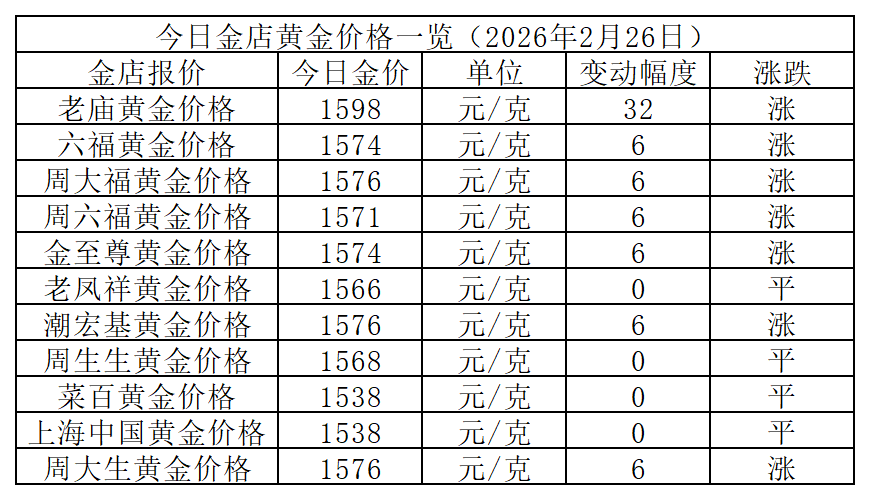
最高1598元/克!2026年2月26日国内金店金价盘点
Sou Hu Cai Jing· 2026-02-26 08:15
Domestic Gold Prices - Domestic gold prices have mostly risen, with some brands remaining stable. Lao Miao Gold saw the largest increase of 32 CNY per gram, leading the market with the highest price [1] - Other brands such as Chow Tai Fook, Chao Hong Ji, and Zhou Da Sheng increased by 6 CNY per gram, while Lao Feng Xiang, Zhou Sheng Sheng, Cai Bai, and Shanghai China Gold prices remained unchanged [1] - The price difference between the highest and lowest gold prices in stores has expanded to 60 CNY per gram, an increase of 28 CNY compared to the previous day [1] Gold Price Overview - The detailed gold price list for various brands shows Lao Miao Gold at 1598 CNY per gram, with other brands like Liu Fu, Zhou Da Fu, and Jin Zun all around 1570 CNY per gram [1] - The gold recycling prices have shown a slight decline, with the average recycling price at 1134 CNY per gram [1] Platinum Prices - Platinum jewelry prices have also increased, with Zhou Da Fu reporting a rise of 36 CNY per gram, now priced at 905 CNY per gram [1] International Gold Prices - International spot gold prices were supported by safe-haven buying, reaching a peak of 5200 USD per ounce before retreating to close at 5164.57 USD per ounce, marking a 0.43% increase [4] - As of the latest update, spot gold is trading at 5196.39 USD per ounce, reflecting a 0.62% increase [4] - Morgan Stanley analysts predict that by the end of 2026, gold prices could reach 6300 USD per ounce, with long-term forecasts adjusted to 4500 USD per ounce [4] Market Sentiment - The market is currently awaiting further developments from the US-Iran nuclear negotiations, which could impact gold prices. Additionally, upcoming US jobless claims data and Federal Reserve officials' speeches may also influence market movements [4]
黄金5200美元关口面临考验 警惕重演1月大跌行情
Jin Tou Wang· 2026-02-26 06:11
Group 1 - The core viewpoint is that gold prices are currently stabilizing above the key breakout level of $5100 per ounce, but face strong resistance in the $5200 to $5300 range, indicating a potential for volatility in the market [1][2][3] - Analysts note that the recent price movements reflect a return to a bullish technical range after significant fluctuations in February, driven by renewed safe-haven buying due to trade policy uncertainties [2] - There are concerns about the sustainability of the current bullish trend, as the market is experiencing historically overbought momentum readings, suggesting a critical turning point in the technical structure [2][3] Group 2 - The current price action is reminiscent of the situation before the sharp decline in January, with potential momentum exhaustion posing risks to the upward trend [3] - If gold prices fail to decisively break through the $5200 to $5300 resistance, there is a risk of a sharp correction, potentially leading to a decline towards $4800 and further down to $4380 if the $5100 support is breached [1][3] - The ability of gold to maintain its upward momentum will depend not only on macroeconomic safe-haven flows but also on whether buyers can hold the breakout area before sellers regain control [3]
金价卡在5200美元关口,分析师:再不突破就要出大事
Xin Lang Cai Jing· 2026-02-26 03:51
Core Viewpoint - Gold prices are stabilizing above the February breakout level of $5100 per ounce, but face significant resistance in the $5200 to $5300 range, indicating potential volatility ahead [2][6]. Technical Analysis - The current technical pattern resembles the situation before the January sell-off, suggesting that a drop below $5100 could lead to a downward risk targeting $4800 or even $4380 [2][3]. - The successful stabilization of gold above $5100 reflects new safe-haven demand driven by trade policy uncertainties, reinforcing investor confidence in precious metals [2][6]. - However, the strong momentum is colliding with historically high overbought readings, raising questions about sustainability [2][7]. Momentum and Risk - There is a warning regarding the risk of momentum exhaustion, as current technical conditions have historically indicated significant pullbacks [7]. - Unless gold decisively breaks through the resistance levels of $5200 and $5300, maintaining prices above $5000 may be challenging due to excessive positioning increasing vulnerability to sharp corrections [3][7]. - If gold closes below the $5100 support level, a clear structural downward path is outlined, with potential targets at $4800, $4600, $4530, and $4380 [3][4]. Market Dynamics - The upward movement of gold now depends not only on macro-driven safe-haven flows but also on buyers' ability to maintain the breakout area before momentum exhaustion hands control back to sellers [4][7].
2026年2月26日,国内黄金9995价格多少钱一克?
Sou Hu Cai Jing· 2026-02-26 01:25
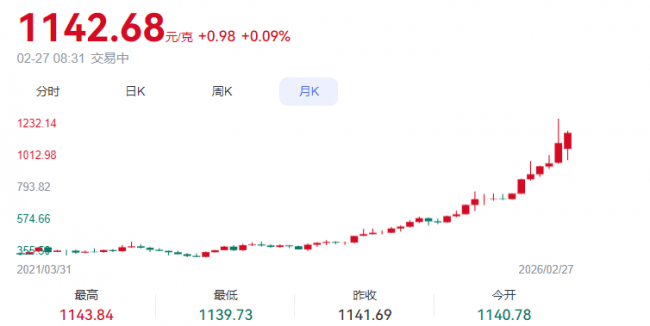
Core Viewpoint - Domestic gold prices have shown a slight increase, while international gold prices have decreased, influenced by various market factors including Federal Reserve policies and geopolitical developments [1][2]. Group 1: Domestic Gold Market - As of 8:30 AM, the latest domestic gold price (99.95%) is reported at 1153.9 yuan per gram, reflecting an increase of 0.65% [1]. Group 2: International Gold Market - The international gold price is reported at 5189.5 USD per ounce, showing a decline of 0.7% [2]. Group 3: Influential Factors on Gold Prices - The hawkish stance of the Federal Reserve has suppressed expectations for interest rate cuts, with Boston Fed President Susan Collins indicating that interest rates will remain unchanged for an extended period. This has strengthened the dollar's appeal and directly pressured gold prices [3]. - The easing of tensions between the U.S. and Iran, along with profit-taking by investors, has contributed to a significant drop in gold prices, with a decline of over 40 USD after reaching near 5200 USD per ounce [3]. - Major international investment banks maintain bullish forecasts for gold prices, with JPMorgan setting a target of 6300 USD per ounce by the end of 2026, Deutsche Bank predicting 6000 USD per ounce, and UBS Wealth Management suggesting a modest allocation of gold in investment portfolios. These bullish expectations provide medium to long-term support for gold prices, alleviating short-term bearish sentiment [4].
2月25日上期所沪金期货仓单较上一日持平
Jin Tou Wang· 2026-02-25 08:04
Group 1 - The total amount of gold futures at the Shanghai Futures Exchange is 105,072 kilograms, with no change from the previous day [1][2] - The main gold futures contract opened at 1,144.80 yuan per gram, reaching a high of 1,154.98 yuan and a low of 1,134.00 yuan, currently trading at 1,151.06 yuan, down 0.04% [1] - Trading volume for the day is 198,537 contracts, with open interest at 155,075 contracts, showing a decrease of 2,336 contracts in daily open interest [1] Group 2 - COMEX gold prices experienced a slight decline after reaching a high of 5,280 USD per ounce, currently fluctuating around 5,180 USD per ounce [2] - Key short-term support for gold prices is influenced by rising uncertainty regarding U.S. tariff policies, ongoing U.S.-Iran negotiations, and heightened tensions in the Middle East [2] - Following a Supreme Court ruling on February 20 regarding tariffs, President Trump announced a temporary 10% tariff increase on a global scale, with plans to raise tariffs on multiple countries to 15% effective February 24 [2] - Gold prices are also facing pressure from mixed U.S. economic data and delayed expectations for the Federal Reserve's first interest rate cut of the year [2] - Upcoming events to monitor include the U.S.-Iran negotiations on February 26, the release of January PPI data on February 27, and the non-farm payroll report next week, along with developments in U.S.-China relations [2]
机构:黄金价格可能在5,000美元上方盘整
Sou Hu Cai Jing· 2026-02-24 05:16
Core Viewpoint - Recent reports suggest that gold prices may stabilize above the $5,000 per ounce mark due to rising geopolitical tensions in the Middle East [1] Group 1: Geopolitical Impact - The escalation of geopolitical tensions in the Middle East is likely to keep gold prices above the critical level of $5,000 per ounce [1] - Ongoing negotiations in the region could quickly influence the price movements of gold [1] Group 2: Market Dynamics - A genuine de-escalation of tensions may weaken safe-haven demand for gold, while renewed friction could drive investors to establish defensive positions in gold [1] - Other macroeconomic factors such as real yields, dollar movements, and Federal Reserve interest rate expectations may also impact the price of gold [1]