邮轮+跨城购

Search documents
“智造+文化+服务”圈粉海外游客 中国消费市场成购物热土
Yang Shi Wang· 2026-01-19 22:28
Core Insights - The Chinese consumer market is becoming a shopping hotspot for overseas tourists, driven by the integration of manufacturing, culture, and services [1] Group 1: Growth in Inbound Tourism - In 2025, inbound tourism from foreign visitors continues to thrive, with cruise tourism showing remarkable performance. Ports like Shanghai, Tianjin, and Xiamen are experiencing a surge in passenger flow, with Xiamen's cruise arrivals increasing by 129% year-on-year [2] - The "cruise + onshore deep travel" model is gaining popularity, with major tourist attractions seeing double-digit growth in foreign visitor numbers [4] - The demand for deep travel among inbound tourists has led to a 170% year-on-year increase in inbound passenger flow in Chongqing, with hotel bookings in some commercial areas surging by 800% [6] Group 2: Cultural and Shopping Integration - The "cruise + cross-city shopping" trend is emerging, with over 60% of tourists on the Yangtze River Delta route choosing the "cruise + Suzhou + Hangzhou" shopping line [7] - Popular products among cruise tourists include Yiwu small commodities and Shenzhen electronic products, highlighting the appeal of "Chinese smart manufacturing" and cultural products [8] Group 3: Technological Advancements in Port Services - Continuous innovation and upgrades at relevant ports are enhancing the overall visitor experience, with the new Xiamen International Cruise Center set to open in 2025, featuring advanced customs clearance technology [9] - The average time for cruise passengers from disembarkation to customs clearance has been reduced to just 10 minutes, improving efficiency by approximately 50% [10] - The logistics sector is also benefiting from innovative models, with Shanghai Port implementing a "pre-declaration + direct loading upon arrival" approach, ensuring stability in international supply chains [11]
“智造+文化+服务”圈粉海外游客 中国消费市场成购物热土多地港口客流持续“爆单”
Yang Shi Wang· 2026-01-14 08:25
Group 1 - The inbound tourism from foreign visitors is expected to remain strong in 2025, with cruise tourism showing significant growth, particularly in ports like Shanghai, Tianjin, and Xiamen, where Xiamen's cruise arrivals increased by 129% year-on-year [1] - The "Cruise + Shore Excursion" model is gaining popularity, with foreign tourist reception at popular attractions achieving double-digit growth [6] - The integration of cultural elements into cruise itineraries, such as traditional performances and Chinese medicine, enhances the cultural value of maritime travel [11] Group 2 - The demand for in-depth travel experiences has led to a 170% year-on-year increase in inbound tourist flow to Chongqing, with hotel bookings in some commercial areas surging by 800% [13] - The "Cruise + Cross-City Shopping" trend is emerging, with over 60% of tourists on the Yangtze River Delta route opting for shopping experiences in Suzhou and Hangzhou [18] - The introduction of smart services at ports, such as the new terminal at Xiamen International Cruise Center, improves the overall visitor experience by streamlining customs processes [23][25] Group 3 - The logistics sector is also innovating, with the implementation of "one order" and "one container" systems to enhance efficiency, leading to a record cargo throughput of 493 million tons at Tianjin Port in 2025 [29]

“秒级”通关!邮轮入境游火爆 多地港口客流创新高
Yang Shi Xin Wen Ke Hu Duan· 2026-01-14 01:23
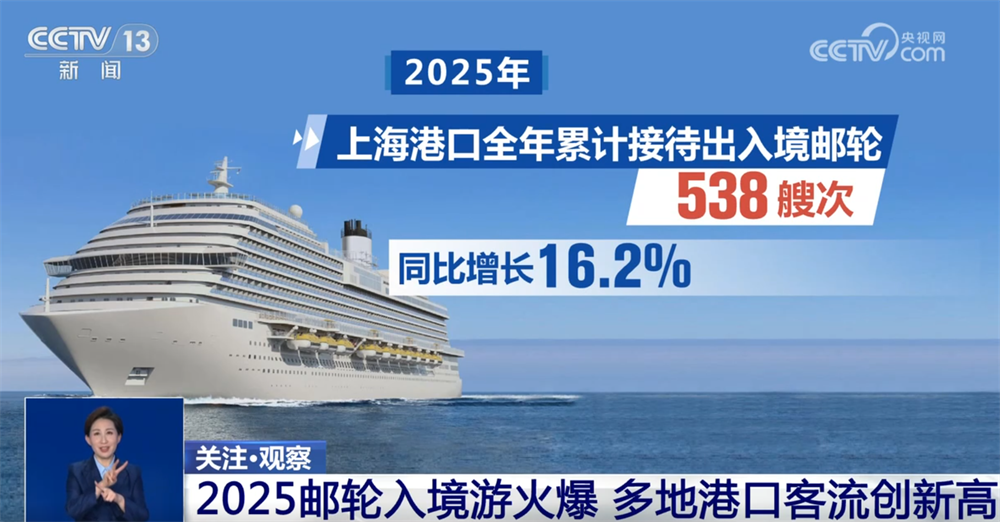
Core Insights - The influx of foreign tourists, particularly through cruise tourism, has significantly increased due to the implementation of visa-free policies for foreign tour groups, leading to record numbers at major ports like Shanghai, Tianjin, and Xiamen [1][4]. Group 1: Cruise Tourism Growth - In 2025, Shanghai port received a total of 538 cruise ships, marking a 16.2% year-on-year increase [1] - Tianjin International Cruise Home Port welcomed over 400,000 passengers [1] - Xiamen port saw a 129% increase in cruise arrivals compared to the previous year [1] Group 2: Efficient Customs Procedures - The "onboard inspection" model has streamlined customs processes, allowing foreign tourists to clear customs in 3 to 5 seconds upon arrival [1][3] - Shanghai's Wu Songkou Port recorded nearly 30,000 inbound and outbound passengers in a single day during the May Day holiday, a three-year high [1] - Average customs clearance time for cruise passengers has been reduced to just 10 minutes, improving efficiency by approximately 50% [13] Group 3: Cultural and Regional Appeal - Cultural experiences have become a key competitive advantage in attracting global tourists, with cities like Chongqing and Datong experiencing rapid growth in inbound traffic [4][5] - Shanghai has introduced cultural experiences such as "making soup dumplings," while Xiamen integrates local culture into travel itineraries [5] Group 4: Shopping Trends - The visa-free policy has facilitated shopping tourism, with a notable increase in foreign tourists' spending, particularly in electronic products and luxury goods [7][10] - Inbound tourists' spending through Alipay has surged by 180% [10] Group 5: Smart Port Upgrades - Ports are enhancing services through digital and intelligent upgrades, addressing pain points in payment, language, and customs processes [10] - The new terminal at Xiamen International Cruise Center has a capacity of 800,000 passengers annually and features advanced customs inspection technologies [11] Group 6: Logistics and Cargo Efficiency - The implementation of innovative logistics models has improved cargo handling efficiency, with Shanghai port adopting a "pre-declaration + direct loading" approach [15] - Tianjin port's smart inspection and multimodal transport have reduced transit times by an average of 12 hours [16]

2025邮轮入境游“热辣滚烫” “文化+科技+服务”让中国消费市场成为购物热土
Yang Shi Wang· 2026-01-13 12:40
Group 1 - The core viewpoint of the article highlights the significant growth in inbound tourism, particularly cruise tourism, in China, driven by the implementation of visa-free policies for foreign tourist groups [1][6] - In 2025, Shanghai's port received a total of 538 cruise ships, marking a 16.2% year-on-year increase, while Tianjin's international cruise home port welcomed over 400,000 passengers [1] - Xiamen's port saw a remarkable 129% year-on-year growth in cruise arrivals, showcasing the ongoing benefits of the policy [1] Group 2 - The "onboard inspection" rapid customs clearance has made inbound travel more convenient, with Shanghai's Wu Songkou Port achieving nearly 30,000 inbound and outbound passengers in a single day during the May Day holiday, a three-year high [4] - Tianjin's international cruise home port set a record with 15,000 passengers processed in one day on May 1, 2025, while Qingdao's cruise home port doubled its annual cruise calls compared to 2024 [4][7] Group 3 - The data from the platform research center indicates a 100% increase in inbound travel bookings in the first three quarters of 2025, with visa-free country orders surging by 153% and Russian visitor numbers increasing by 205% [6] - Major source countries for tourists include South Korea, Singapore, and Malaysia, which remain the top three [6] Group 4 - Cultural and regional characteristics are becoming core competitive advantages in attracting global tourists, with ports like Shanghai and Xiamen offering unique cultural experiences [8] - Shanghai has introduced deep experience projects such as "making soup dumplings," while Xiamen integrates local culture into travel itineraries [8] Group 5 - The cruise tourism sector is driving a surge in shopping, with foreign tourists increasingly favoring Chinese products, including electronics and cultural items [14][18] - The "cruise + cross-city shopping" trend is emerging, with over 60% of tourists opting for shopping routes that include Suzhou and Hangzhou from Shanghai [18] Group 6 - The upgrade of smart port services has enhanced visitor experiences, with Xiamen's new international cruise terminal capable of handling 800,000 passengers annually [19] - Innovations in cargo handling at ports have also improved efficiency, with Shanghai's port implementing a "pre-declaration + direct loading" model to stabilize international logistics [23]