
金融中心

Search documents
香港特区政府强烈反对美国国务院投资环境报告
Zhong Guo Xin Wen Wang· 2025-09-29 00:29
Core Viewpoint - The Hong Kong SAR government strongly opposes the U.S. State Department's Investment Environment Report, claiming it contains biased statements regarding Hong Kong's business environment and unjust accusations related to the National Security Law [1][2]. Group 1: Business Environment - The implementation of the National Security Law has restored safety and stability in Hong Kong, enhancing its attractiveness as a safe harbor for international funds and investments [1]. - Various data indicate that Hong Kong's excellent business environment is highly appealing to both domestic and foreign enterprises, with international recognition of its core advantages [1][2]. Group 2: Economic Rankings and Investments - Hong Kong continues to achieve high rankings in international competitiveness, being recognized as the world's freest economy and a top financial center, ranking third globally in competitiveness [2]. - According to the UN Conference on Trade and Development, Hong Kong's foreign direct investment inflow is projected to reach $126 billion in 2024, elevating its global ranking to third [2]. - As of last year, nearly 10,000 parent companies from overseas and mainland China chose Hong Kong as their base, marking a historical high [2]. Group 3: Foreign Confidence and Policies - Surveys indicate that foreign businesses generally have high confidence in the rule of law in Hong Kong [2]. - Amid increasing geopolitical tensions and protectionism, Hong Kong remains committed to maintaining its status as a free port, implementing free trade, and a simple low tax system to facilitate the free flow of capital, information, goods, and talent [2].
第38期全球金融中心指数报告发布 深圳金融科技排名第2 创下历史最好成绩
Sou Hu Cai Jing· 2025-09-25 11:42
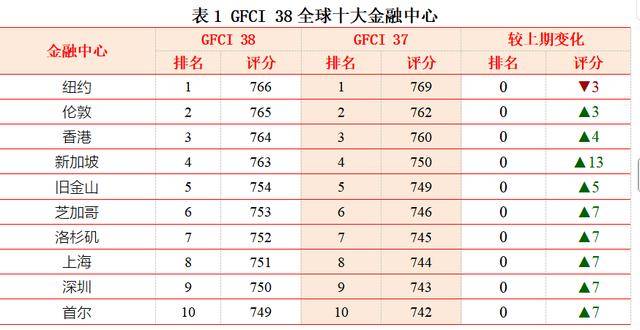
Core Insights - The 38th Global Financial Centre Index (GFCI 38) report was jointly released by Z/Yen Group and the China (Shenzhen) Comprehensive Development Research Institute, ranking Shenzhen 9th overall and 2nd in the fintech sector, marking its best performance to date [1][3]. Group 1: Overall Rankings - The GFCI report evaluated 120 financial centers, with the top ten ranked as follows: New York, London, Hong Kong, Singapore, San Francisco, Chicago, Los Angeles, Shanghai, Shenzhen, and Seoul [1][2]. - The rankings of the top ten financial centers remained stable compared to the previous report, with a scoring gap of only 1 point among the top four centers [2]. Group 2: Financial Technology Rankings - In the fintech sector, Hong Kong ranked 1st, followed by Shenzhen in 2nd place, with both cities showing significant improvements in their scores [5]. - The report highlighted that the Greater Bay Area has three financial centers (Hong Kong, Shenzhen, and Guangzhou) in the top ten for fintech, showcasing the competitive landscape in this sector [3][5]. Group 3: Competitive Landscape - Shanghai and Shenzhen ranked in the top 15 globally across five categories: business environment, human capital, infrastructure, financial industry development level, and reputation, with Shenzhen achieving 5th in financial industry development [3]. - The report noted increasing competition from U.S. financial centers such as San Francisco, Chicago, and Los Angeles, which have impacted the rankings of Chinese financial hubs [3].

一张蓝图绘到底 厦门“两岸金融中心”发展实践与启示
Jin Rong Shi Bao· 2025-07-25 05:44
Core Insights - The development of financial centers is a long-term process that requires significant investment, patience, and continuous effort, as exemplified by the evolution of various global financial hubs [3][4][5] Group 1: Historical Context and Development Plans - The goal to establish Xiamen as a "Free Financial Zone" and one of Asia's financial centers was first proposed in the 1985-2000 development strategy, with a target year of 2050 [2] - The establishment of the "Cross-Strait Regional Financial Center" was approved 15 years ago, with significant support from national planning documents [2] - Xiamen's financial development is closely linked to cross-strait integration, with strategic planning aimed at making it a financial hub for Southeast Asia [5][9] Group 2: Key Contributions and Perspectives - Xi Jinping's early work in Xiamen laid the foundation for the city's financial strategy, emphasizing its unique positioning and mission [3] - Financial institutions are seen as the soul and ballast of financial centers, with their presence being crucial for success [6] - Various financial leaders, including representatives from major banks and investment firms, expressed commitment to supporting the development of the "Cross-Strait Financial Center" through innovative financial products and services [6][7] Group 3: Infrastructure and Future Vision - The "Cross-Strait Financial Center" aims to create a high-quality urban financial hub, with a focus on building a core area that reflects excellence and innovation [5][10] - The completion of landmark buildings for the financial center symbolizes Xiamen's open and inclusive spirit, contributing to its skyline and identity [9][10] - The center is positioned as a bridge connecting cross-strait and global economic activities, with a vision to enhance its international influence [8][9]
中国人民大学长江经济带研究院院长:投资四川就是投资未来
Sou Hu Cai Jing· 2025-07-18 07:50
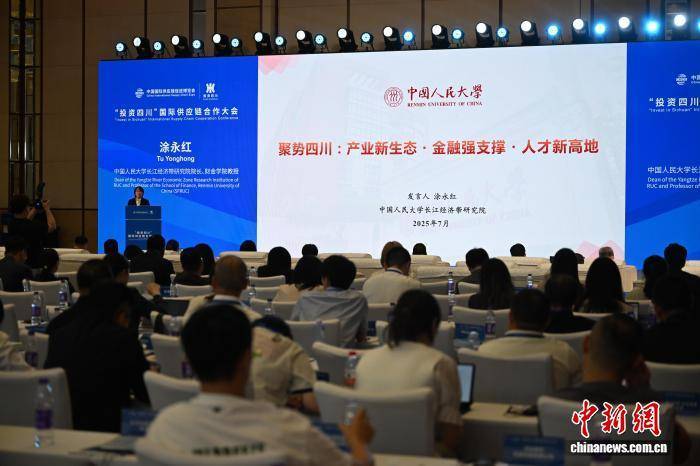
Core Viewpoint - Sichuan is positioned as a strong investment destination due to its industrial foundation, innovation ecosystem, and supportive policies, attracting significant international capital, particularly in the context of the Chengdu-Chongqing economic region [1][3]. Investment Environment - The Chengdu-Chongqing area is emerging as China's fourth economic growth pole, providing vast opportunities and platforms for investment [3]. - Sichuan's industrial ecosystem includes both traditional and emerging industries, with strong sectors such as electronic information, equipment manufacturing, food and textiles, energy and chemicals, advanced materials, and healthcare [3]. Financial Support - Chengdu ranks fourth among major Chinese cities in financial development, providing robust support for industrial growth and acting as an "accelerator" for innovation and green development [4]. - The financial sector in Sichuan is crucial for supporting technological innovation and sustainable development, with a strong emphasis on fostering a conducive environment for startups and young entrepreneurs [4][5]. Talent and Innovation - Sichuan offers a fertile ground for young talent to unleash creativity, supported by a trillion-level emerging industry and various industrial parks and high-tech zones [5]. - The region's favorable policies regarding funding, talent recognition, and business environment contribute to a strong sense of belonging for newcomers, promoting entrepreneurial aspirations [5].
市场分析:海湾国家罕见同步关闭领空 金融中心愿景遭遇现实冲击
news flash· 2025-06-23 19:27
Core Viewpoint - The simultaneous closure of airspace by the UAE, Bahrain, Qatar, and Kuwait is unprecedented, reflecting the Gulf region's struggle to transform into a financial hub while attracting foreign capital and talent [1] Group 1: Regional Security and Stability - The Gulf region is facing heightened fears among residents due to recent attacks, which have materialized into a reality as tensions escalate [1] - Videos showing missiles being intercepted over Doha's skyscrapers highlight the unusual and alarming security situation in the area [1] Group 2: Geopolitical Dynamics - The Gulf states, long-time allies of the U.S., have been working to improve relations with Iran to avoid conflict, yet they find themselves caught between U.S. and Iranian interests [1] - Allowing Iran to retaliate in Qatar may be seen as a strategy by Gulf states to absorb potentially more dangerous reactions from the region [1]
英国Z/Yen集团首席执行官麦克·沃德:金融中心在全球面临的关键问题中扮演着重要角色
news flash· 2025-06-19 13:43
Core Insights - The importance of financial centers in the global economy and the multiple challenges they face were emphasized by Mike Wardle, CEO of Z/Yen Group, during the CLF50 Summer Conference [1] Group 1 - Financial centers play a crucial role in driving industrial transformation and innovation in products and services [1] - They provide essential funding, skills, and resources necessary for global development [1]