
金融机构客户尽职调查

Search documents
2026年1月起,这些新规将影响大家的生活
Sou Hu Cai Jing· 2026-01-02 11:59
Domestic Regulations - From January 1, 2026, China will implement a temporary import tariff lower than the most-favored-nation rate on 935 items, including key components, advanced materials, and energy resources [2] - The new Value-Added Tax Law will take effect on January 1, 2026, consisting of 54 articles covering tax rates, taxable amounts, tax incentives, and collection management [4] - The Personal Information Export Certification Measures will be enforced starting January 1, 2026, aimed at protecting personal information rights and regulating cross-border data flow [5] - A one-time credit repair policy will be implemented on January 1, 2026, allowing for automatic adjustments of overdue records under specific conditions, which will not appear on personal credit reports [6][18] - The revised National Common Language and Writing Law will come into effect on January 1, 2026, promoting the use of standardized language and writing across the country [7][14] - The revised Civil Case Cause Regulations will also take effect on January 1, 2026, expanding the scope of legal causes to include data and virtual property [8] International Developments - Mexico will increase import tariffs on non-free trade partners starting January 1, 2026, affecting a wide range of products including automotive parts, textiles, and plastics [8] - Germany will raise child benefits by 4 euros per month starting January 2026, bringing the total to 259 euros [9]


新规来了!取消“个人存取现金超5万元需登记”规定
Yang Shi Xin Wen· 2025-11-29 13:52
Core Points - The new regulation eliminates the requirement for banks to register the source of funds for cash withdrawals exceeding 50,000 yuan, aligning with the previous draft [1] - Banks will no longer apply a uniform questioning approach for all customers during withdrawals; instead, they will assess risk levels to determine the necessity of further inquiries [1] - In cases of high money laundering risk, banks are mandated to conduct enhanced investigations to understand the source and purpose of funds, while low-risk situations will be subject to simplified measures [1]
《金融机构客户尽职调查和客户身份资料及交易记录保存管理办法》自2026年起施行
Zheng Quan Ri Bao Wang· 2025-11-28 12:29
Core Points - The People's Bank of China has announced the implementation of the "Management Measures for Customer Due Diligence and Customer Identity Data and Transaction Record Keeping" effective from January 1, 2026 [1] - Financial institutions are required to adhere to the principle of "Know Your Customer" and must identify and verify the identity of customers and their beneficial owners [1] - Institutions must continuously monitor and assess the overall status and transaction activities of customers to understand risks related to money laundering and terrorist financing [1] Summary by Sections - **Regulatory Framework** - The new management measures were approved during the 14th executive meeting of the People's Bank of China on October 11, 2025, and have received consent from the National Financial Regulatory Administration and the China Securities Regulatory Commission [1] - **Due Diligence Requirements** - Financial institutions must take appropriate due diligence measures based on customer characteristics and the nature and risk of transaction activities [1] - Enhanced due diligence measures are required for customers with higher risks of money laundering and terrorist financing, while simplified measures can be applied for lower-risk customers [1] - **Record Keeping and Data Management** - Institutions are mandated to securely, accurately, completely, and confidentially maintain customer identity data and transaction records [1] - The records must be sufficient to reconstruct each transaction and provide necessary information for due diligence, transaction monitoring, investigation of suspicious activities, and handling of money laundering and terrorist financing cases [1]
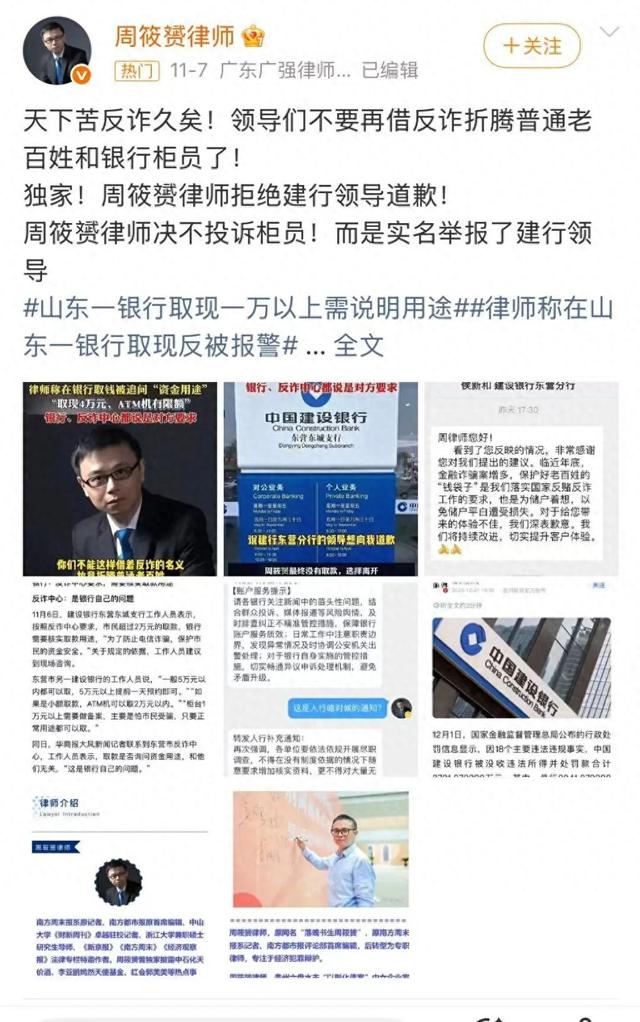
“取现1万以上要扫码报备,现场核实”| 实测多家银行取款门槛
Xin Lang Cai Jing· 2025-11-11 12:41
Core Viewpoint - Recent incidents of banks questioning the purpose of cash withdrawals below 50,000 yuan in Dongying, Shandong, have raised public concern about the implementation of anti-fraud measures in banking practices [1][3] Group 1: Regulatory Changes - The People's Bank of China, along with other financial regulatory bodies, has proposed a new draft regulation that aims to relax the previous requirement for cash withdrawals over 50,000 yuan to disclose the source and purpose of funds, effective from August 4, 2025 [4][10] - The previous regulation, which mandated that cash transactions over 50,000 yuan be documented for their source and purpose, was met with criticism and is now being reconsidered to balance fraud prevention with customer convenience [9][11] Group 2: Regional Variations in Banking Practices - A survey conducted across various provinces revealed significant discrepancies in the requirements for cash withdrawals, with some banks enforcing strict verification processes for amounts as low as 10,000 yuan [5][6] - In Dongying, banks like the Industrial and Commercial Bank of China and China Construction Bank have implemented stringent measures, such as requiring identification and purpose verification for withdrawals exceeding 20,000 yuan [6][8] - Conversely, some banks in regions like Anhui and Zhejiang have higher thresholds for questioning the source of funds, with some not requiring any verification for withdrawals below 50,000 yuan [7][8] Group 3: Impact on Customers - The stringent measures are primarily aimed at protecting elderly customers from fraud, as there have been numerous cases of scams targeting this demographic [6][7] - The inconsistency in withdrawal policies across different regions may lead to confusion and frustration among customers, highlighting the need for clearer guidelines from regulatory authorities [5][6]

从“普遍登记”到“精准风控”,单笔存取超5万元或将放宽登记限制
Sou Hu Cai Jing· 2025-08-12 13:44
Core Viewpoint - The People's Bank of China, along with the National Financial Regulatory Administration and the China Securities Regulatory Commission, has released a draft regulation that removes the strict requirement for financial institutions to register the source or purpose of cash transactions exceeding 50,000 yuan, which was part of the 2022 regulatory framework [1][2]. Group 1 - The draft regulation has been open for public consultation since August 4, with a deadline for feedback set for September 3 [1]. - The previous regulation, introduced in January 2022, faced significant public controversy and was postponed due to technical reasons before its intended implementation [1]. - The central bank indicated that cash transactions over 50,000 yuan accounted for only about 2% of all cash transactions, suggesting limited impact on the majority of customers [1]. Group 2 - The removal of the 50,000 yuan cash source or purpose registration does not imply a relaxation of anti-money laundering regulations [2]. - Financial institutions are still required to conduct due diligence based on customer characteristics and the nature of transactions, ensuring a balanced approach to risk management [2]. - The Anti-Money Laundering Law, effective from January 1, emphasizes risk-based customer due diligence, aligning with the new draft regulation [2].
央行等三部门:金融机构应当了解客户及信托业务性质、所有权和控制权结构
Bei Jing Shang Bao· 2025-08-04 12:08
Core Points - The People's Bank of China, the National Financial Regulatory Administration, and the China Securities Regulatory Commission have released a draft regulation for public consultation regarding the management of customer due diligence and the preservation of customer identity information and transaction records [1] Group 1: Regulatory Framework - The draft regulation requires trust companies to identify and verify the identity of the trustor when establishing a trust or transferring trust beneficiary rights [1] - Financial institutions must understand the source of trust assets and maintain basic identity information of the trustor and beneficiary, including copies of valid identification documents [1] Group 2: Client Identification Requirements - For clients that are legal entities or non-legal organizations, or when the funds are trust funds, financial institutions must understand the nature of the client's business, ownership, and control structure [1] - Institutions are required to take reasonable measures to verify the identity of the ultimate beneficial owners of the clients [1] Group 3: Information Gathering - Financial institutions must obtain the name, founding agreement documents, and the name and address of the trust manager when dealing with trust funds [1] - In cases where the registered location and the main operating location of the manager differ, the main operating location should be used for identification [1] - For entities registered or operating overseas, at least the country or region information must be identified and recorded [1]