
金融法立法

Search documents
金融法草案向社会公开征求意见
证券时报· 2026-03-20 09:42
Core Viewpoint - The draft of the Financial Law aims to establish a comprehensive legal framework for China's financial sector, enhancing regulation, preventing risks, and promoting high-quality financial development, in line with the principles of socialism with Chinese characteristics [1][2]. Group 1: Overall Requirements and Objectives - The draft emphasizes the centralized leadership of the Communist Party over financial work and aims to build a financial power that supports the modernization of the Chinese nation [2]. - It highlights the importance of a modern central banking system, clarifying the roles of the central bank and improving monetary policy frameworks [2][3]. Group 2: Regulation and Compliance - Financial institutions will be subject to full-cycle management regarding entry, operation, and exit, with strict approval requirements for significant changes [2][3]. - The draft aims to enhance the standardization of financial products and services, ensuring compliance and addressing issues like financial fraud [2][3]. Group 3: Financial Market and Infrastructure - The draft outlines the basic functions and trading principles of financial markets, establishing mechanisms for stability and risk management [2][3]. - It emphasizes the need for a robust financial infrastructure that supports registration, custody, and transaction services, ensuring safety and efficiency [30][31]. Group 4: Risk Management and Legal Accountability - A comprehensive financial risk disposal mechanism is proposed, focusing on market-oriented and legal principles to prevent systemic risks [3][4]. - The draft increases penalties for illegal activities in the financial sector, aiming to enhance accountability and compliance [4][58]. Group 5: Financial Development and Security - The draft encourages the development of various financial sectors, including technology finance and green finance, to support national strategies and high-quality economic development [52][53]. - It aims to strengthen the financial security framework, including anti-money laundering measures and the protection of financial data [54][55].

金融法草案向社会公开征求意见
证监会发布· 2026-03-20 09:16
Core Viewpoint - The draft of the Financial Law aims to strengthen financial regulation, prevent and resolve financial risks, and promote high-quality financial development in China, reflecting the leadership of the Communist Party and the principles of Xi Jinping's thoughts on socialism with Chinese characteristics [2][3]. Summary by Sections Section 1: Overall Requirements for Financial Work - The draft emphasizes the centralized and unified leadership of the Communist Party over financial work and aims to establish a financial power that supports the modernization of the Chinese nation [3]. Section 2: Central Bank System - It outlines the need to build a modern central bank system, clarifying the central bank's functions and improving the monetary policy framework to maintain the stability of the RMB and the financial system [3]. Section 3: Financial Institutions - The draft proposes full-cycle management of financial institutions, requiring approval for the establishment and significant changes of financial institutions and their branches [4]. Section 4: Financial Products and Services - It aims to enhance the compliance management of financial products and services, ensuring they meet the diverse needs of the real economy and the public [4]. Section 5: Financial Market System - The draft clarifies the basic functions and trading principles of financial markets, establishing a stable mechanism for financial markets and risk management for financial infrastructure [4]. Section 6: Financial Regulation - It defines the regulatory responsibilities across various financial sectors and establishes a comprehensive regulatory mechanism to protect consumer and investor rights [4]. Section 7: Financial Risk Management - The draft emphasizes a market-oriented and legal approach to risk management, aiming to prevent systemic financial risks [4]. Section 8: High-Quality Financial Development - It focuses on improving the efficiency of financial resource allocation and enhancing the financial security framework, while promoting the construction of a credit system and anti-money laundering measures [4]. Section 9: Legal Responsibilities - The draft proposes increasing penalties for illegal activities in the financial sector to strengthen institutional constraints [4]. Section 10: Legislative Process - The public consultation process for the draft is a significant practice of scientific, democratic, and lawful legislation, aimed at improving the quality of financial law and enhancing regulatory effectiveness [5].
金融法草案入围国务院2025年度立法计划
Bei Jing Shang Bao· 2025-05-14 15:56
Core Points - The State Council has released the 2025 Legislative Work Plan, which includes 16 proposed laws for review by the National People's Congress Standing Committee, such as the Medical Security Law and the Food Safety Law [1][3] - The plan emphasizes the need for timely legislation to support comprehensive reforms and to modify or abolish outdated laws that do not meet current development needs [1][3] Legislative Proposals - The plan includes proposals for laws related to high-quality development and the socialist market economy, such as the National Development Planning Law and the Banking Supervision Law [3] - It also outlines the need for laws to strengthen government construction and promote lawful administration, including the People's Police Law and the Petition Law [3][4] Focus on Education and Culture - The plan proposes revisions to laws related to education and culture, including the Trademark Law and the Teacher Law, to support the strategy of building a strong socialist cultural nation [4][5] National Security and Foreign Relations - The plan includes proposals for laws aimed at enhancing national security, such as the Food Safety Law and the Prison Law, as well as laws to improve foreign legal frameworks, including the Foreign Trade Law [5] Artificial Intelligence Legislation - The plan highlights the advancement of legislation for the healthy development of artificial intelligence, building on previous legislative efforts and addressing challenges in intellectual property rights related to AI-generated works [7][8] - Experts suggest that AI legislation will balance technological innovation with social governance, clarifying responsibilities and enhancing international cooperation [9]
全国人大常委会2025年度立法工作计划公布,金融法安排初次审议
Di Yi Cai Jing· 2025-05-14 09:10
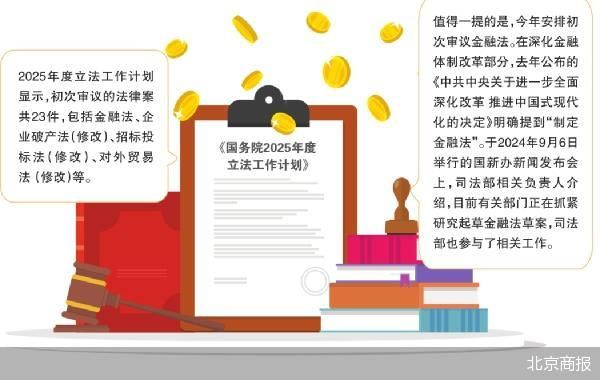
Legislative Work Plan Overview - The National People's Congress (NPC) Standing Committee has announced the legislative work plan for 2025, which includes 14 bills for continued review and 23 bills for initial review [2][3] Continued Review Bills - The 14 bills for continued review include significant laws such as the Representative Law (amendment), Private Economy Promotion Law, Infectious Disease Prevention Law (amendment), and Financial Stability Law [2][3] Initial Review Bills - The 23 bills for initial review encompass a wide range of topics, including the Ecological Environment Code, National Development Planning Law, and Financial Law, indicating a focus on environmental and financial regulations [3][4] Financial Law Development - The Financial Law is highlighted as a crucial piece of legislation aimed at providing a foundational legal framework for financial activities, addressing existing legislative gaps and regulatory blind spots [4] Legislative Clean-up Initiatives - The NPC Standing Committee plans to initiate a comprehensive legal clean-up in 2025 to address inconsistencies and improve the legal framework, ensuring a more coherent legal system [6] Strengthening Review Mechanisms - The legislative work plan emphasizes enhancing the record review system, including the establishment of a unified platform for legal documents and improved coordination among relevant agencies [5]