
钙钛矿电池产业化

Search documents
东兴证券晨报-20260224
Dongxing Securities· 2026-02-24 09:35
Core Insights - The report highlights the structural expansion of the rubidium and cesium market driven by the increasing penetration of perovskite solar cells and the development of space photovoltaics [7][12][13] Industry Overview - Perovskite solar cells (PSCs) are identified as a new type of solar cell with advantages such as low cost, high efficiency, lightweight, and flexibility compared to traditional silicon cells [7] - The report predicts that the penetration rate of perovskite solar cells in the photovoltaic market will rise significantly, from 1.3% in 2025 to 30% by 2030, driven by their cost-effectiveness and efficiency [9][12] Market Dynamics - The demand for rubidium and cesium is expected to grow substantially, with a projected CAGR of 115% from 2025 to 2030, as the perovskite battery market expands [12][16] - The report estimates that global demand for rubidium will increase from 37 tons in 2025 to 1696 tons by 2030, correlating with the anticipated growth in perovskite solar cell production [12][16] Technological Advancements - The stability of perovskite solar cells is a key challenge, but the addition of rubidium and cesium is expected to enhance their performance and longevity [8] - Flexible perovskite solar cells are anticipated to find applications in various fields, including building-integrated photovoltaics (BIPV), wearable devices, and automotive power generation [10][11] Future Outlook - The report suggests that the period from 2026 to 2027 will be crucial for the industrialization and validation of perovskite solar cells, with significant advancements expected in their application in space photovoltaics [13][14] - The integration of perovskite solar cells in space applications is projected to drive demand for rubidium significantly, with estimates indicating a potential need for 220 tons by 2030 due to space solar power initiatives [15][16]






钙钛矿电池实现双重突破!5只概念股年内跑出翻倍行情
Zheng Quan Shi Bao Wang· 2025-12-06 04:28
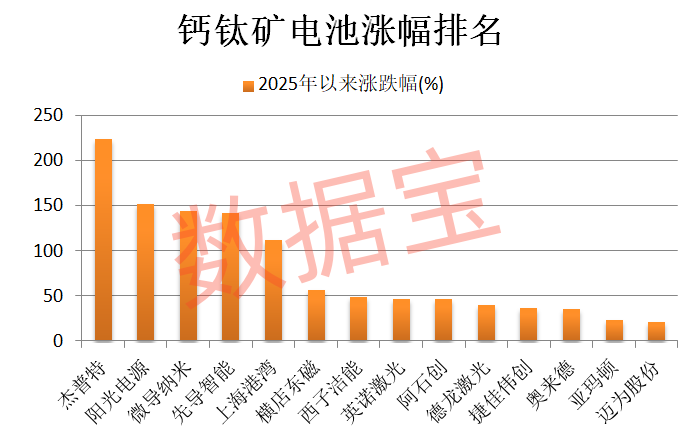
Core Viewpoint - The research team from Nanjing University, led by Professor Tan Hairen, has made significant advancements in the production of perovskite solar cells, overcoming challenges related to the preparation of green solvents and uniformity in film production, which enhances both the photoelectric conversion efficiency and long-term reliability of the components [1] Industry Summary - The breakthrough is considered a key step towards the commercialization of perovskite solar cells, addressing critical bottlenecks in the industry [1] - Perovskite battery concept stocks have shown a mixed performance in the secondary market, with an average increase of 29.25% year-to-date, significantly outperforming the Shanghai Composite Index [1] - Five stocks have seen their prices double this year, including Jieput, Sunshine Power, Weidao Nano, Xiandao Intelligent, and Shanghai Port [1] - Over half of the 20 concept stocks have underperformed compared to the Shanghai Composite Index, with seven stocks experiencing a cumulative decline of over 10%, including Baoxin Technology, ST Quanwei, Dongfang Risheng, Nengzhiguang, Jinko Energy, Zerun New Energy, and Junda Co. [1]

钙钛矿电池光暗交替环境下光电转化效率提高
Ke Ji Ri Bao· 2025-09-08 00:13
Core Insights - A research team led by Huang Wei and Qin Tianshi from Sun Yat-sen University has made significant advancements in perovskite solar cells, addressing key failure mechanisms during real-world day-night cycling operations and developing a lithium-free doping technology that enhances the commercialization potential of these cells [1][2]. Group 1: Research Findings - The performance of perovskite solar cells has seen remarkable improvements, with energy conversion efficiency surpassing 26% [1]. - A major challenge for commercialization is the long-term stability of these cells, particularly their durability in real outdoor environments, as existing tests often do not simulate actual day-night cycles [1]. - The research team discovered that lithium ions migrate from the hole transport layer to the perovskite layer during light-dark cycling, leading to a phase transition that causes rapid performance degradation [1]. Group 2: Innovative Solutions - The team introduced a novel lithium-free dopant, methylammonium bis(trifluoromethanesulfonyl)imide (MATFSI), which replaces the traditional lithium salt LiTFSI in the hole transport layer [2]. - Devices using MATFSI achieved a power conversion efficiency of 26.1% (certified efficiency of 25.6%), with significantly improved hole mobility and enhanced charge extraction capabilities [2]. - This innovation demonstrates substantial advantages in simulated real-world light-dark cycling and voltage switching, marking a breakthrough in stability for practical applications [2]. Group 3: Future Directions - The research has been jointly completed by teams from Nanjing Tech University and Sun Yat-sen University and has received patent protection [2]. - The next steps involve advancing the technology towards practical applications [2].