
钠电池产业化

Search documents
钠电池迈向规模化应用阶段 多个细分应用场景有望进一步渗透
Zheng Quan Ri Bao· 2026-02-10 15:41
Core Viewpoint - Changan Automobile and CATL have launched a global sodium battery strategy, introducing the world's first mass-produced sodium battery passenger vehicle, set to be released in mid-2026, marking a significant step towards the commercialization of sodium batteries [1] Group 1: Sodium Battery Development - Sodium batteries utilize sodium ions as charge carriers and offer advantages over lithium batteries, including abundant resources, lower extraction costs, wider temperature ranges, fast charging capabilities, and lower thermal runaway risks [1] - By 2025, China's sodium-ion battery production is expected to reach 3.45 GWh, a 96% year-on-year increase, with total production of sodium battery cathodes projected to be 11,000 tons, up 101% [1] - CATL plans to apply sodium batteries on a large scale in various sectors, including battery swapping, passenger vehicles, commercial vehicles, and energy storage by 2026 [1] Group 2: Industry Insights - EVE Energy has successfully transitioned its first large-capacity sodium-ion battery energy storage system into commercial operation, marking a key breakthrough in new energy storage technology [1] - EVE Energy's sodium battery headquarters project is set to commence in December 2025, aiming to become a leading sodium battery industrialization base in China, with a 2 GWh production capacity to address market supply gaps [2] - The sodium battery industry is currently in the late stage of commercialization, moving towards growth, with completed technical validations and rapid capacity expansion [2][3] Group 3: Market Dynamics - The rising prices of lithium battery materials are a core driver for the development of sodium batteries, with expectations that sodium battery costs could drop below 0.40 yuan/Wh by 2026, nearing the price level of lithium iron phosphate cells [3] - Sodium batteries are expected to find significant applications in energy storage due to their wide temperature range, high safety, and low cost advantages, particularly in low-end applications where energy density requirements are not high [3] - Despite entering the commercialization phase, the sodium battery industry faces challenges related to technology, costs, supply chains, and market recognition, including high costs of core materials and a lack of unified manufacturing standards [3]



钠电池商业化进程提速多元场景落地激活产业链
Zhong Guo Zheng Quan Bao· 2026-02-09 20:25
Core Viewpoint - Changan Automobile and CATL have launched the world's first mass-produced sodium battery passenger vehicle, marking the beginning of large-scale application of sodium batteries in the passenger car sector [1][2]. Industry Development - Sodium batteries have entered a new stage of maturity and technological iteration after five years of industrial exploration, with costs stabilizing and a significant acceleration in industry layout [1]. - CATL's sodium battery has achieved a maximum energy density of 175Wh/kg and over 90% capacity retention at -40°C, with future electric range potentially reaching 500-600 km [2]. - The sodium battery's advantages include abundant resources, wide distribution, and reduced reliance on scarce minerals like lithium and cobalt, enhancing supply chain security [2]. Market Dynamics - The sodium battery is currently in the initial stage of commercialization, with lower cost and energy density compared to lithium batteries [3]. - It is expected that within 2-3 years, sodium battery energy density will reach levels comparable to lithium iron phosphate batteries, with significant cost advantages emerging when lithium prices exceed 120,000 yuan/ton [3]. - By the second half of 2026, sodium batteries are projected to achieve comprehensive competitiveness in terms of cost, even if lithium prices remain stable [3]. Technological Coexistence - The sodium battery industry is still in its early development phase, but its direction is clear, with expectations for it to play a significant role in energy transformation [4]. - The sodium battery is anticipated to enter a year of large-scale application in 2026, with promising prospects for industry scale expansion [4]. Industry Collaboration - Companies across the sodium battery supply chain are actively pursuing technological research, capacity construction, and strategic partnerships to accelerate their presence in this field [4][5]. - Notable developments include the establishment of a production base for sodium battery materials and ongoing collaborations with major players like CATL [5]. - Companies like Electric Science Blue Sky and Puli Te are advancing their sodium battery initiatives, with plans for mass production and increased output expected in the coming years [5].
钠电池商业化进程提速 多元场景落地激活产业链
Zhong Guo Zheng Quan Bao· 2026-02-09 20:21
Core Viewpoint - Changan Automobile and CATL have launched the world's first mass-produced sodium battery passenger vehicle, marking the beginning of large-scale application of sodium batteries in the passenger car sector [1][2]. Group 1: Sodium Battery Development - Sodium batteries have transitioned from laboratory research to large-scale application, showing advantages such as abundant resource availability, wide temperature range, long cycle life, and high safety [1]. - The sodium battery industry has seen accelerated development, with significant cost reductions and improved product maturity over the past five years [2]. - CATL's sodium battery, with a maximum energy density of 175Wh/kg, has demonstrated over 90% capacity retention in extreme cold conditions, with future electric ranges potentially reaching 500km to 600km [2]. Group 2: Market Dynamics and Competitive Landscape - The sodium battery market is expected to reach a scale of 100GWh by 2028, transitioning from a commercialization phase to a large-scale era [5]. - Sodium batteries are anticipated to achieve competitive cost advantages by 2026, especially if lithium prices remain stable [4]. - The unique application value of sodium batteries in cold regions is highlighted, with expectations for various technologies to coexist and complement each other in the energy transformation [5]. Group 3: Industry Collaboration and Capacity Expansion - Companies across the sodium battery supply chain are actively enhancing their positions through technology development, capacity building, and strategic partnerships [6]. - ZHONGDA Energy has established a production base for sodium iron phosphate materials, while other companies are also making strides in sodium battery applications in electric two-wheelers and energy storage systems [6]. - PULIT has achieved mass production of sodium batteries and is expanding its capacity, with new production lines expected to come online in the third quarter of this year [7].
全球首款钠电池量产乘用车上市!
DT新材料· 2026-02-05 16:07
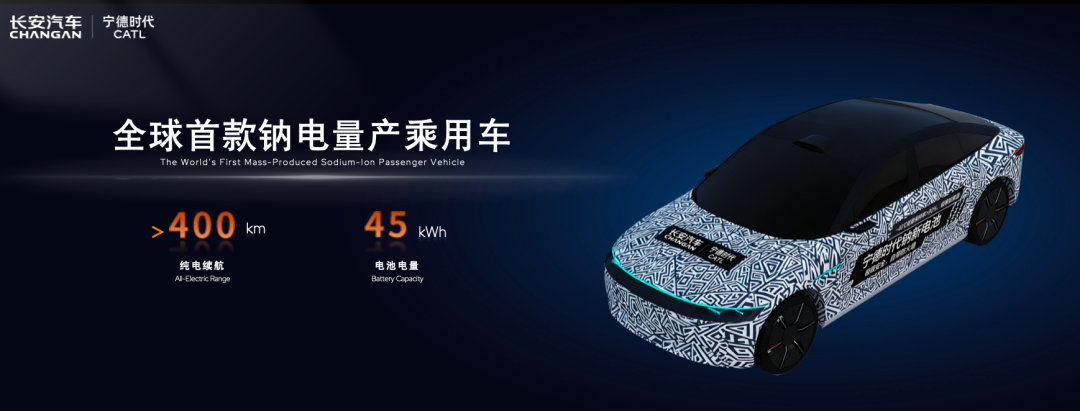
Core Viewpoint - The article highlights the launch of the world's first sodium battery mass-produced passenger vehicle by Changan Automobile, expected to be available in mid-2026, marking a significant milestone in the sodium battery market for passenger cars [1][3]. Group 1: Sodium Battery Development - 2026 is identified as the year for large-scale application of sodium batteries in the passenger vehicle market, with Changan Automobile being the first major automaker to fully embrace sodium batteries [3]. - Changan's brands, including Avita, Deep Blue, Qiyuan, and Gravity, will utilize CATL's sodium battery technology, which is branded as "Sodium New" [3]. - CATL plans to apply sodium batteries across various sectors, including passenger vehicles, commercial vehicles, and energy storage, establishing a dual development trend of "sodium-lithium" [3]. Group 2: Technical Advantages of Sodium Batteries - Sodium batteries are not a downgraded alternative to lithium batteries; they offer superior low-temperature performance and safety features, addressing concerns of some users regarding electric vehicles [3]. - For instance, the sodium battery-equipped vehicle can maintain a discharge power nearly three times higher than conventional lithium iron phosphate models at -30°C, with over 90% capacity retention at -40°C [4]. - The sodium battery's energy density reaches 175 Wh/kg, which is among the highest in the industry, and it is expected that the pure electric range could increase to 500 km or even 600 km in the future [6]. Group 3: Market Potential and Growth - The sodium battery industry is entering a rapid development phase, with global shipments projected to reach 9 GWh by 2025, a 150% increase year-on-year [6]. - By 2030, the global market for sodium batteries in energy storage is expected to reach 580 GWh, while the automotive sector's market size will exceed 410 GWh [6]. - The average price of sodium cells is anticipated to decrease from approximately 0.52 yuan/Wh in 2025 to 0.25 yuan/Wh by 2030, indicating a trend towards cost-effectiveness [6]. Group 4: Strategic Partnerships and Infrastructure - CATL's sodium battery technology is designed to be adaptable across multiple brands, enhancing flexibility and performance for Changan's upcoming sodium battery models [7]. - Since starting research on sodium batteries in 2016, CATL has invested nearly 10 billion yuan and tested around 300,000 battery cells by 2025 [7]. - CATL plans to establish over 3,000 chocolate battery swap stations across more than 140 cities in China by 2026, facilitating quick energy replenishment for users [7].

长安汽车携手宁德时代发布钠电战略,全球首款钠电量产乘用车亮相钠电池核心特性凸显钠电池迎来产业化关键窗口期
Zhong Guo Ji Jin Bao· 2026-02-05 07:13
Core Viewpoint - Changan Automobile, in collaboration with CATL, has unveiled the world's first sodium battery mass-produced passenger vehicle, expected to launch in mid-2026 [2][4]. Group 1: Sodium Battery Characteristics - Sodium batteries are gaining attention as an alternative to lithium batteries, with CATL's chairman highlighting the resource advantages of sodium, which is 421 times more abundant in the earth's crust compared to lithium [5]. - The sodium battery's low-temperature performance and safety features address concerns regarding electric vehicles, with the first sodium battery vehicle demonstrating nearly three times the discharge power at -30°C compared to conventional lithium iron phosphate models [5][7]. - The sodium battery's energy density reaches 175Wh/kg, positioning it among the highest in the industry, and future advancements could increase electric range to 500-600 km [7]. Group 2: Market Potential and Growth - The sodium battery industry is entering a critical growth phase, with global shipments expected to reach 9GWh by 2025, marking a 150% year-on-year increase [8]. - By 2030, the global market for sodium batteries in energy storage is projected to reach 580GWh, while the automotive sector is expected to exceed 410GWh [8]. - CATL's sodium battery development began in 2016, with nearly 10 billion yuan invested by 2025, and the company plans to establish over 3,000 battery swap stations across more than 140 cities by 2026 [8].
钠电上车!万亿宁王,大动作
Zhong Guo Ji Jin Bao· 2026-02-05 07:12
Core Viewpoint - Changan Automobile and CATL have launched a sodium battery strategy, unveiling the world's first mass-produced sodium battery passenger vehicle, expected to hit the market in mid-2026 [1][3]. Group 1: Sodium Battery Development - 2026 is projected to be the year of large-scale application of sodium batteries in the passenger vehicle market, with Changan becoming the first major automaker to fully embrace sodium batteries [3]. - CATL's sodium battery brand, "Sodium New," will see extensive application across various sectors including passenger vehicles, commercial vehicles, and energy storage by 2026, marking a new trend of "sodium-lithium dual stars" [4]. - The sodium battery's core characteristics, such as high low-temperature performance and safety, address current user concerns regarding electric vehicles [7]. Group 2: Resource Availability and Market Potential - The rapid growth of electric vehicles has led to increased demand for lithium batteries, prompting battery manufacturers to focus on sodium resources, which are 421 times more abundant in the earth's crust compared to lithium [6]. - The global sodium battery shipment is expected to reach 9 GWh by 2025, representing a 150% year-on-year growth, with the market for sodium batteries in automotive applications projected to exceed 410 GWh by 2030 [10]. - The average price of sodium battery cells is anticipated to decrease from 0.52 yuan/Wh in 2025 to 0.25 yuan/Wh by 2030 [11]. Group 3: Performance and Technological Advancements - The sodium battery, when paired with CATL's third-generation CTP system, can achieve a pure electric range of over 400 km, with potential upgrades to 500 km or even 600 km in the future [8]. - The sodium battery's discharge performance in extreme cold conditions is significantly improved, with a power output nearly three times higher than conventional lithium iron phosphate models at -30°C [7]. - The sodium battery's energy density reaches 175 Wh/kg, placing it among the highest in the industry [8]. Group 4: Strategic Partnerships and Infrastructure - CATL's sodium battery technology is designed to be compatible with multiple brands, enhancing flexibility and performance for Changan's upcoming sodium battery models [12]. - CATL plans to establish over 3,000 rapid charging stations across more than 140 cities in China by 2026, facilitating quick energy replenishment for users [15].
20cm速递|钠电池产业化有望加速落地!创业板新能源ETF华夏(159368)近五日净流入超2200万元,同类费率最低
Mei Ri Jing Ji Xin Wen· 2026-02-02 06:00
Core Viewpoint - The article discusses the performance of the ChiNext New Energy ETF (159368) and highlights the growth potential of sodium batteries in the energy storage market, emphasizing their cost advantages and safety features compared to lithium batteries [1]. Group 1: ETF Performance - On February 2, the ChiNext New Energy ETF (159368) experienced a decline of 1.19%, while its holdings, including Jing Sheng Electric and Ying Jie Electric, saw gains of over 6% and 4% respectively [1]. - Over the past five days, the ChiNext New Energy ETF (159368) has seen a net inflow of over 22 million yuan [1]. Group 2: Sodium Battery Market - By 2025, sodium batteries are expected to achieve large-scale applications, with energy storage being the largest market, accounting for over 50% of the total [1]. - The annual shipment volume of sodium batteries is projected to nearly double year-on-year, with further significant growth anticipated in 2026 according to Xinluo Sodium Battery forecasts [1]. - Dongguan Securities predicts that by 2026, the cost of sodium batteries may drop below 0.40 yuan/Wh, approaching the current price level of lithium iron phosphate cells, with potential for further reduction to below 0.3 yuan/Wh due to technological advancements and economies of scale [1]. - Sodium batteries offer differentiated advantages over lithium batteries, including high safety, wide temperature range, and high discharge rates [1]. Group 3: ChiNext New Energy Index - The ChiNext New Energy Index primarily covers the new energy and electric vehicle industries, encompassing various sub-sectors such as batteries and photovoltaics [1]. - The ChiNext New Energy ETF (159368) is characterized by high elasticity, with a maximum fluctuation limit of 20%, and has the lowest fee structure, with a total management and custody fee of only 0.2% [1]. - The ETF has a nearly 90% allocation to energy storage and solid-state batteries, aligning with current market trends [1].

电池新技术系列报告之钠电池:产业化破局在即,多场景有望加速渗透
Dongguan Securities· 2026-01-30 08:46
Investment Rating - The report maintains an "Overweight" rating for the sodium battery industry, indicating a positive outlook for investment opportunities in this sector [1]. Core Insights - Sodium batteries are positioned as a significant supplement to lithium batteries, driven by the rising costs of lithium materials and the abundant availability of sodium resources, particularly in China [3][12]. - The report anticipates that sodium battery costs will drop below 0.40 CNY/Wh by 2026, approaching the current price levels of lithium iron phosphate batteries, with further reductions expected due to technological advancements and economies of scale [12][19]. - The sodium battery industry is expected to see accelerated commercialization, with significant growth in applications across energy storage, electric two-wheelers, and other sectors by 2025 [3][51]. Summary by Sections 1. Introduction to Sodium Batteries - Sodium batteries utilize sodium ions (Na+) as charge carriers and share structural similarities with lithium batteries, making them a viable alternative [10]. - They offer differentiated advantages such as resource abundance, lower costs, high safety, wide temperature range, and superior charge/discharge rates compared to lithium batteries [11][12]. 2. Multi-Technology Pathways and Rapid Technological Iteration - The sodium battery industry is characterized by multiple technological routes, including layered oxides, polyanions, and Prussian blue materials, with polyanion technology expected to dominate by 2025 [39]. - The supply chain for sodium batteries is evolving, with a focus on reducing costs and improving performance through advancements in materials and manufacturing processes [24][44]. 3. Accelerated Commercialization of Sodium Batteries - The report highlights that sodium batteries will achieve significant market penetration in energy storage, light-duty applications, and start-stop power systems by 2025, with energy storage being the largest market segment [51][53]. - The production capacity for sodium batteries is projected to expand significantly, with an expected output of 11.7 GWh in 2026, nearly doubling from 2025 [62][63]. 4. Investment Recommendations - Companies that strategically position themselves in the core segments of the sodium battery supply chain are likely to benefit from the industry's growth [3].
冬天也能跑远路:雅迪华宇钠电破解电动车低温衰减难题
Sou Hu Wang· 2026-01-28 10:33
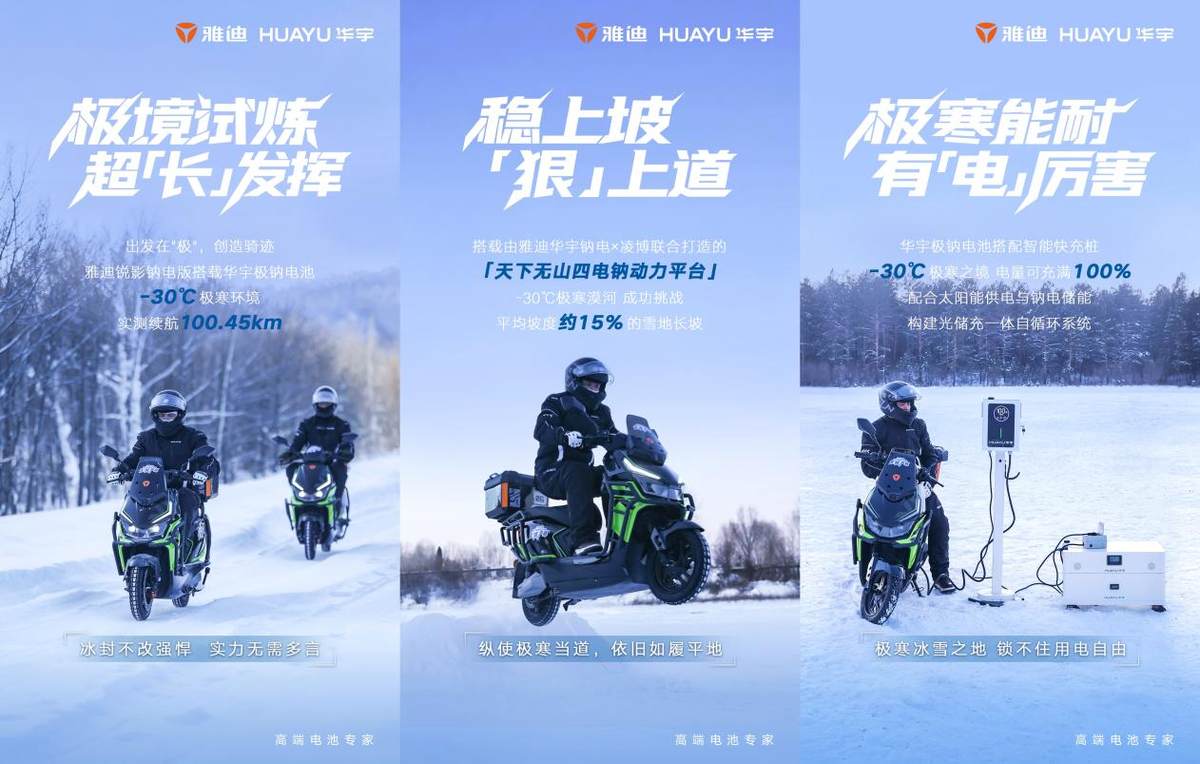
Core Viewpoint - Sodium batteries are emerging as a significant development direction in the new energy sector due to their outstanding low-temperature performance and cost advantages [1] Group 1: Industry Development - Leading companies in the industry, such as CATL and Yadi Huayu, are actively promoting the industrialization process of sodium batteries and accelerating their application in various scenarios [1] - Yadi Huayu's sodium battery has been recognized as a national high-tech enterprise, highlighting its research and development strength and contribution to the industry [13] Group 2: Performance Testing - The "Yadi Huayu Battery Mohe Extreme Cold Challenge" successfully tested the sodium battery in extreme cold conditions ranging from -35°C to -28°C, demonstrating impressive low-temperature performance [3] - The Yadi Ruiying sodium battery version achieved a comprehensive range of 100.45 kilometers in extreme cold conditions, with a discharge retention rate of approximately 92% [5] - In a low-temperature long slope power challenge, the Yadi Ruiying sodium battery version consistently completed five uphill tests, confirming stable power output under low friction conditions [7] Group 3: Charging Efficiency - The ultra-low temperature charging efficiency test showed that the Yadi Huayu sodium battery could charge from 35% to 100% in 10 minutes without any interruptions, demonstrating good adaptability to low temperatures [9] Group 4: Technological Innovation - Yadi Huayu's sodium battery products utilize high-performance hard carbon anode materials and patented sodium-ion formulations, achieving an energy density exceeding 145Wh/kg and ensuring multiple safety protections [11] - The company plans to promote large-scale application of sodium batteries by 2026, focusing on reducing user replacement costs through "lead-sodium compatibility" and actively entering the global energy storage market [15] Group 5: Future Outlook - Sodium batteries are set to initiate a new transformation in energy applications, with Yadi Huayu positioned to lead this process by enabling "fearless cold" mobility for the public [17]
钠离子电池:行则将至,未来可期
Changjiang Securities· 2026-01-06 09:07
Investment Rating - The report maintains a "Positive" investment rating for the sodium-ion battery industry [9] Core Insights - The sodium-ion battery technology has regained attention due to fluctuations in lithium prices and strategic moves by leading manufacturers, transitioning from a "technology reserve" to "scale commercialization" [5][17] - The sodium-ion battery benefits from low cost, abundant resources, and compatibility with industrialization factors, making it a promising new technology route [6][39] - The industry consensus has shifted from viewing sodium-ion batteries as substitutes for lithium-ion batteries to recognizing them as important complements [8] Summary by Sections Cost Drivers - Current cost estimates for sodium-ion battery materials are as follows: copper-iron-manganese system at 296.6 CNY/kWh, nickel-iron-manganese system at 398.1 CNY/kWh, and sodium iron phosphate system at 379.3 CNY/kWh, which are near the cost balance point of lithium iron phosphate [6][40] - The economic viability of sodium-ion batteries is enhanced by not using high-cost metals like lithium carbonate and copper, with estimated economic balance points depending on copper prices [41] Scene Expansion - Sodium-ion batteries are entering a phase of deep industrialization, expanding from niche applications to widespread market penetration, particularly in low-temperature and high-power scenarios [7][45] - They are positioned as cost-effective alternatives in applications where energy density is less critical, such as battery swapping and low-speed electric vehicles [7][45] - The technology is expected to play a significant role in the electric two-wheeler market and energy storage systems due to its cost advantages and resource endowment [7][45] Investment Recommendations - The report suggests focusing on the material segments of the sodium-ion battery supply chain, such as sodium-ion cathodes and aluminum foils, which are expected to see incremental expansion [8]


