
银行二永债

Search documents
2026银行二永债,交易为主下沉为辅
Xin Lang Cai Jing· 2025-12-04 10:08
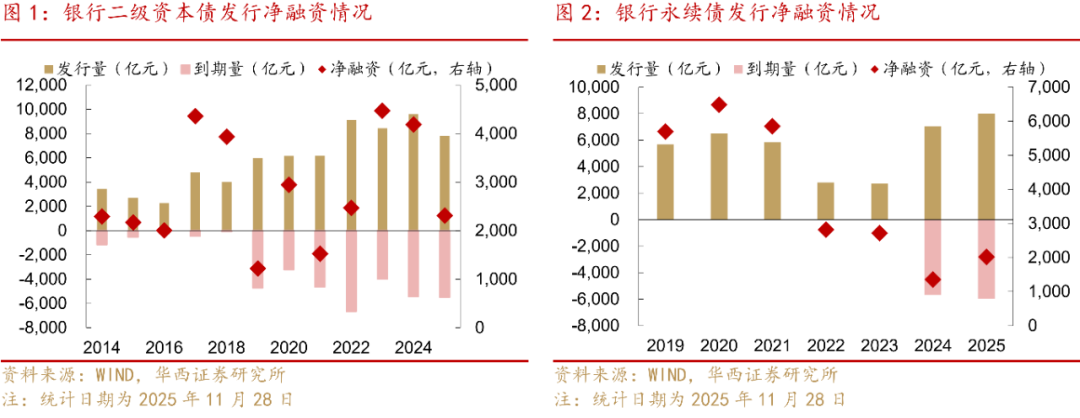
Group 1 - The core viewpoint of the articles indicates that the trading activity of bank perpetual bonds (二永债) has increased significantly in 2025, with daily transaction volumes and the proportion of these bonds in the overall credit bond market rising from 31% in 2024 to 39% in 2025 [1][21] - Major non-bank institutions, including funds, wealth management, insurance, and other asset management products, have increased their allocation to perpetual bonds, with net purchases reaching 325.8 billion, 386.5 billion, 43.2 billion, and 433.8 billion yuan respectively [1][21] - The demand for perpetual bonds may face pressure in 2026 due to structural impacts, particularly from new fund sales fee regulations that could lead to redemption pressures on short and medium-term bond funds [2][28] Group 2 - The net supply of perpetual bonds is expected to remain low, with state-owned banks showing stable issuance while smaller banks may continue to increase supply due to declining capital adequacy ratios [3][9] - The trading characteristics of perpetual bonds in 2025 show a "top and bottom" pattern in yield spreads, with slight downward adjustments in the 3-year and 5-year spreads, while the 10-year spreads have increased [4][11] - The trading environment for perpetual bonds has become more challenging, requiring institutions to engage in more frequent trading to enhance returns, especially as the yield spreads have narrowed [5][12] Group 3 - The performance of perpetual bonds has been differentiated, with short-term and low-grade bonds performing strongly while long-term bonds have lagged behind [16][17] - The insurance sector has shown a weaker demand for perpetual bonds in recent years, influenced by declining yields and the introduction of new accounting standards that affect the valuation of these bonds [37][38] - The overall market sentiment and trading dynamics for perpetual bonds are expected to be influenced by regulatory changes and market conditions, with potential opportunities arising from adjustments in fund management practices [28][33]

2026年银行二永债年度策略:供需两弱下的逆风局
Shenwan Hongyuan Securities· 2025-11-19 13:42
Core Insights - The report indicates a challenging environment for perpetual bonds in the banking sector, with both supply and demand expected to remain weak in 2026 [2][3] - The net supply of perpetual bonds is projected to stabilize at a low level, with significant contributions from TLAC bonds [2][3] - Demand for bank perpetual bonds is facing challenges due to regulatory changes and market conditions, impacting their attractiveness [2][3] Supply - The net supply of perpetual bonds has decreased significantly, with 2025's issuance at 1.38 trillion yuan, down from previous years, and net financing dropping to 363 billion yuan [8][12] - The supply is expected to remain low in 2026, with net financing projected to be around 400-500 billion yuan, characterized by a decline in large banks' issuance and an increase from smaller banks [2][3] - TLAC bonds are anticipated to provide some relief to the supply side, with a projected net supply of around 300 billion yuan in 2026 [2][3] Demand - Bank perpetual bonds continue to be a crucial component of the credit bond market, but demand is weakening due to regulatory changes and market dynamics [2][3] - The implementation of new accounting standards for insurance companies may reduce their investment capacity in perpetual bonds, although the overall impact is expected to be manageable [2][3] - The demand from banks for self-managed investments is likely to stabilize, while mutual funds may face challenges due to new fee regulations, impacting their allocation to perpetual bonds [2][3] Valuation - The report highlights the potential for a shift in the relative valuation of perpetual bonds due to weak supply and demand dynamics [3][3] - Credit spreads for perpetual bonds may face upward pressure if participation from funds and insurance companies diminishes, with projected spreads for 3-year AAA-rated bonds in the range of 25-60 basis points [3][3] - The valuation of different bond types is expected to diverge, with higher-grade bonds potentially facing upward pressure on spreads [3][3] Strategy - The report suggests a tactical approach to trading opportunities in high-grade bank perpetual bonds, with a focus on price differences between new and existing bonds [3][3] - For mid-sized banks' perpetual bonds, it is recommended to actively monitor value propositions while being cautious of non-redemption risks [3][3] - TLAC bonds are noted for their dual value in both allocation and trading, with a particular emphasis on floating rate bonds [3][3]
