
银行间外汇市场监管

Search documents
《银行间外汇市场管理规定》发布
Ren Min Ri Bao Hai Wai Ban· 2025-12-30 00:28
Core Viewpoint - The People's Bank of China is revising the regulations governing the interbank foreign exchange market to enhance supervision, promote high-quality development, and protect the rights of market participants, effective from February 1, 2026 [1] Summary by Relevant Sections Regulatory Framework - The new regulations aim to create a systematic regulatory framework that integrates existing rules and practices in the interbank foreign exchange market [1] Market Supervision - Enhanced supervision will cover various aspects including trading venues, qualification requirements, pricing standards, transaction clearing rules, information management, data services, and self-regulation [1] Market Stability - The regulations are designed to maintain the stable operation of the foreign exchange market and to standardize the rights and obligations of market infrastructure, domestic and foreign financial institutions, currency brokers, and financial information service providers [1] Principles of Operation - Market operations must adhere to principles of openness, fairness, justice, and good faith to protect the legitimate rights and interests of market participants [1] Development Support - The regulations will support the continuous enrichment of trading and clearing varieties, currencies, and methods in the foreign exchange market infrastructure, facilitating financial institutions in providing foreign exchange services to clients [1]
规范和发展外汇市场 《银行间外汇市场管理规定》出炉
Shang Hai Zheng Quan Bao· 2025-12-26 18:58
Core Viewpoint - The People's Bank of China has released new regulations for the interbank foreign exchange market to enhance market management, promote high-level openness, and ensure the protection of legal rights while mitigating risks, effective from February 1, 2026 [1][2] Group 1: Regulatory Framework - The new regulations aim to strengthen the supervision of the interbank foreign exchange market by clarifying requirements across various areas such as trading venues, qualification conditions, pricing norms, transaction clearing rules, information management, data services, and self-regulation, achieving comprehensive business oversight [1] - The regulations emphasize that transactions in the interbank foreign exchange market must adhere to principles of openness, fairness, justice, and good faith, prohibiting fraudulent activities, market manipulation, and insider trading that could disrupt market order and harm participants' legal rights [1] Group 2: Market Stability and Infrastructure - The regulations seek to maintain the stable operation of the foreign exchange market by standardizing the rights and obligations of market infrastructure, domestic and foreign financial institutions, currency brokers, and financial information service providers, while ensuring adherence to principles of openness, fairness, justice, and good faith [2] - Financial institutions are required to establish robust internal management systems and risk control mechanisms, implementing a separation of front, middle, and back office functions to enhance operational efficiency and security [2] Group 3: High-Quality Development - The regulations promote the high-quality development of the interbank foreign exchange market by encouraging the expansion of trading and clearing varieties, currencies, and methods based on market demand, facilitating financial institutions in providing foreign exchange services to clients [2] - The People's Bank of China and the State Administration of Foreign Exchange will continue to improve the management of the interbank foreign exchange market and deepen its development to ensure stable market operations [2]
央行发布银行间外汇市场管理新规 实现业务监管全覆盖
Sou Hu Cai Jing· 2025-12-26 15:52
Core Viewpoint - The People's Bank of China has issued new regulations to enhance the supervision of the interbank foreign exchange market, effective from February 1, 2026, aiming for comprehensive regulatory coverage and high-quality market development [1][1][1] Group 1: Regulatory Framework - The new regulations specify requirements for trading venues, qualification conditions, pricing norms, and transaction clearing rules for participants in the interbank foreign exchange market [1][1] - Financial institutions are mandated to establish robust internal management systems and risk control mechanisms, implementing a separation of front, middle, and back offices [1][1] Group 2: Market Operations - The regulations outline the rights and obligations of market infrastructure, domestic and foreign financial institutions, currency brokers, and financial information service providers, emphasizing principles of openness, fairness, justice, and good faith [1][1] - The regulations support the continuous enrichment of trading and clearing varieties, currencies, and methods in the foreign exchange market infrastructure, facilitating financial institutions in providing services to clients [1][1]
央行发布重要新规,2026年2月1日起实施
21世纪经济报道· 2025-12-26 14:24
Core Viewpoint - The People's Bank of China has issued the "Regulations on the Interbank Foreign Exchange Market" to standardize and develop the foreign exchange market, enhance high-level openness, prevent related risks, and better serve the real economy, effective from February 1, 2026 [1][4]. Group 1: Regulatory Framework - The new regulations are a comprehensive revision of the "Interim Regulations on the Interbank Foreign Exchange Market" issued in 1996, aiming to integrate existing systems into a systematic regulatory framework [4]. - The regulations strengthen supervision of the interbank foreign exchange market by clarifying requirements in areas such as trading venues, qualification conditions, pricing norms, trading and clearing rules, information management, data services, and self-regulation [4]. Group 2: Market Stability - The regulations aim to maintain the stable operation of the foreign exchange market by standardizing the rights and obligations of market infrastructure, domestic and foreign financial institutions, currency brokers, and financial information service providers [4]. - Participants in the interbank foreign exchange market are required to adhere to principles of openness, fairness, justice, and good faith to protect the legitimate rights and interests of market participants [4]. Group 3: High-Quality Development - The regulations promote high-quality development of the interbank foreign exchange market by supporting the continuous enrichment of trading and clearing varieties, currencies, and methods based on market demand [4]. - Financial institutions are encouraged to provide foreign exchange services to clients more conveniently [4]. Group 4: Compliance and Penalties - The regulations prohibit fraudulent activities, market manipulation, and insider trading that harm market order and participant rights [5]. - The People's Bank of China is authorized to calculate and publish the central parity rate of the Renminbi based on quotes from qualified financial institutions, with strict rules on information dissemination regarding the central parity rate [5][6].


央行发布新规,事关银行间外汇市场
2 1 Shi Ji Jing Ji Bao Dao· 2025-12-26 13:04
Core Viewpoint - The People's Bank of China (PBOC) has issued the "Regulations on the Interbank Foreign Exchange Market" to regulate and develop the foreign exchange market, enhance high-level openness, mitigate risks, and better serve the real economy, effective from February 1, 2026 [1][4]. Group 1: Regulatory Framework - The new regulations are a comprehensive revision of the "Interim Regulations on the Interbank Foreign Exchange Market" issued in 1996, reflecting the development and regulatory practices of China's interbank foreign exchange market [4]. - The regulations establish a systematic regulatory framework by integrating existing systems and clarifying requirements across various areas such as trading venues, qualification conditions, pricing norms, transaction clearing rules, information management, data services, and self-regulation [4]. Group 2: Market Stability and Integrity - The regulations aim to maintain the stable operation of the foreign exchange market by standardizing the rights and obligations of market infrastructure, domestic and foreign financial institutions, currency brokers, and financial information service providers, adhering to principles of openness, fairness, justice, and good faith [4]. - Prohibited behaviors include fraud, market manipulation, and insider trading that harm market order and participant rights [4]. Group 3: Development and Innovation - The regulations promote high-quality development of the interbank foreign exchange market by supporting the continuous enrichment of trading and clearing varieties, currencies, and methods based on market demand, facilitating financial institutions in providing foreign exchange services to clients [4]. - The PBOC is authorized to calculate, form, and publish the central parity rate of the Renminbi based on quotes from qualified financial institutions, with restrictions on sharing this information with other entities [4]. Group 4: Feedback and Implementation - The draft of the regulations was publicly solicited for opinions on August 21, 2025, receiving 10 suggestions, most of which were adopted after thorough research and analysis [5]. - Key adopted suggestions include ensuring consistency in data distribution by financial information service providers, adhering to principles of timeliness and consistency, and adding penalties for responsible personnel in the legal liability clauses [5].
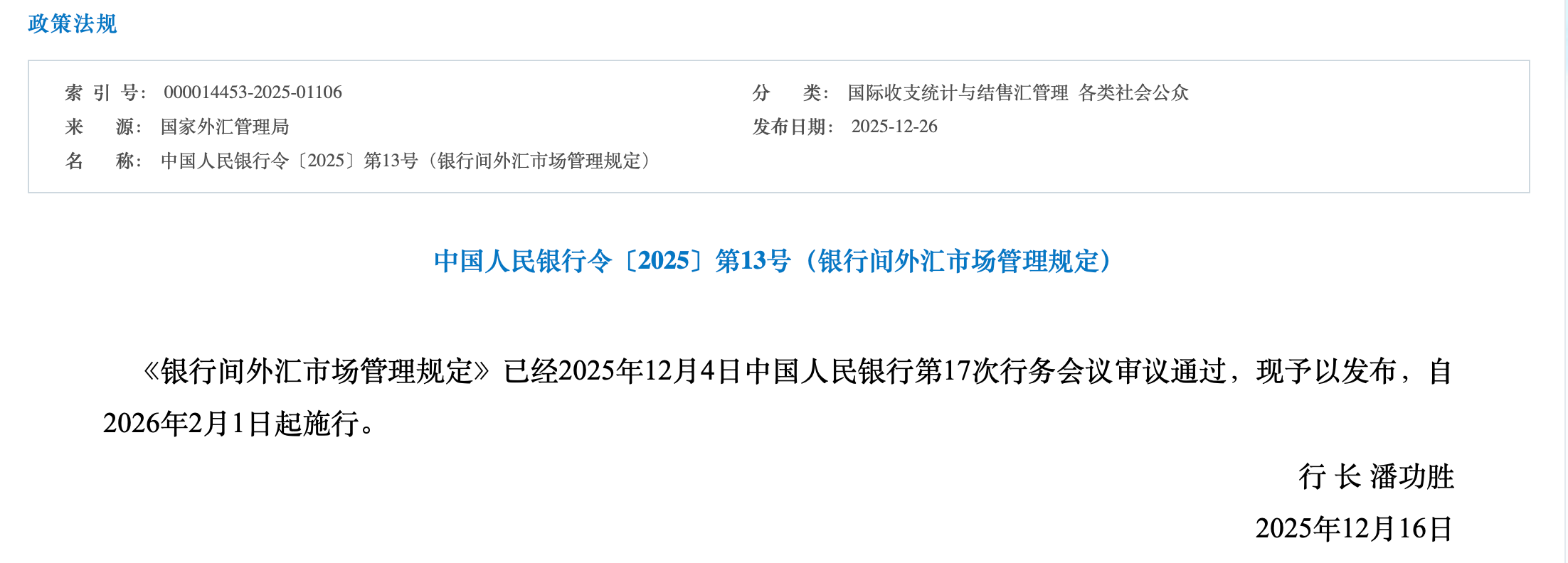
事关外汇市场,央行重要新规
Xin Lang Cai Jing· 2025-12-26 12:21
Core Viewpoint - The People's Bank of China (PBOC) has released new regulations for the interbank foreign exchange market to standardize and develop the market, enhance high-level openness, protect legal rights, prevent risks, and better serve the real economy, effective from February 1, 2026 [1][3]. Group 1: Regulatory Framework - The new regulations aim to strengthen supervision of the interbank foreign exchange market by clarifying requirements across various areas such as trading venues, qualification conditions, pricing norms, transaction clearing rules, information management, data services, and self-regulation, achieving comprehensive business oversight [1][3]. - The regulations emphasize that transactions in the interbank foreign exchange market must adhere to principles of openness, fairness, justice, and good faith, prohibiting fraud, market manipulation, and insider trading that could disrupt market order and harm participants' legal rights [1][3]. Group 2: Market Stability - The regulations are designed to maintain the stable operation of the foreign exchange market by standardizing the rights and obligations of market infrastructure, domestic and foreign financial institutions, currency brokers, and financial information service providers, while also requiring adherence to principles of openness, fairness, justice, and good faith to protect participants' legal rights [2][4]. Group 3: High-Quality Development - The regulations promote high-quality development of the interbank foreign exchange market by supporting the infrastructure to continuously enrich trading and clearing varieties, currencies, and methods based on market demand, facilitating financial institutions in providing foreign exchange services to clients [5]. - The PBOC and the State Administration of Foreign Exchange (SAFE) plan to continuously improve the management of the interbank foreign exchange market and deepen its development to maintain stable operations [5].
【金融政策】中国人民银行发布《银行间外汇市场管理规定》
Xin Lang Cai Jing· 2025-12-26 12:21
Core Viewpoint - The People's Bank of China has revised the interim regulations on the interbank foreign exchange market to establish a systematic regulatory framework and promote high-quality development of the foreign exchange market, effective from February 1, 2026 [1][2] Group 1: Regulatory Framework - The new regulations aim to strengthen supervision of the interbank foreign exchange market, covering trading venues, qualification requirements, pricing norms, transaction clearing rules, information management, data services, and self-regulation [1][2] - The regulations will ensure comprehensive business supervision across all areas of the interbank foreign exchange market [1][2] Group 2: Market Stability - The regulations are designed to maintain the stable operation of the foreign exchange market by standardizing the rights and obligations of market infrastructure, domestic and foreign financial institutions, currency brokers, and financial information service providers [1][2] - Participants are required to adhere to principles of openness, fairness, justice, and good faith to protect their legitimate rights and interests [1][2] Group 3: Market Development - The regulations support the continuous enrichment of trading and clearing varieties, currencies, and methods in the foreign exchange market infrastructure based on market demand [1][2] - Financial institutions will be facilitated in providing foreign exchange services to their clients [1][2] Group 4: Future Directions - The People's Bank of China and the State Administration of Foreign Exchange will continue to improve the management of the interbank foreign exchange market and deepen its development [1][2] - Efforts will be made to maintain the stable operation of the foreign exchange market [1][2]
事关外汇!央行发布新规
中国基金报· 2025-12-26 11:47
Core Viewpoint - The People's Bank of China (PBOC) has revised the "Interbank Foreign Exchange Market Management Regulations" to enhance the regulation and development of the foreign exchange market, aiming to better serve the real economy and expand high-level opening-up [2][3]. Summary by Sections General Principles - The regulations aim to standardize and develop the foreign exchange market, protect the legal rights of all parties, maintain market order, and promote the market's service to the real economy [5]. - The interbank foreign exchange market refers to the market for trading Renminbi and foreign currencies through the China Foreign Exchange Trading Center [5]. Market Participant Management - The Foreign Exchange Trading Center and Shanghai Clearing House will operate under the supervision of the PBOC and the State Administration of Foreign Exchange, organizing trading and clearing in the interbank foreign exchange market [8]. - Domestic financial institutions must obtain qualifications for foreign exchange business to participate in the interbank foreign exchange market [10]. Business Supervision and Legal Responsibilities - The PBOC authorizes the Foreign Exchange Trading Center to calculate and publish the Renminbi central parity rate based on quotes from qualified financial institutions [12]. - The regulations implement a daily maximum fluctuation management mechanism for spot trading prices, with limits set by the PBOC [13]. Additional Provisions - The regulations will take effect on February 1, 2026, replacing previous interim regulations [21].
事关外汇!央行发布新规
Zhong Guo Ji Jin Bao· 2025-12-26 11:39
Core Viewpoint - The People's Bank of China (PBOC) has released the "Regulations on the Management of the Interbank Foreign Exchange Market" to standardize and develop the foreign exchange market, enhance high-level openness, and protect the legitimate rights and interests of all parties involved, effective from February 1, 2026 [1]. Group 1: Regulatory Framework - The new regulations aim to strengthen supervision of the interbank foreign exchange market by clarifying requirements across various areas such as trading venues, qualification conditions, pricing standards, trading and clearing rules, information management, data services, and self-regulation [5]. - The regulations emphasize maintaining the stable operation of the foreign exchange market by standardizing the rights and obligations of market infrastructure, domestic and foreign financial institutions, currency brokers, and financial information service providers, adhering to principles of openness, fairness, justice, and good faith [5][6]. - The regulations promote high-quality development of the interbank foreign exchange market by supporting the continuous enrichment of trading and clearing varieties, currencies, and methods based on market demand [5]. Group 2: Market Conduct and Compliance - Transactions in the interbank foreign exchange market must adhere to principles of openness, fairness, justice, and good faith, prohibiting fraud, market manipulation, and insider trading that could disrupt market order and harm participants' rights [6][9]. - A daily maximum fluctuation management mechanism for spot trading prices will be implemented, with the PBOC determining and publishing the fluctuation limits for currency pairs [6][13]. - Financial institutions are required to manage conflicts of interest effectively and must not harm the legitimate rights of clients [6][17]. Group 3: Market Participants and Responsibilities - The regulations specify that the foreign exchange trading center and Shanghai Clearing House will operate under the supervision of the PBOC and the State Administration of Foreign Exchange, organizing trading and clearing within defined scopes [10]. - Financial institutions must establish robust internal management and risk control systems, ensuring separation of front, middle, and back offices [12]. - The regulations outline that financial institutions participating in the interbank foreign exchange market must take effective measures to manage conflicts of interest between themselves and their clients [17]. Group 4: Data Management and Disclosure - The foreign exchange trading center is authorized to calculate and publish the RMB central parity rate based on quotes from qualified financial institutions, with strict confidentiality regarding the quotes [13]. - The foreign exchange trading center and Shanghai Clearing House are required to fulfill information disclosure obligations, regularly publishing market data and clearing information [19][20]. - Data services provided by the foreign exchange trading center and Shanghai Clearing House must adhere to principles of fairness, reasonableness, and non-discrimination, ensuring data security and compliance with relevant regulations [21].
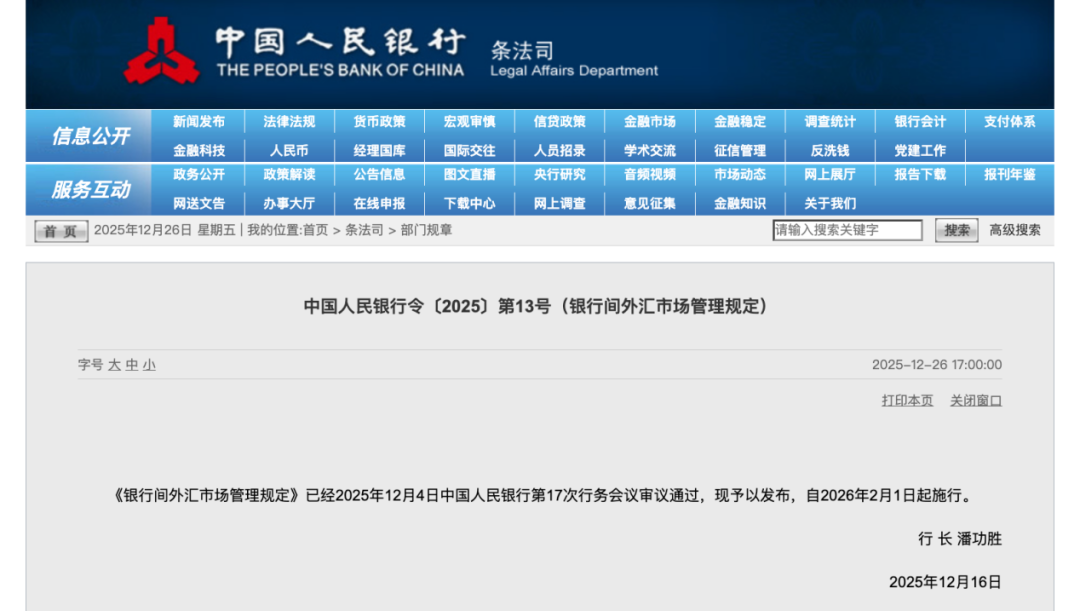
央行发布《银行间外汇市场管理规定》 自2026年2月1日起施行
Shang Hai Zheng Quan Bao· 2025-12-26 10:26
Core Viewpoint - The People's Bank of China has revised the interim regulations on the interbank foreign exchange market to enhance regulation, promote high-level opening-up, and ensure the protection of legal rights and interests of all parties involved, effective from February 1, 2026 [1] Group 1: Regulatory Enhancements - The new regulations aim to strengthen supervision of the interbank foreign exchange market by establishing comprehensive requirements across various areas including trading venues, qualification conditions, pricing norms, transaction clearing rules, information management, data services, and self-regulation [1] - The regulations will ensure full coverage of business supervision in the foreign exchange market [1] Group 2: Market Stability and Participant Protection - The regulations are designed to maintain the stable operation of the foreign exchange market by standardizing the rights and obligations of market infrastructure, domestic and foreign financial institutions, currency brokers, and financial information service providers [1] - Participants in the market are required to adhere to principles of openness, fairness, justice, and good faith to protect their legal rights [1] Group 3: Development of the Foreign Exchange Market - The regulations promote the high-quality development of the interbank foreign exchange market by supporting the continuous enrichment of trading and clearing varieties, currencies, and methods based on market demand [1] - Financial institutions are encouraged to provide foreign exchange services to clients more conveniently [1]