
外汇市场

Search documents
鹰派预期升温 沃什提名扰动全球资产
Jin Tou Wang· 2026-02-04 07:56
Core Viewpoint - The nomination of Kevin Warsh as the next Federal Reserve Chairman by Trump signals a clear shift towards a hawkish monetary policy, leading to significant volatility in global financial markets [1] Group 1: Federal Reserve Policy - The Federal Reserve has maintained the federal funds rate in the range of 3.50%-3.75%, pausing rate cuts for several meetings and adhering to a data-driven decision-making framework [1] - Warsh's past tenure emphasizes inflation control and monetary policy independence, contrasting with the dovish stance of some current Fed members [2] - If confirmed, Warsh is likely to refocus the Fed on dual objectives of inflation and employment, potentially accelerating balance sheet reduction and delaying rate cuts until mid-2026 [2] Group 2: Market Reactions - The hawkish expectations have strengthened the US dollar, which has regained key resistance levels, while commodity and emerging market currencies face depreciation pressures [3] - Long-term US Treasury yields have risen, reflecting market concerns over persistent inflation and tightening policies, although the yield curve inversion has eased somewhat [3] - Commodity markets show divergence, with gold prices weakening under the dual pressure of a strong dollar and rising real interest rates, while oil prices are influenced by geopolitical risks and demand concerns [3] Group 3: Capital Flows and Global Impact - Global capital is flowing back to the US market, increasing pressure on emerging markets facing capital outflows and potential debt default risks due to currency depreciation [4] - The current market environment is characterized by high volatility and strong differentiation among asset classes, with investor risk appetite shrinking [4] - The future direction of Fed policy will depend on key variables, including core inflation trends, US economic data performance, the Senate confirmation process for Warsh, and liquidity constraints from balance sheet reduction [4] Group 4: Outlook - Until the Fed's policy framework is fully clarified, markets will continue to navigate the dynamics of balance sheet reduction and rate cut expectations, with a strong dollar likely to persist [5] - Investors should monitor Fed policy developments and US economic data closely to mitigate risks associated with emerging market currencies and debt, while seizing opportunities in dollar and safe-haven assets [5] - Central banks worldwide need to prepare for policy adjustments to address challenges from capital flows and currency volatility, ensuring financial stability [5]
外汇市场保持较强韧性和活力
Jing Ji Ri Bao· 2026-01-21 22:29
Group 1: Foreign Exchange Market Overview - In 2025, China's foreign exchange market trading volume reached $42.6 trillion, marking a historical high, with the corporate foreign exchange hedging ratio rising to 30% [1] - The demand for managing exchange rate risks among enterprises has increased, with the scale of using foreign exchange derivatives for risk management exceeding $1.9 trillion, nearly doubling since 2020 [1] - The foreign exchange reserve level has remained above $3.3 trillion for five consecutive months, the highest since December 2015, indicating a stable market supply and demand [1] Group 2: Regulatory and Policy Developments - The State Administration of Foreign Exchange (SAFE) has been enhancing services for corporate exchange rate risk management, including promoting the concept of exchange rate risk neutrality and improving financial institutions' service mechanisms [2] - SAFE has introduced measures to promote high-level institutional opening of capital projects, including direct investment and cross-border financing, to facilitate financial market openness [3] - The integration of domestic and foreign currency fund pools for multinational companies has been expanded nationwide, benefiting over 1,100 multinational companies and 19,000 member enterprises [4][5] Group 3: Future Outlook and Market Stability - The foreign exchange market is expected to maintain stable operations in 2026, with cross-border capital flows remaining orderly and resilient [6] - The external environment is projected to support stable operations, with moderate global economic growth and potential interest rate cuts in major developed economies [6] - The People's Bank of China aims to enhance the resilience of the foreign exchange market and maintain the RMB exchange rate at a reasonable and balanced level [7]
2025年人民币外汇衍生品市场回顾与展望
Sou Hu Cai Jing· 2026-01-05 02:50
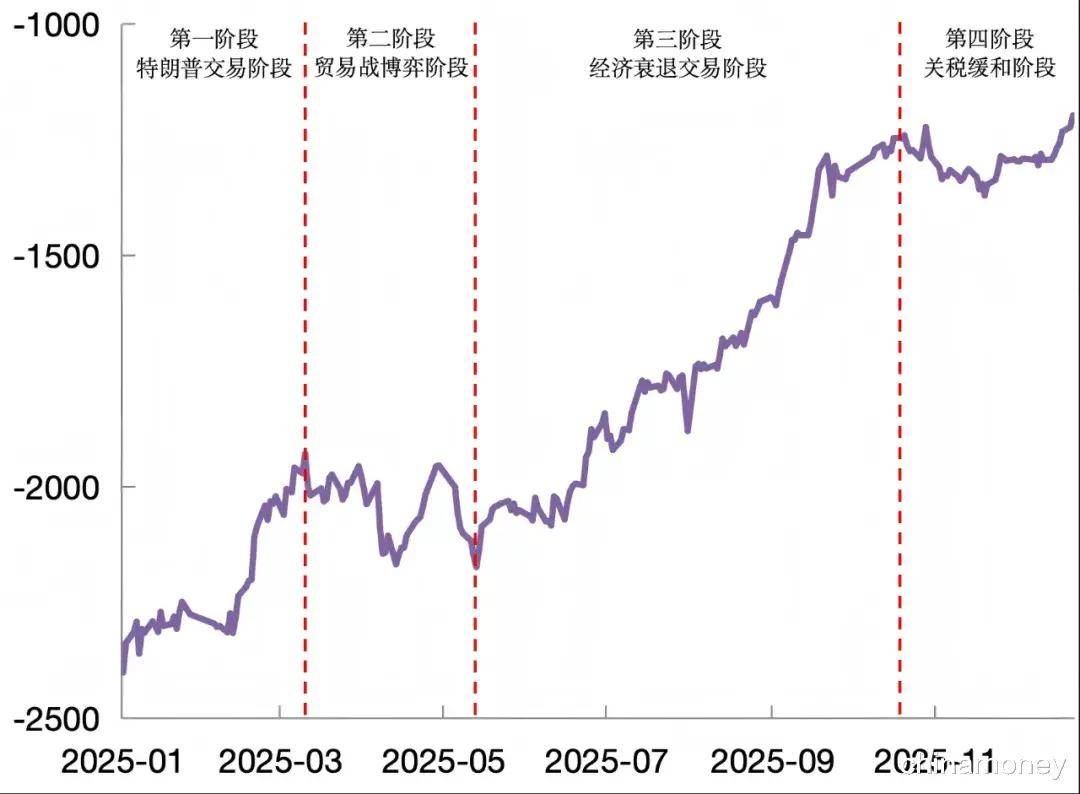
Group 1 - The core viewpoint of the article indicates that the RMB foreign exchange derivatives market in 2025 exhibited different phase characteristics, with the foreign exchange swap showing an overall upward trend and the volatility of foreign exchange options experiencing phase increases but remaining stable overall [1][3] - In 2025, the RMB foreign exchange swap market showed an overall upward trend, influenced by domestic and international economic fundamentals, the evolution of China-US trade friction, and the anticipated interest rate cuts by the Federal Reserve [3][19] - The one-year RMB/USD swap points rose from -2400 pips at the beginning of the year to around -1200 pips by year-end, reflecting different phase characteristics throughout the year [3][19] Group 2 - The first phase from the beginning of the year to mid-March saw the one-year swap points rise from -2400 pips to around -1900 pips, driven by market expectations of inflation due to tariff threats [6] - The second phase from mid-March to mid-May experienced a fluctuation in swap points between -2200 pips and -1950 pips, influenced by the tightening of RMB liquidity and the announcement of tariffs by the Trump administration [7] - The third phase from mid-May to mid-October saw swap points rise from around -2200 pips to about -1250 pips, as initial agreements on tariffs were reached and economic data from the US began to show weakness [8] - The fourth phase from mid-October to year-end saw a further easing of tariffs, with swap points adjusting to around -1330 pips, reflecting a temporary reversal in the market's pricing of interest rate cuts by the Federal Reserve [11] Group 3 - The RMB foreign exchange options market in 2025 experienced significant volatility increases in early January and from mid-March to mid-April, while other periods showed a steady decline [12][21] - The first phase at the beginning of the year saw implied volatility for short-term and long-term options remain high, with 1M and 1Y ATM implied volatilities fluctuating between 4.5%-4.7% and 5.7%-5.9% respectively [15] - The second phase from early February to mid-March saw a decline in implied volatility as market sentiment stabilized, with 1M ATM volatility dropping from 4.8% to about 3.7% [16] - The third phase from mid-March to mid-April saw a spike in implied volatility due to heightened market fears, with 1M ATM volatility reaching around 6.5% [17] - The fourth phase from mid-April to year-end saw a steady decline in implied volatility, with 1M ATM volatility dropping to around 2% and 1Y ATM volatility to about 3.4% [18] Group 4 - Looking ahead to 2026, the RMB foreign exchange swap market is expected to continue its upward trend in the first half, supported by anticipated economic policies and a stable monetary policy environment [19] - The foreign exchange options market in 2026 is expected to experience lower overall implied volatility compared to 2025, with potential spikes during specific political and economic events [21]

事关外汇!央行发布新规
中国基金报· 2025-12-26 11:47
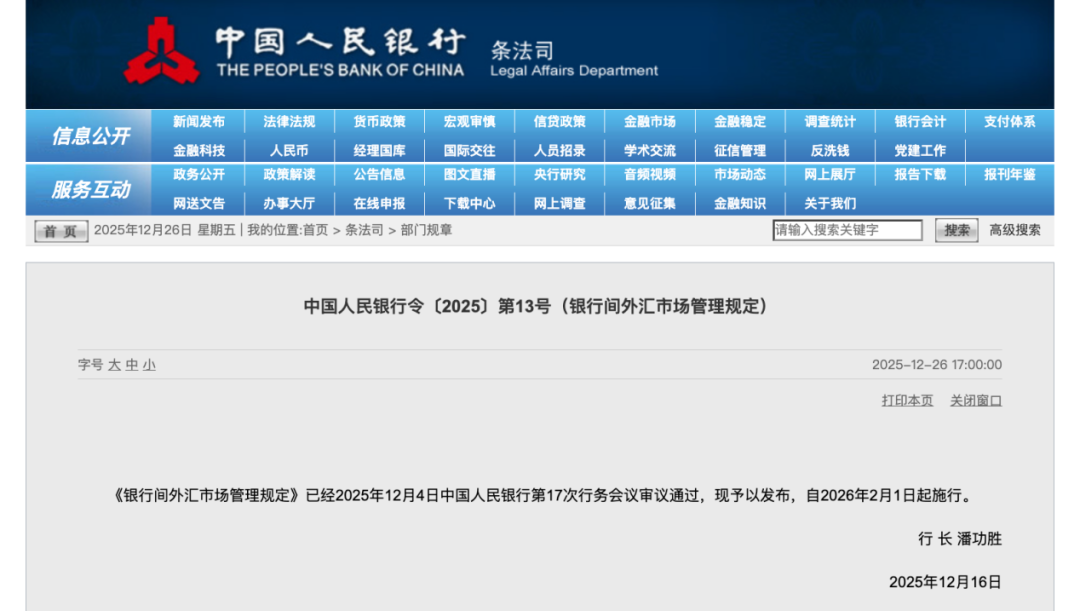
Core Viewpoint - The People's Bank of China (PBOC) has revised the "Interbank Foreign Exchange Market Management Regulations" to enhance the regulation and development of the foreign exchange market, aiming to better serve the real economy and expand high-level opening-up [2][3]. Summary by Sections General Principles - The regulations aim to standardize and develop the foreign exchange market, protect the legal rights of all parties, maintain market order, and promote the market's service to the real economy [5]. - The interbank foreign exchange market refers to the market for trading Renminbi and foreign currencies through the China Foreign Exchange Trading Center [5]. Market Participant Management - The Foreign Exchange Trading Center and Shanghai Clearing House will operate under the supervision of the PBOC and the State Administration of Foreign Exchange, organizing trading and clearing in the interbank foreign exchange market [8]. - Domestic financial institutions must obtain qualifications for foreign exchange business to participate in the interbank foreign exchange market [10]. Business Supervision and Legal Responsibilities - The PBOC authorizes the Foreign Exchange Trading Center to calculate and publish the Renminbi central parity rate based on quotes from qualified financial institutions [12]. - The regulations implement a daily maximum fluctuation management mechanism for spot trading prices, with limits set by the PBOC [13]. Additional Provisions - The regulations will take effect on February 1, 2026, replacing previous interim regulations [21].
事关外汇!央行发布新规
Zhong Guo Ji Jin Bao· 2025-12-26 11:39
Core Viewpoint - The People's Bank of China (PBOC) has released the "Regulations on the Management of the Interbank Foreign Exchange Market" to standardize and develop the foreign exchange market, enhance high-level openness, and protect the legitimate rights and interests of all parties involved, effective from February 1, 2026 [1]. Group 1: Regulatory Framework - The new regulations aim to strengthen supervision of the interbank foreign exchange market by clarifying requirements across various areas such as trading venues, qualification conditions, pricing standards, trading and clearing rules, information management, data services, and self-regulation [5]. - The regulations emphasize maintaining the stable operation of the foreign exchange market by standardizing the rights and obligations of market infrastructure, domestic and foreign financial institutions, currency brokers, and financial information service providers, adhering to principles of openness, fairness, justice, and good faith [5][6]. - The regulations promote high-quality development of the interbank foreign exchange market by supporting the continuous enrichment of trading and clearing varieties, currencies, and methods based on market demand [5]. Group 2: Market Conduct and Compliance - Transactions in the interbank foreign exchange market must adhere to principles of openness, fairness, justice, and good faith, prohibiting fraud, market manipulation, and insider trading that could disrupt market order and harm participants' rights [6][9]. - A daily maximum fluctuation management mechanism for spot trading prices will be implemented, with the PBOC determining and publishing the fluctuation limits for currency pairs [6][13]. - Financial institutions are required to manage conflicts of interest effectively and must not harm the legitimate rights of clients [6][17]. Group 3: Market Participants and Responsibilities - The regulations specify that the foreign exchange trading center and Shanghai Clearing House will operate under the supervision of the PBOC and the State Administration of Foreign Exchange, organizing trading and clearing within defined scopes [10]. - Financial institutions must establish robust internal management and risk control systems, ensuring separation of front, middle, and back offices [12]. - The regulations outline that financial institutions participating in the interbank foreign exchange market must take effective measures to manage conflicts of interest between themselves and their clients [17]. Group 4: Data Management and Disclosure - The foreign exchange trading center is authorized to calculate and publish the RMB central parity rate based on quotes from qualified financial institutions, with strict confidentiality regarding the quotes [13]. - The foreign exchange trading center and Shanghai Clearing House are required to fulfill information disclosure obligations, regularly publishing market data and clearing information [19][20]. - Data services provided by the foreign exchange trading center and Shanghai Clearing House must adhere to principles of fairness, reasonableness, and non-discrimination, ensuring data security and compliance with relevant regulations [21].
央行发新规,促进外汇市场服务实体经济
Wind万得· 2025-12-26 09:37
Group 1 - The core viewpoint of the article is the revision of the interim regulations on the interbank foreign exchange market by the People's Bank of China, aimed at standardizing and developing the foreign exchange market, enhancing high-level openness, and safeguarding the legitimate rights and interests of all parties involved [2] Group 2 - The new regulations will take effect on February 1, 2026, and are designed to create a systematic regulatory framework and requirements based on the development and regulatory practices of China's interbank foreign exchange market [2] - The regulations emphasize strengthening supervision of the interbank foreign exchange market, covering areas such as trading venues, qualification conditions, pricing norms, transaction clearing rules, information management, data services, and self-regulation [2] - The regulations aim to maintain the stable operation of the foreign exchange market by standardizing the rights and obligations of market infrastructure, domestic and foreign financial institutions, currency brokers, and financial information service providers, ensuring adherence to principles of openness, fairness, justice, and good faith [2] - The regulations promote high-quality development of the interbank foreign exchange market by supporting the continuous enrichment of trading and clearing varieties, currencies, and methods based on market demand, facilitating financial institutions in providing foreign exchange services to clients [2] - The People's Bank of China and the State Administration of Foreign Exchange will continue to improve the management of the interbank foreign exchange market and deepen its development to maintain stable operations [2]

日银决议前瞻 汇债市屏息日元区间博弈中
Jin Tou Wang· 2025-12-17 02:25
Core Viewpoint - The focus of the global currency and bond markets is on the upcoming Bank of Japan monetary policy decision, with expectations of a 25 basis point rate hike to 0.75% [1] Group 1: Currency Market - The USD/JPY exchange rate is currently at 154.858, down 0.22% for the day, indicating a cautious market sentiment ahead of the policy decision [1] - The USD/JPY has shown a clear downward trend, recently breaking below the key psychological level of 155.00, influenced by both fundamental and technical factors [2] - Key resistance levels for USD/JPY are at 155.438 (Bollinger Band middle line) and 156.263 (Bollinger Band upper line), while support levels are at 154.613 (Bollinger Band lower line) and 154.342 (recent low) [3] Group 2: Bond Market - The 10-year Japanese government bond yield is currently at 1.951%, having slightly decreased by 0.15% for the day, with a previous high of 1.976% [1] - The 10-year bond yield is exhibiting a range-bound trading pattern, with resistance levels at 1.976 (previous high) and 1.991 (Bollinger Band upper line), and support levels at 1.941 (Bollinger Band middle line) and 1.891 (Bollinger Band lower line) [3] - The MACD indicator for the 10-year bond yield shows a DIFF value of 0.032 and a DEA value of 0.038, indicating a weak bullish trend with insufficient momentum [2]
韩元波动加剧,韩国政府加强外汇市场稳定和监管
Sou Hu Cai Jing· 2025-12-01 08:40
Core Viewpoint - The South Korean government has announced new measures to stabilize the foreign exchange market, addressing the long-standing imbalance in foreign exchange supply and demand, which has recently intensified fluctuations in the Korean won's exchange rate [1] Group 1: Government Measures - The regulatory authorities will review the foreign exchange income and expenditure of export enterprises and seek policy tools to support their overseas investment activities [1] - Special inspections will be conducted to ensure adequate protective measures for overseas investments [1] Group 2: Central Bank Actions - The South Korean central bank is in discussions with pension funds to expand foreign exchange swap limits, which will help alleviate dollar liquidity pressure and enhance market resilience [1] - These initiatives are part of broader measures aimed at strengthening market operations and maintaining stability [1]
马勇:通过六大子市场指数,系统衡量中国金融整体形势
Sou Hu Cai Jing· 2025-11-24 03:01
Core Insights - The China Financial Situation Index (CAFI) indicates a gradual recovery in China's financial landscape, moving away from a cold phase, although the foreign exchange and bond markets remain constraints [1][10] - The report suggests maintaining a loose monetary policy and leveraging the Federal Reserve's interest rate cuts to attract international capital back to China, providing new momentum for economic recovery [1][10] Index Construction Methodology - The CAFI is based on the intrinsic relationship between financial activities and the real economy, comprising six sub-market indices: Money Supply Index (MSI), Credit Situation Index (CSI), Stock Market Index (SSI), Bond Market Index (BSI), Exchange Rate Pressure Index (EPI), and Real Estate Situation Index (RSI) [3][4] - The index is designed to provide a quantifiable assessment of China's overall financial situation, reflecting the operational status and structural changes within the financial system [3][4] Current Financial Situation Analysis - As of Q3 2025, the MSI and CSI are in a moderately positive state, indicating a mild recovery in the banking credit market [7][8] - The SSI is also in a positive state, while the BSI shows a slight cooling, reflecting a "see-saw" effect between the stock and bond markets [7][8] - The EPI is currently the lowest among the indices, indicating moderate cooling, primarily due to the impact of the Federal Reserve's interest rate hikes [8] Future Outlook and Policy Predictions - The CAFI index for Q3 2025 shows signs of recovery, with values indicating a shift from a moderately cold state to a warming trend, although the recovery is not yet solidified [10] - Monetary policy is expected to remain moderately loose to support economic recovery and counter deflationary pressures, while credit policies will focus on key economic areas [10][11] - The opening of the Federal Reserve's interest rate cut cycle presents an opportunity to alleviate pressure on the RMB exchange rate and attract international capital, which could be crucial for the financial situation's improvement [11]
美韩达成协议缓解韩元压力
Jin Tou Wang· 2025-10-30 02:29
Group 1 - The core point of the news is the agreement between the US and South Korea regarding a $350 billion investment fund, which includes $200 billion in cash, aimed at alleviating pressure on the Korean won and easing short-term financing burdens in the local bond market [1][3] - The 25% tariff on South Korean automobiles will be reduced to 15%, with most other goods maintaining current tariff levels, effective from a likely date of November 1 [3] - The reduction in tariffs is expected to significantly mitigate the downside risks faced by the South Korean automotive industry, which is heavily reliant on US demand [3] Group 2 - The role of the National Pension Service (NPS) in the foreign exchange market may become increasingly important as the Bank of Korea is required to remit investment earnings from foreign reserves to the US [3] - There is a potential risk of depreciation for the Korean won in the coming years as the proportion of dollar export revenues converted to won by private enterprises may decrease [3] - The impact of these developments on South Korea's monetary policy is expected to be neutral [3] Group 3 - Technical analysis indicates that the USD/KRW exchange rate is trading around 1420, with resistance levels at 1430-1450 and support levels at 1400-1420 [4]
