
外汇市场发展

Search documents
2025年超10亿笔外汇业务在线办理
Ren Min Ri Bao Hai Wai Ban· 2026-01-07 02:12
Core Viewpoint - The 2026 National Foreign Exchange Management Work Conference highlighted the achievements and future goals of foreign exchange management in China, focusing on supporting trade and enhancing the foreign exchange market [1] Group 1: Achievements in 2025 - In 2025, over 1 billion cross-border e-commerce foreign exchange transactions were processed online, serving more than 1.8 million small and micro businesses [1] - The foreign exchange management department strengthened policy integration and market construction, achieving historical highs in foreign exchange market trading volume and corporate foreign exchange hedging ratios [1] - Banks processed foreign exchange transactions worth $440 billion based on customer instructions throughout the year [1] Group 2: Goals for 2026 - The foreign exchange management work in 2026 aims to better balance development and security, creating a more convenient, open, secure, and intelligent foreign exchange management system [1] - There will be a focus on deepening reforms and high-level openness in the foreign exchange sector, ensuring that various entities' foreign exchange needs are met while mitigating external risks [1] - Enhanced supervision during and after transactions will be emphasized to foster a foreign exchange policy environment that is both flexible and well-regulated, contributing to the successful start of the 14th Five-Year Plan [1]
中国央行:保持人民币汇率在合理均衡水平上的基本稳定
Sou Hu Cai Jing· 2025-12-26 14:21
Core Viewpoint - The People's Bank of China emphasizes the importance of market-driven exchange rate formation and aims to maintain the basic stability of the RMB at a reasonable and balanced level while preventing excessive fluctuations [1] Group 1: Exchange Rate and Market Development - The report advocates for further development of the foreign exchange market and steady expansion of openness to promote integrated domestic and foreign trade [1] - It highlights the need to enhance the resilience of the foreign exchange market and to strengthen the concept of neutral exchange rate risk [1] - The report calls for increasing the use of RMB in cross-border trade and investment [1] Group 2: Risk Management and Financial Support - The report outlines a cautious approach to resolving risks in key areas, particularly in managing local government financing platform debt risks [1] - It encourages financial institutions to negotiate with financing platforms based on market-oriented and legal principles, including measures like lowering interest rates and extending debt maturities [1] - The report emphasizes the importance of improving macro-prudential management of real estate finance and supporting the development of new models in the real estate sector [1]
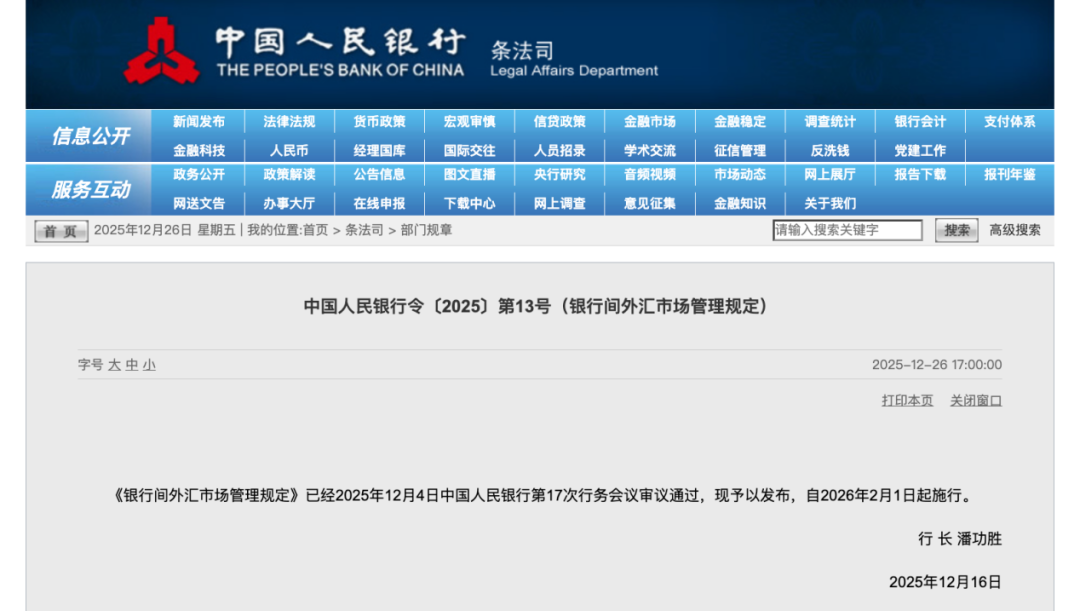
事关外汇!央行发布新规
Zhong Guo Ji Jin Bao· 2025-12-26 11:39
Core Viewpoint - The People's Bank of China (PBOC) has released the "Regulations on the Management of the Interbank Foreign Exchange Market" to standardize and develop the foreign exchange market, enhance high-level openness, and protect the legitimate rights and interests of all parties involved, effective from February 1, 2026 [1]. Group 1: Regulatory Framework - The new regulations aim to strengthen supervision of the interbank foreign exchange market by clarifying requirements across various areas such as trading venues, qualification conditions, pricing standards, trading and clearing rules, information management, data services, and self-regulation [5]. - The regulations emphasize maintaining the stable operation of the foreign exchange market by standardizing the rights and obligations of market infrastructure, domestic and foreign financial institutions, currency brokers, and financial information service providers, adhering to principles of openness, fairness, justice, and good faith [5][6]. - The regulations promote high-quality development of the interbank foreign exchange market by supporting the continuous enrichment of trading and clearing varieties, currencies, and methods based on market demand [5]. Group 2: Market Conduct and Compliance - Transactions in the interbank foreign exchange market must adhere to principles of openness, fairness, justice, and good faith, prohibiting fraud, market manipulation, and insider trading that could disrupt market order and harm participants' rights [6][9]. - A daily maximum fluctuation management mechanism for spot trading prices will be implemented, with the PBOC determining and publishing the fluctuation limits for currency pairs [6][13]. - Financial institutions are required to manage conflicts of interest effectively and must not harm the legitimate rights of clients [6][17]. Group 3: Market Participants and Responsibilities - The regulations specify that the foreign exchange trading center and Shanghai Clearing House will operate under the supervision of the PBOC and the State Administration of Foreign Exchange, organizing trading and clearing within defined scopes [10]. - Financial institutions must establish robust internal management and risk control systems, ensuring separation of front, middle, and back offices [12]. - The regulations outline that financial institutions participating in the interbank foreign exchange market must take effective measures to manage conflicts of interest between themselves and their clients [17]. Group 4: Data Management and Disclosure - The foreign exchange trading center is authorized to calculate and publish the RMB central parity rate based on quotes from qualified financial institutions, with strict confidentiality regarding the quotes [13]. - The foreign exchange trading center and Shanghai Clearing House are required to fulfill information disclosure obligations, regularly publishing market data and clearing information [19][20]. - Data services provided by the foreign exchange trading center and Shanghai Clearing House must adhere to principles of fairness, reasonableness, and non-discrimination, ensuring data security and compliance with relevant regulations [21].

国家外汇管理局副局长刘斌:研究长期限、多品种、小币种等外汇市场发展问题|2025外滩年会
Sou Hu Cai Jing· 2025-10-23 15:11
Core Viewpoint - The National Foreign Exchange Administration is focusing on enhancing the foreign exchange management system in Shanghai to support its development as an international financial center, emphasizing convenience, openness, security, and intelligence in its approach [1]. Group 1: Expansion of Foreign Exchange System - The administration plans to steadily expand high-level institutional openness in the foreign exchange sector, balancing the internationalization of the Renminbi with high-quality capital account openness [2]. - There will be a focus on integrating domestic and foreign currency management, facilitating foreign financial institutions' investment in China, and enhancing the development of the foreign exchange market [2]. - The administration aims to support the foreign exchange trading center in strengthening its financial infrastructure and service capabilities, particularly in managing exchange rate risks as international transaction volumes grow [2]. Group 2: Facilitation of Cross-Border Trade and Investment - The administration will continue to promote reforms and innovations in foreign exchange management based on market demand and national conditions, providing higher convenience for compliant entities [2]. - The principle of "the more honest, the more convenient" will guide the administration's approach, ensuring that genuine transactions and compliant entities receive greater ease of fund usage [2]. - There is encouragement for Shanghai to implement pioneering and integrated exploratory policies, utilizing technologies like artificial intelligence and big data to offer smarter and more efficient foreign exchange services [2]. Group 3: Balancing Financial Openness and Security - The administration emphasizes that openness and convenience must be predicated on security, advocating for a dual management approach of "macro-prudential + micro-regulation" in the foreign exchange market [3]. - Effective risk prevention is deemed essential for high-quality development and high-level openness, with a focus on preventing risk transmission and accumulation across regions, markets, and borders [3].
刘斌:从三方面入手提升上海跨境金融服务能级
Jing Ji Guan Cha Wang· 2025-10-23 13:15
Core Viewpoint - The National Foreign Exchange Administration aims to enhance Shanghai's cross-border financial services by establishing a more convenient, open, secure, and intelligent foreign exchange management system, supporting the city's development as an international financial center [1][2]. Group 1: Expansion of Foreign Exchange System - The administration plans to steadily expand high-level institutional openness in the foreign exchange sector, focusing on the integration of RMB internationalization and high-quality capital account opening [1]. - There will be an emphasis on facilitating foreign financial institutions' investment in China while deepening the development of the foreign exchange market [1]. - The administration will explore issues related to long-term, multi-variety, and small currency foreign exchange market development, enhancing the financial infrastructure and services of the foreign exchange trading center [1]. Group 2: Promotion of Cross-Border Trade and Investment - The administration will continue to innovate foreign exchange management reforms based on market demand and national conditions, providing higher convenience for compliant entities [1]. - There is encouragement for Shanghai to implement pioneering and integrated exploratory policies, utilizing technologies such as artificial intelligence and big data to offer smarter, more efficient, and secure foreign exchange services [1]. Group 3: Balancing Financial Openness and Security - The relationship between financial openness and security will be carefully managed, ensuring that convenience and openness are predicated on safety [2]. - The administration will strengthen the dual management of macro-prudential and micro-regulation in the foreign exchange market to prevent risks across regions, markets, and borders [2].