长尾风险

Search documents
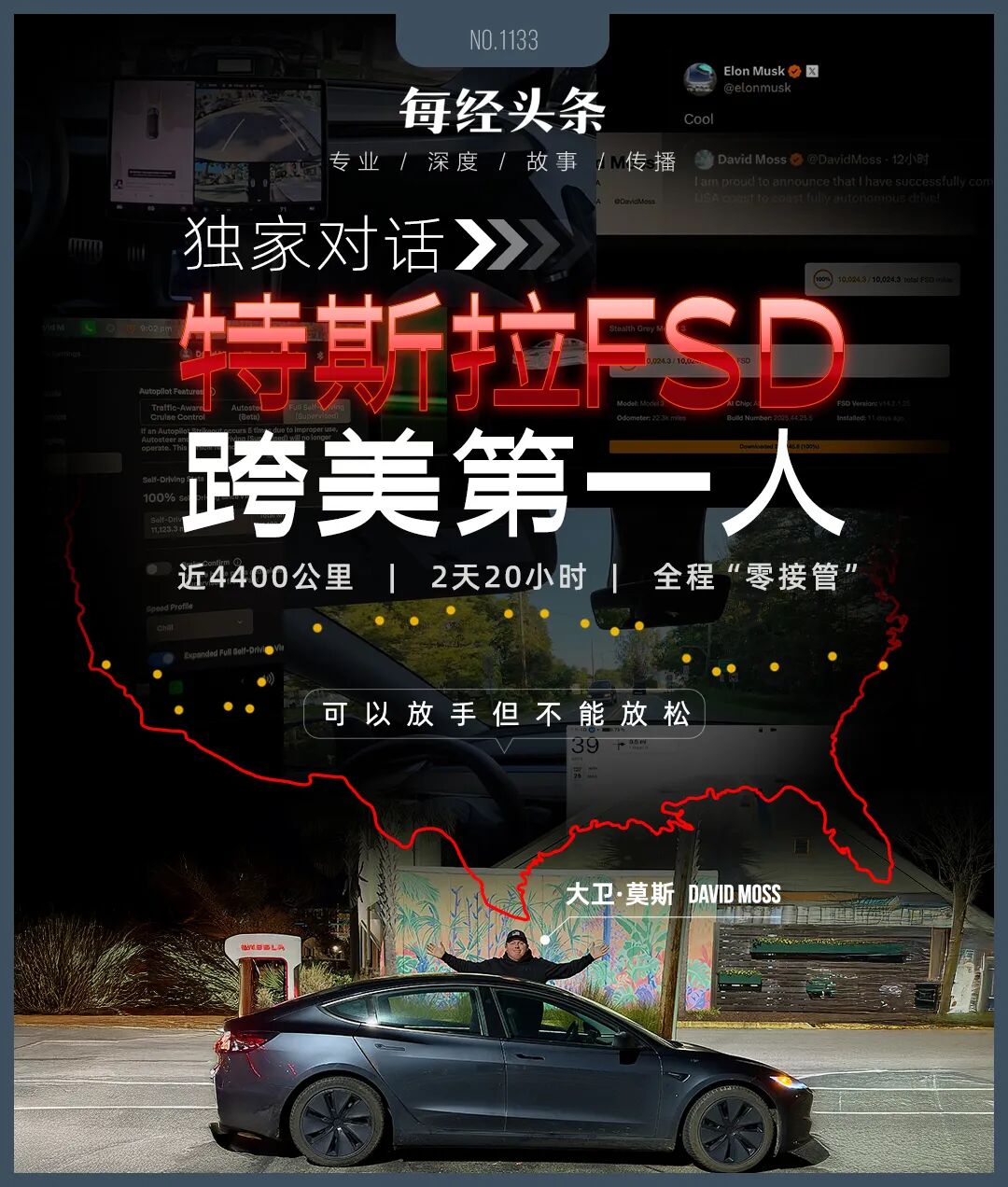
对话特斯拉FSD跨美第一人:4400公里“零接管”,手没碰过方向盘
Mei Ri Jing Ji Xin Wen· 2026-01-11 12:39
Core Insights - The journey of David Moss across the United States using Tesla's Full Self-Driving (FSD) system demonstrates the potential of achieving fully autonomous driving without the need for LiDAR technology [2][9] - The trip covered 2,732.4 miles (approximately 4,397 kilometers) without any human intervention, marking a significant milestone in the development of autonomous driving technology [2][6] Group 1: Journey Details - David Moss initiated his journey from a Tesla restaurant in Los Angeles to Myrtle Beach, South Carolina, taking approximately 20 hours over two days [4][6] - The FSD system managed various challenging conditions, including low visibility fog, sudden rain, and complex urban traffic, without any incidents [5][6] - Moss maintained an average speed of about 120 kilometers per hour, with a maximum speed of 136 kilometers per hour, while taking approximately 12 hours of rest during the trip [6][8] Group 2: Technology Insights - Moss transitioned from being a LiDAR salesperson to a proponent of Tesla's "pure vision" approach, believing that full autonomy does not necessarily require LiDAR [9] - The FSD system has evolved significantly, with the latest version (FSD V14.2) allowing for complete control in various driving scenarios, including city driving and charging station navigation [8] - Despite the success of the journey, there are ongoing debates in the industry regarding the effectiveness of Tesla's vision-based system compared to multi-sensor fusion approaches like those used by Waymo [9][10] Group 3: Challenges and Regulatory Issues - The journey highlights the challenges of achieving commercial viability for fully autonomous driving, including the need to address rare edge cases and regulatory hurdles [10][12] - Current regulations classify Tesla's FSD as a Level 2 driver assistance system, requiring driver supervision, which complicates public perception and regulatory alignment [11][12] - The lack of a comprehensive regulatory framework for autonomous driving in the U.S. poses significant challenges for the industry, with many executives citing regulation as a major bottleneck for deployment [12][13]


独家对话特斯拉FSD跨美第一人:4400公里“零接管”,手没碰过方向盘!作为激光雷达销售员,他为何站队马斯克的“纯视觉”?
Mei Ri Jing Ji Xin Wen· 2026-01-08 11:17
Core Insights - The journey of David Moss across the United States using Tesla's Full Self-Driving (FSD) system demonstrates the potential of achieving fully autonomous driving without the need for LiDAR technology [2][19] - Moss's experience highlights the effectiveness of Tesla's "pure vision" approach compared to multi-sensor fusion systems like those used by Waymo [19][21] Group 1: Journey Overview - David Moss completed a 2-day, 20-hour journey covering 2,732.4 miles (approximately 4,397 kilometers) from Los Angeles to Myrtle Beach, South Carolina, without manual intervention [2][4] - The FSD system managed various challenging conditions, including low visibility fog, sudden rain, and heavy traffic, without any incidents [7][14] - Moss maintained a supervisory role throughout the journey, focusing on system alerts and ensuring he remained attentive [4][8] Group 2: Technical Insights - The FSD V14.2 version allowed for end-to-end driving capabilities, including city navigation, highway merging, and parking, which previously required driver intervention [11][19] - Moss's experience suggests that Tesla's "pure vision" approach, relying solely on cameras, can be effective, although it faces challenges in extreme lighting and weather conditions [19][23] - In contrast, Waymo's multi-sensor approach offers advantages in certain scenarios but comes with higher costs and complexity [21][19] Group 3: Industry Implications - The successful completion of the journey raises questions about the future of autonomous driving technology and its commercial viability [24][30] - There are significant hurdles to overcome for full commercialization, including addressing long-tail risks, regulatory definitions, and the lack of a comprehensive regulatory framework [27][29] - Moss aims to showcase the value of autonomous driving technology, emphasizing its potential to benefit individuals who are unable to drive [30]