
限塑

Search documents
前东家已上市,他携昌亚股份二冲IPO,可降解赛道落后半步难追
Sou Hu Cai Jing· 2026-01-15 10:34
Core Viewpoint - The article focuses on the journey of Changya Co., Ltd., a company that started from humble beginnings and has secured significant orders from major clients like KFC and Haidilao, as it attempts to navigate the challenges of going public amid the plastic restriction wave [1]. Company Background - Changya Co., Ltd. was founded by Xu Jianhai, a former engineer with a diverse career trajectory, who transitioned from a stable job in a research institute to entrepreneurship, initially facing significant challenges [4][6]. - The company began with a focus on plastic bags and films but pivoted to manufacturing plastic straws, targeting the high-end markets in Europe and the United States [6][8]. Financial Performance - From 2020 to 2022, Changya's revenue grew from 512 million yuan to 919 million yuan, nearly doubling, with over 95% of sales coming from international markets, particularly the U.S. [8]. - However, the net profit showed significant volatility, dropping from 73.04 million yuan to 53.49 million yuan before rebounding to 125 million yuan, influenced by currency fluctuations and rising raw material costs [10][12]. Market Challenges - The company faces challenges due to its reliance on external factors, such as raw material prices and currency exchange rates, which significantly impact profitability [12]. - The ongoing global trend towards plastic restrictions poses a long-term threat to Changya, as its revenue is still heavily dependent on traditional plastic products, with biodegradable products accounting for only 3.96% of revenue [14]. Competitive Landscape - Competitors have already begun to establish themselves in the green product market, with companies like Fuling and Jialian Technology making significant strides in biodegradable and alternative materials [14].

70后卖房造吸管,“啃下”肯德基、海底捞,如今撑得起一个IPO吗?
3 6 Ke· 2026-01-09 13:08
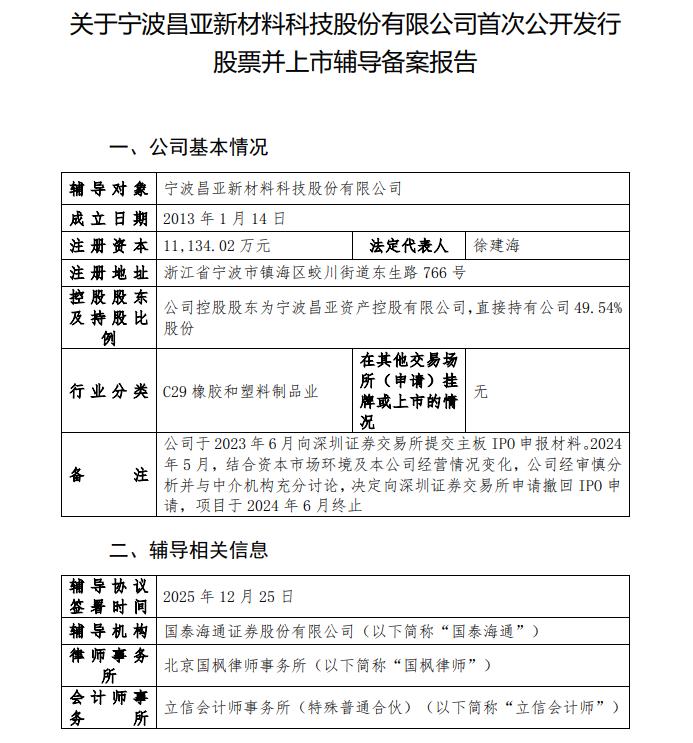
Core Viewpoint - Ningbo Changya New Materials Technology Co., Ltd. (Changya Co.) is attempting to re-enter the capital market with a new IPO application after previously withdrawing its application in 2024, facing significant industry changes and survival challenges [1][19]. Company Overview - Changya Co. was established on January 14, 2013, and is primarily engaged in the production of disposable food containers, including straws and boxes [2]. - The company is controlled by Ningbo Changya Asset Holding Co., which holds 49.54% of its shares [2]. - The company previously submitted an IPO application to the Shenzhen Stock Exchange in June 2023 but withdrew it in May 2024 due to changes in market conditions and operational circumstances [2]. Founder Background - The founder, Xu Jianhai, is a 70s engineer who started the company after selling his house for over 1 million yuan, initially producing plastic bags and films before pivoting to straws targeting the European and American markets [3][4][7]. Market Position and Clientele - Changya Co. has established a strong presence in the overseas market, with major clients including KFC, Burger King, and Walmart, contributing significantly to its revenue [7][9]. - From 2020 to 2022, the company's revenue grew from 512 million yuan to 919 million yuan, nearly doubling in three years, with over 95% of sales coming from international markets, particularly the U.S. [10][12]. Financial Performance - The company's revenue figures for 2020, 2021, and 2022 were 512 million yuan, 623 million yuan, and 919 million yuan, respectively, while net profits fluctuated from 73 million yuan to 125 million yuan, with a notable drop in 2021 [10][12]. - The gross profit margins were 25.89%, 17.83%, and 21.22% for the same years, indicating volatility influenced by exchange rates and raw material costs [10][12]. Challenges and Industry Trends - Changya Co. faces challenges from rising raw material prices and exchange rate fluctuations, which directly impact its gross margins [12][14]. - The global trend towards "plastic restrictions" poses a significant threat, as the company heavily relies on plastic products, with over 90% of its revenue coming from plastic food containers [14][15]. - Competitors like Fuling and Jialian Technology are advancing in biodegradable products, which could further challenge Changya Co.'s market position [16][18]. Future Outlook - The company is attempting to capitalize on the current IPO window but must navigate a changing competitive landscape and increasing environmental regulations [19]. - Without a clear strategy for product diversification and adaptation to eco-friendly materials, Changya Co. may struggle to achieve higher valuations in the future [19].

马来西亚槟城州强化“限塑”
Ren Min Ri Bao· 2025-10-20 22:42
Core Viewpoint - Penang, Malaysia has implemented a strong "plastic limit" initiative starting September 1, prohibiting the distribution of plastic bags in fixed commercial establishments such as supermarkets, malls, convenience stores, and restaurants [1][2]. Group 1: Policy Implementation - The "plastic limit" policy in Penang is part of a phased approach, with a transition period from March 1 to August 31, 2025, where retailers gradually stop providing plastic bags, shifting to cloth or biodegradable alternatives [1]. - The full enforcement phase began on September 1, 2025, where no plastic bags are allowed, except for traditional markets and roadside stalls temporarily [1]. Group 2: Community Engagement and Education - The Penang Green Council distributed 100,000 reusable eco-bags for free during the first three months of the transition period to assist customers who forget to bring their own bags [2]. - Local schools have incorporated environmental education into their curriculum, encouraging students to create art from recycled materials and promoting "bring your own utensils day" in cafeterias [2]. Group 3: Environmental Impact and Recognition - The stricter "plastic limit" policies have led to cleaner streets and enhanced tourist experiences in George Town, a UNESCO World Heritage site, earning praise for its commitment to environmental protection and sustainable development [2]. - The initiative aligns with Malaysia's low-carbon vision and the United Nations Sustainable Development Goals [2]. Group 4: Broader National Efforts - Other states in Malaysia, such as Sabah and Selangor, have also introduced similar "plastic limit" policies, contributing to a national strategy for unified plastic management [3]. - The Malaysian government has designated the last Saturday of September as "National Clean Day" to strengthen public awareness of environmental issues [3].