
险资增配权益类资产

Search documents
险资增配权益类资产,证券保险ETF(512070)获资金持续布局
Sou Hu Cai Jing· 2025-11-17 09:54
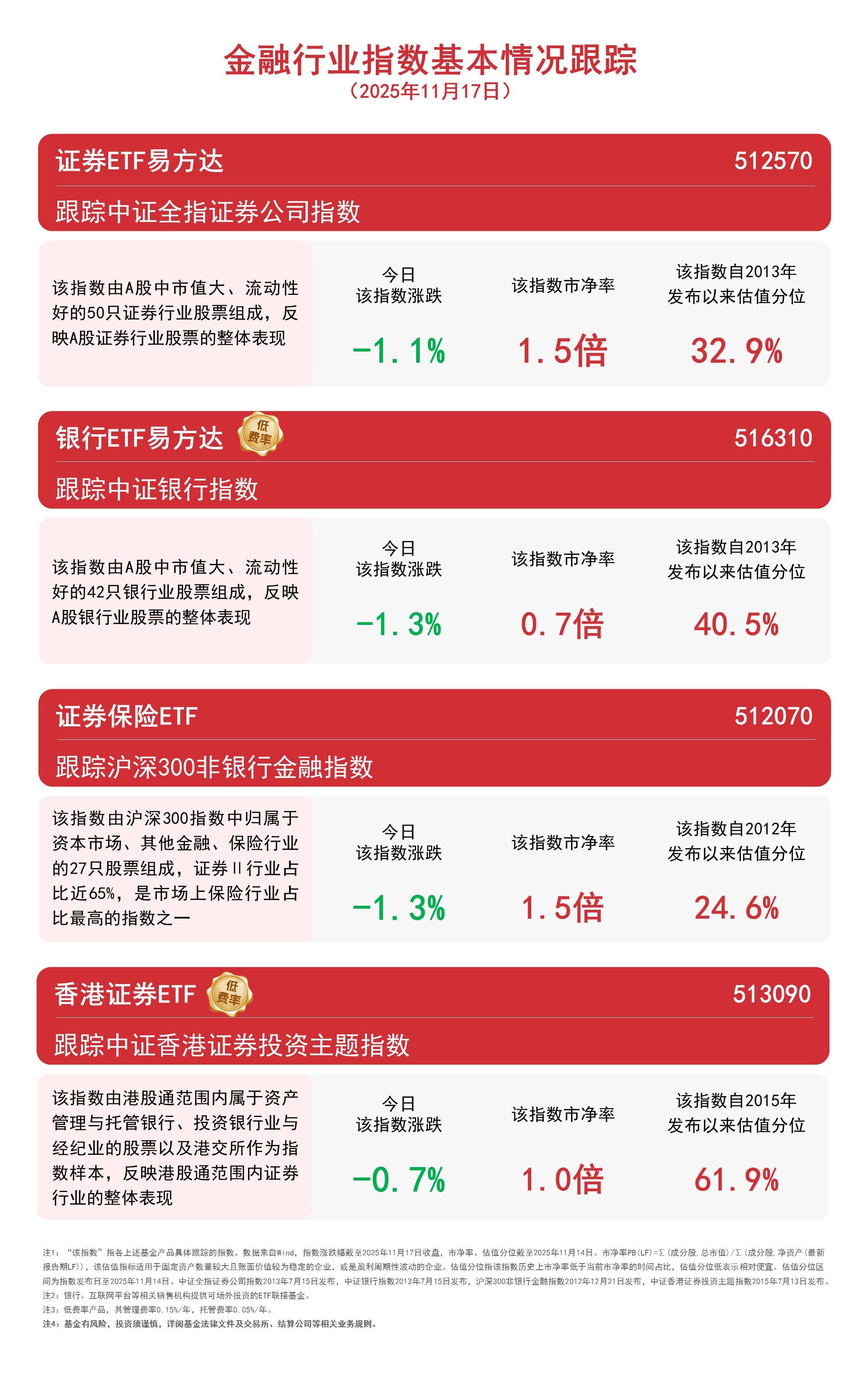
Group 1 - The Hong Kong Securities Index fell by 0.7%, while the CSI All Share Securities Companies Index decreased by 1.1%, and both the CSI Bank Index and the CSI 300 Non-Bank Financial Index dropped by 1.3% [1] - The Securities Insurance ETF (512070) has seen a continuous net inflow of funds exceeding 2.2 billion since November [1] - By the third quarter of 2025, the scale of core equity assets invested by insurance funds is expected to significantly increase, with a quarterly increase of 864 billion in "stocks + funds," including a rise of 552.5 billion in stocks and 311.5 billion in funds [1] Group 2 - The analysis indicates that the current valuation of the securities insurance sector and public fund holdings are at historical lows, suggesting potential for valuation recovery as liabilities improve and asset stability is achieved [1] - The Securities Insurance ETF tracks the CSI 300 Non-Bank Financial Index, which consists of 27 stocks from the CSI 300 Index related to capital markets, other financial services, and the insurance industry, with nearly 65% representation from the securities insurance sector [3]

四大证券报精华摘要:7月9日
Xin Hua Cai Jing· 2025-07-09 03:17
Group 1 - The core viewpoint is that the interest rates for business loans have dropped below 3%, leading to sustained pressure on banks' net interest margins and profitability [1] - Major banks like China Construction Bank and China Merchants Bank have introduced business loan products with minimum annual interest rates as low as 3%, and some products are even in the "2" range when combined with interest rate coupons [1] - The banking industry is facing challenges in credit issuance, and experts suggest that banks should seek breakthroughs through refined management, structural optimization, and comprehensive services [1] Group 2 - The momentum for companies listing in Hong Kong remains strong, with around 200 IPO applications currently in queue [2] - The Hong Kong stock market has shown good performance in the first half of the year, although major stock indices have recently experienced a slowdown in growth [2] - Analysts believe that ongoing regulatory reforms in Hong Kong will enhance market competitiveness and liquidity, leading to continued strong momentum in the new stock market [2] Group 3 - The brokerage sector is expected to maintain high growth in mid-year earnings, driven by a significant increase in new account openings and favorable market conditions in both bond and stock markets [3] - Analysts recommend focusing on mid-year earnings forecasts and themes like stablecoins as potential catalysts for investment in the brokerage sector [3] Group 4 - Insurance capital is expected to increase its allocation to equity assets in the second half of the year, focusing on low-valuation, high-dividend stocks and high-growth sectors like new productivity and new consumption [4] - The low-interest-rate environment has led to a consensus among insurance capital to enhance equity asset allocation as long-term bond yields struggle to meet liability costs [4] Group 5 - As of June 30, northbound funds held a total market value of 2.29 trillion yuan, an increase of approximately 508.85 billion yuan from the previous quarter [5] - The top sectors for northbound fund holdings include power equipment, banking, electronics, food and beverage, and biomedicine [5] Group 6 - The gold market has experienced significant price fluctuations, with prices rising over 30% in the first half of the year, outperforming most asset classes [6] - Factors such as U.S. tariff policies, geopolitical risks, and central bank purchases in emerging markets have supported gold prices [6] - Experts predict that while the long-term upward trend for gold remains intact, short-term price movements may be influenced by U.S. macroeconomic data [6] Group 7 - Northbound funds have increased their holdings in popular sectors, reflecting a strategic shift in investment focus [7] - The overall increase in northbound fund holdings indicates a positive outlook on the recovery of the Chinese economy and trends in consumption and industrial upgrades [8] Group 8 - The Bond Connect program has significantly enhanced the international influence and attractiveness of China's bond market over the past eight years [9] - More than 80 of the world's top 100 asset management firms have entered the Chinese bond market, indicating active participation from foreign investors [9] Group 9 - The lithium battery industry is shifting from a focus on capacity expansion to value optimization, with a consensus emerging around avoiding price wars [10] - Industry experts emphasize the need for both market regulation and technological innovation to address challenges such as idle capacity and declining profits [10] Group 10 - The People's Bank of China has initiated a 500 billion yuan re-loan program to support service consumption and the elderly care industry, encouraging financial institutions to increase support in key areas [11] - The program aims to stimulate financial backing for sectors like accommodation, dining, entertainment, and education [11] Group 11 - The People's Bank of China and the Hong Kong Monetary Authority have announced three measures to optimize cross-border investment mechanisms, enhancing the operational framework of Bond Connect [12] - These measures aim to facilitate more domestic investors in accessing offshore bond markets and improve liquidity management for foreign investors [12] Group 12 - The number of A-share companies intending to acquire IPO candidates has significantly increased, with 27 companies disclosing acquisition plans this year compared to 6 last year [13] - This surge is attributed to policy incentives, increased demand for mergers and acquisitions, and the valuation advantages of IPO candidates [13]
险资下半年有望增配权益类资产
news flash· 2025-07-08 21:12
Core Viewpoint - Insurance capital is expected to increase allocation to equity assets in the second half of the year due to the low interest rate market environment [1] Group 1 - Insurance capital will focus on two main directions for equity asset allocation: undervalued, high-dividend stocks and high-growth stocks represented by new productive forces and new consumption [1]