
靠前发力

Search documents
各部委各地学习中央经济工作会议“划重点”【国盛宏观熊园团队】
Xin Lang Cai Jing· 2025-12-24 16:47
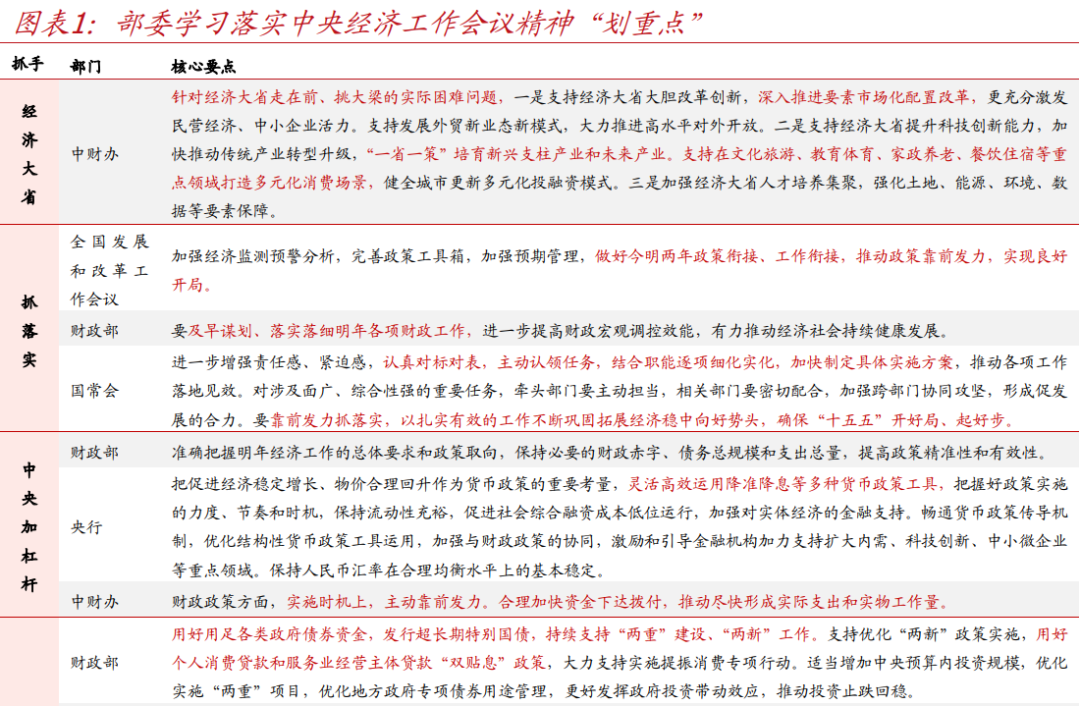
Core Viewpoint - The recent learning and dissemination of the Central Economic Work Conference's spirit by various departments and regions is a crucial window for tracking the implementation of the conference's directives, revealing more details and actionable measures. There are several highlights and new proposals, including a focus on proactive measures, accelerating fund disbursement, supporting new consumption growth points, and emphasizing real and substantial growth without exaggeration [2][3][11]. Group 1: Overall Direction - All parties are refining their deployment around the Central Economic Work Conference's principle of "seeking progress while maintaining stability and improving quality and efficiency," with clear directions and highlighted priorities such as expanding domestic demand, strengthening technology, promoting reform, and stabilizing real estate [3][11]. - The emphasis is on policies that "act proactively" to ensure a good start to the year [3][11]. Group 2: Departmental Deployment - Each department has made detailed deployments based on their functional positioning, with the Central Financial Office providing the most comprehensive interpretation of the conference's spirit, revealing specific tasks and details [4][12]. - Signal 1: The continuation of "central leverage" is confirmed, with specific scales to be determined at the 2026 National Two Sessions, emphasizing proactive measures and reasonable acceleration of fund disbursement [4][12]. - Signal 2: Multiple departments will prioritize expanding domestic demand, utilizing various funds, and supporting "two new" and "two heavy" projects, with new focuses on cultivating trillion-level new consumption growth points and increasing investment in consumption infrastructure and livelihood projects [4][12][13]. Group 3: Industry Focus - Signal 3: There is a strong focus on industrial transformation, self-control, and innovation leadership, promoting the expansion and efficiency of technology finance, particularly in the Beijing-Tianjin-Hebei and Yangtze River Delta regions [5][14]. - Signal 4: The emphasis on reform includes advancing a unified market, combating "involution," and stabilizing the private sector, with more details on fiscal and tax reforms to be discussed in the upcoming National Fiscal Work Conference [6][15]. Group 4: Risk Management and Market Stability - Signal 6: There is a strict adherence to the "no explosion" bottom line for risk prevention, balancing the needs of residents and real estate companies, and reiterating the principles for debt resolution while increasing financial and fiscal support [8][17]. - Signal 7: Efforts to stabilize the stock market will continue, promoting the narrative of the Chinese stock market and accelerating reforms in the Sci-Tech Innovation Board and commercial real estate REITs [9][18]. Group 5: Local Implementation - Many regions have begun to learn and convey the spirit of the Central Economic Work Conference, tailoring key tasks to local conditions, with a focus on proactive measures and concrete actions, particularly in the lead-up to the January 2026 local two sessions [10][23]. - Localities like Zhejiang and Hainan are emphasizing innovation and openness, respectively, while ensuring that actionable measures are taken to support economic growth [10][23][24].

做好明年经济工作,国务院再提跨部门协同,部委几十条举措齐发
2 1 Shi Ji Jing Ji Bao Dao· 2025-12-22 09:04
Core Viewpoint - The State Council's recent meeting emphasizes the need for various departments to align their actions with the central government's economic work decisions, focusing on enhancing responsibility and urgency to ensure effective implementation of economic policies for the upcoming year [2][12]. Group 1: Economic Policy Implementation - The meeting highlighted the importance of cross-departmental collaboration to tackle significant tasks that have broad implications, ensuring a collective effort to promote economic development [2][8]. - Departments have already proposed numerous detailed measures to implement the central economic work meeting's decisions, showcasing characteristics such as specificity, collaboration, and proactive efforts [2][12]. Group 2: Investment and Consumption - The National Development and Reform Commission (NDRC) aims to stabilize investment by planning major engineering projects and clarifying investment rules, while also enhancing the management of investment projects [4]. - The Ministry of Finance plans to increase the scale of central budget investments and optimize the use of local government special bonds to better leverage government investment [5]. - To boost consumption, the NDRC is focusing on practical measures such as optimizing policies for replacing old consumer goods and expanding service consumption [6][7]. Group 3: Policy Coordination - The meeting called for enhanced coordination between fiscal and monetary policies, with the Ministry of Finance and the People's Bank of China both emphasizing the need for collaborative efforts to support domestic demand and innovation [9][10]. - The NDRC is tasked with developing regulations for a unified national market, which is essential for promoting fair competition and economic circulation [10]. Group 4: Education and Talent Development - The central economic work meeting introduced a plan for integrated development of education, technology, and talent, with the Ministry of Science and Technology focusing on policy coordination and resource integration [11]. - The Ministry of Education is set to advance the construction of interdisciplinary centers and improve the standards for top-tier universities to support the cultivation of new economic drivers [11]. Group 5: Forward-Looking Strategies - The meeting underscored the importance of proactive measures to ensure a strong start to the 14th Five-Year Plan, with various departments already drafting development plans across multiple sectors [12][13]. - The NDRC emphasized the need for policy continuity and early implementation to achieve a good start for the upcoming years [15].

对标对表抓落实 协同发力开好局
Xin Lang Cai Jing· 2025-12-20 11:52
Group 1 - The State Council emphasizes the need for all departments to align their actions with the central government's scientific judgment and decision-making regarding the economic situation, ensuring comprehensive implementation of the overall requirements and policy directions for next year's economic work [1][2] - Departments are required to take proactive responsibility for tasks, reflecting a mechanism for responsibility transmission, and to detail and implement specific policies based on the macro policy direction set by the Central Economic Work Conference [2][3] - The importance of cross-departmental collaboration is highlighted, as many key tasks require cooperation among various departments to avoid fragmented policies and enhance implementation effectiveness [3][4] Group 2 - The meeting stresses the need for early and proactive policy implementation, particularly in light of the current economic situation, which necessitates timely responses to challenges such as insufficient domestic demand [4] - The economic growth momentum needs to be maintained, with GDP growth of 5.2% year-on-year for the first three quarters of 2025, indicating an acceleration compared to previous periods [4] - The State Council signals that policy implementation must be swift, departmental collaboration must be strong, and the effectiveness of work must be tangible, especially in the face of complex domestic and international circumstances [4]
中央定调后,国务院开会部署
Xin Lang Cai Jing· 2025-12-20 10:54
Core Viewpoint - The State Council emphasizes the need for all departments to align their actions with the central government's economic work directives for the upcoming year, focusing on responsibility, urgency, and effective implementation of policies [1][2]. Group 1: Policy Implementation - Departments must ensure strict adherence to the central government's spirit when formulating specific policies, avoiding deviations [2]. - The meeting highlights the importance of a responsibility transmission mechanism, where departments actively take on tasks following the macro policy direction set by the central economic work conference [2]. - There is a call for proactive planning and detailed execution of fiscal policies to enhance macroeconomic regulation effectiveness and support sustainable economic development [2]. Group 2: Inter-Departmental Collaboration - The meeting stresses the necessity of cross-departmental collaboration for comprehensive tasks, with leading departments taking initiative and related departments coordinating closely [3]. - The need for a unified approach is emphasized to prevent policy fragmentation, particularly in areas like expanding domestic demand and technological innovation, which require multiple departments to work together [3]. - Future policy-making will likely see the establishment of more inter-departmental coordination mechanisms to enhance policy efficiency, especially in critical areas [3]. Group 3: Proactive Policy Measures - The concept of "early and proactive implementation" is highlighted, indicating that policies should be executed swiftly without delay [3]. - The meeting underscores the importance of early planning for major projects and policies to lay a solid foundation for economic development in the coming year [4]. - Departments are urged to conduct thorough research and analysis to identify core issues, ensuring that policies are precise and effective in addressing real problems [4]. Group 4: Economic Growth and Stability - The meeting aims to maintain and expand the positive momentum of economic growth, with a focus on avoiding formalism and ensuring that policies effectively resolve actual issues [4]. - China's GDP growth for the first three quarters of 2025 is reported at 5.2%, with an increase in economic output, indicating a need to sustain this growth trajectory [4]. - The State Council signals a clear message: policy implementation must be swift, inter-departmental collaboration must be strong, and the effectiveness of work must be tangible [4].