顺周期领域

Search documents
A股首周“开门红”!基金经理发声
Zhong Guo Ji Jin Bao· 2026-01-11 12:58
Group 1 - The core viewpoint of the news is that the A-share market has started the year with a strong performance, indicating robust investor confidence and a favorable environment for growth in 2026 [1][2] - Multiple fund managers believe that the current market rally is supported by clear policy direction and strong capital inflow, which could set a solid foundation for the market's performance throughout the year [2][3] - The spring market rally is characterized by a diverse performance across sectors, with technology, cyclical, consumer, innovative pharmaceuticals, and advanced manufacturing sectors being highlighted as key areas of interest [2][3] Group 2 - Fund managers are focusing on core investment opportunities in technology innovation, cyclical sectors, and strategic emerging industries, suggesting a diversified investment approach to adapt to market changes [3][4] - Specific sectors of interest include AI-related industries, semiconductor equipment, and commercial aerospace, which are expected to benefit from technological advancements and policy support [3][4] - The cyclical sector is also seen as having potential, with fund managers emphasizing the importance of tracking opportunities in coal, engineering machinery, and consumer goods as they may present favorable investment conditions [4]
QFII三季度持股市值已超212亿元
Zheng Quan Ri Bao· 2025-10-27 17:09
Core Insights - QFII's latest holdings reveal a significant presence in the A-share market, with a total of 10.18 billion shares valued at 21.283 billion yuan as of the end of Q3 [1] - The trend shows both new investments and increased holdings in cyclical sectors, particularly in non-ferrous metals and electricity [1][3] - Notable stocks include Shengton Mining, which has the highest QFII holdings at 43.2996 million shares, followed by Shanjin International and Platinum New Materials [1][2] QFII Holdings Overview - As of the end of Q3, 236 A-share companies had QFII among their top ten shareholders, with 93 new heavy positions taken by QFII [1] - 24 new heavy positions had a market value exceeding 100 million yuan, with Platinum New Materials leading at 60.7 million yuan [2] - QFII increased holdings in 67 stocks, with China West Electric and Zhaoxin Shares seeing significant increases, particularly China West Electric with an increase of 72.8511 million shares [3] Institutional Investment Trends - Major international asset management firms are actively increasing their positions, with JPMorgan Securities leading at a holding value of 3.551 billion yuan [3] - Morgan Stanley follows closely with a holding value of 3.184 billion yuan, indicating strong interest in sectors like electricity and technology [3] - The data reflects a positive outlook from foreign institutions towards quality assets in the Chinese capital market [4] Market Outlook - The ongoing disclosure of Q3 reports is expected to clarify foreign investment strategies and sector preferences, potentially leading to more value discovery opportunities [4] - Analysts suggest that the Chinese stock market has medium to long-term investment value due to ample liquidity, structural reforms, and improving profitability [4] - Service consumption is highlighted as a significant growth area, with potential opportunities in tourism and innovative dining sectors [4]
首尾相差近110个百分点 权益类基金业绩分化明显
Shang Hai Zheng Quan Bao· 2025-05-21 19:14
Core Viewpoint - The active equity funds have shown significant performance disparity in 2023, with some funds achieving over 80% returns while others have seen declines exceeding 25% [1][2][5]. Group 1: Performance Highlights - As of May 20, 63 active equity funds have returned over 30% this year, with 11 funds exceeding 50% [1][2]. - More than 150 active equity funds have reached historical highs in their adjusted net asset values [1][2]. - The top-performing funds have capitalized on opportunities in innovative pharmaceuticals, new consumption, and robotics sectors [1][3]. Group 2: Characteristics of Top-Performing Funds - The leading fund, 华夏北交所创新中小企业精选两年定开混合基金, achieved a return of 80.79%, followed by 中信建投北交所精选两年定开混合基金 at 73.12% and 汇添富北交所创新精选两年定开混合基金 at 63.29% [3]. - Funds heavily invested in the robotics sector, such as 鹏华碳中和主题混合基金, reported returns of 61.72%, with several others exceeding 50% [3]. - Pharmaceutical-themed funds, particularly those focused on innovative drugs, have also performed well, with 长城医药产业精选混合基金 returning 55.32% [3]. - Funds focused on new consumption have seen significant rebounds, with 恒越匠心优选一年持有期混合基金 achieving a return of 51.49% [3]. Group 3: Underperforming Funds - Over 90 active equity funds have experienced declines of more than 10%, with the worst-performing fund down by 27.03%, resulting in a performance gap of 107.82 percentage points [1][5]. - Underperforming funds often exhibit concentrated holdings and frequent changes in their top stocks, indicating a trend of chasing market movements [5]. Group 4: Fund Flow and Market Outlook - Due to increased inflows into high-performing funds, several have announced purchase limits, including 中信保诚多策略混合基金 and 中欧价值回报混合基金 [5][6]. - The market is expected to shift from emotion-driven pricing to a focus on fundamentals, with attention on technology growth sectors, cyclical areas, and dividend assets [6]. - The AI sector is highlighted as a key investment theme for the year, with opportunities in AI applications and related hardware expected to exceed market expectations [6].
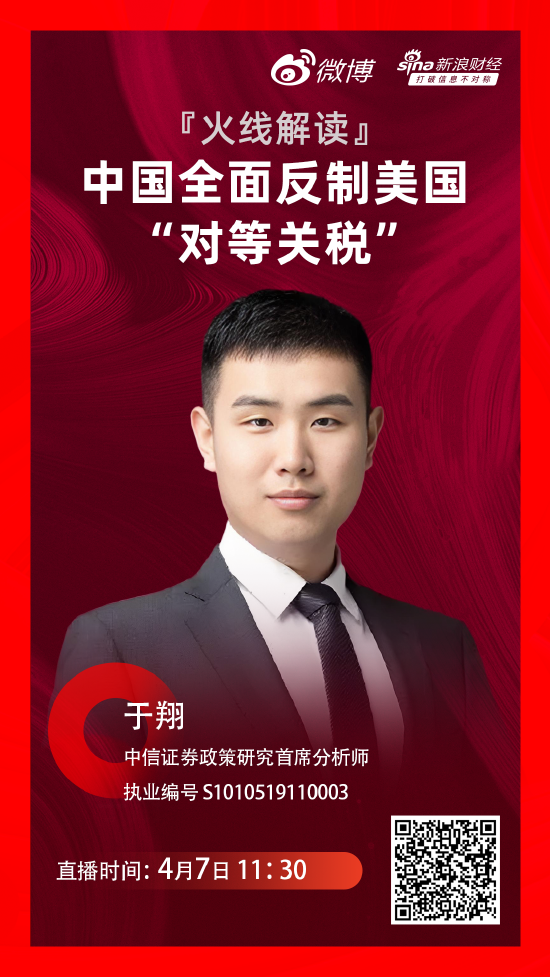
中信证券于翔:现在的大跌是个合适的布局时间点
Xin Lang Zheng Quan· 2025-04-07 04:27
Group 1 - The core viewpoint of the article is that the recent implementation of "reciprocal tariffs" by the Trump administration, which includes a 34% tariff on Chinese imports effective April 9, has led to significant market volatility and a strong response from China, which will impose the same tariff on U.S. goods starting April 10 [1][2] - The A-share market experienced a substantial decline, primarily due to China's unexpected countermeasures and a downturn in overseas markets, which heightened global panic and reduced the likelihood of other countries reaching agreements with the U.S. [1] - The article suggests that the current market downturn may be overly pessimistic, and it recommends focusing on cyclical sectors that are undervalued, such as infrastructure, real estate, and consumer recovery [1][2] Group 2 - The analysis indicates that if China engages in counter-cyclical measures, such as increasing leverage in real estate and city investment, it could lead to an improvement in fundamentals and a potential return of foreign capital [2] - The pressure on the U.S. economy and stock market ahead of the midterm elections in November 2024 may prompt the Trump administration to consider easing policies, which could coincide with China's easing cycle, thus providing a more optimistic outlook for the stock market [2]