
预制菜监管

Search documents
预制菜冒充现炒菜、开封复用?检察机关严查!
Zhong Guo Jing Ji Wang· 2026-02-10 07:07
Core Viewpoint - The article highlights the efforts of the public prosecution in Yunnan Province to address food safety issues related to pre-prepared dishes in online food delivery services, emphasizing the need for integrated regulation to ensure consumer protection and the healthy development of the pre-prepared food industry [1][2]. Group 1: Case Background - The Yunnan Province public prosecution has included a case from the Mengzi City People's Procuratorate in its "Food and Drug Safety Public Interest Litigation Supervision" initiative, focusing on issues such as the misrepresentation of pre-prepared dishes as freshly cooked and improper storage practices [1]. - A specific area in Mengzi City, known for its low rent and convenient transportation, has attracted numerous food service businesses, leading to significant food safety concerns due to non-compliance with storage temperature regulations and unsanitary conditions [1]. Group 2: Investigation and Findings - Following complaints from the public, the Mengzi City Procuratorate conducted an investigation, examining 37 businesses and identifying 6 that were violating food safety regulations by misrepresenting pre-prepared dishes as freshly cooked and failing to maintain proper storage temperatures [1]. - The investigation revealed that some businesses were using thawed pre-prepared dishes that had been refrozen, which raised serious food safety issues [1]. Group 3: Regulatory Actions and Outcomes - In September 2024, a hearing was organized by the Mengzi City Procuratorate in collaboration with the market regulatory bureau and third-party food delivery platforms to build consensus on regulatory measures [2]. - By December 2024, the market regulatory bureau had inspected 389 businesses, issuing corrective notices to 42 of them, while also guiding 11 businesses to clearly indicate the use of pre-prepared dishes on their online platforms [2]. - The efforts led to the establishment of a "standardized takeaway merchant demonstration base" in the area, ensuring compliance with food safety standards and protecting consumer rights [2].
经济观察|中国加快制定国家标准 推动预制菜走向“明白菜”
Zhong Guo Xin Wen Wang· 2025-09-23 01:49
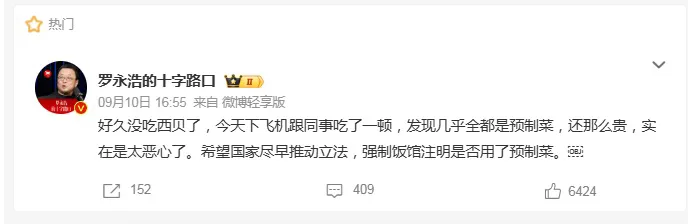
Core Viewpoint - The recent public dispute between the restaurant chain Xibei and internet celebrity Luo Yonghao has brought the topic of prepared dishes back into the spotlight, highlighting the differences in understanding between consumers and restaurant operators regarding prepared dishes and concerns over transparency in the use of such products [1][2]. Industry Development - The rapid industrialization of the restaurant sector is driven by the need for quick service, a wide variety of dishes, and high consumption volumes, leading to the development of central kitchens and chain stores [2]. - The prepared dish market in China is expected to reach a scale of 674.9 billion yuan by 2030, with a compound annual growth rate exceeding 10% over the next decade [2]. Consumer Concerns - Consumers express a need for transparency regarding the use of prepared dishes in restaurants, emphasizing the importance of knowing the true nature of the products they are consuming [3]. - The lack of clear standards and mandatory disclosure requirements has led many operators to avoid informing consumers about the use of prepared dishes, which has contributed to a lack of trust [3]. Regulatory Developments - The Chinese government has initiated efforts to establish national standards for prepared dishes and promote transparency in their use within the restaurant industry to protect consumer rights [1][3]. - Regions such as Guangdong, Shanghai, and Hunan are actively exploring ways to promote transparency in the use of prepared dishes, including labeling them clearly on menus [3].
预制菜监管:如何平衡个人偏好、公众感知与专业认知
Zhong Guo Jing Ji Wang· 2025-09-22 06:41
Core Insights - The recent "pre-prepared food dispute" highlights a preference gap between consumers and restaurant operators regarding pre-prepared dishes [1][2] - The development of the food service industry is pushing for industrialization to meet the demand for quick service, diverse menu options, and high consumption [1][3] Industry Development - The food service industry is rapidly advancing industrialization, with many steamed and soup dishes being stored as semi-finished products to enhance kitchen efficiency [1][3] - A business model combining central kitchens and chain stores is emerging as a response to the need for efficiency and scalability in food service [1][4] Consumer Perception - There is a fundamental difference in perception between operators, who focus on the product itself, and consumers, who are concerned with the production methods [2][3] - Consumers express their economic and social value preferences through their choices regarding food production methods, such as supporting environmentally friendly or traditional practices [3][4] Regulatory Environment - The regulatory landscape is evolving to support the pre-prepared food industry, with national standards for food safety being developed [4] - The government is encouraged to balance industry development needs with consumer transparency desires when considering regulations for pre-prepared foods [4]
罗永浩炮轰西贝:“预制菜卖高价太恶心”!客服喊冤“全是现做”!创始人曾说“好菜靠预制”
Guo Ji Jin Rong Bao· 2025-09-11 07:12
Core Viewpoint - The controversy surrounding Xibei restaurant's use of pre-prepared dishes has sparked widespread discussion online, particularly after a public critique by a prominent figure, Luo Yonghao, who called for clearer labeling of such dishes in restaurants [1][3]. Company Response - Xibei's customer service stated that certain dishes, such as beef bone soup and noodles, are made fresh on-site, denying the extensive use of pre-prepared ingredients [2]. - However, this response contrasts with previous statements from Xibei's founders regarding the use of pre-prepared dishes, leading to consumer confusion [3]. Consumer Sentiment - Many consumers resonate with Luo Yonghao's perspective, arguing that while the use of pre-prepared dishes is acceptable, restaurants should disclose this information to avoid misleading customers [3][4]. - The definition of pre-prepared dishes remains ambiguous, with no industry-wide standards, complicating consumer understanding [3]. Industry Context - The application and frequency of pre-prepared dishes in China are increasing, as noted by industry analysts [5]. - Regulatory bodies have issued guidelines to enhance the safety and transparency of pre-prepared food, emphasizing the need for restaurants to inform consumers about their use [7]. Company Overview - Xibei was founded in 1988 in Inner Mongolia and has expanded to nearly 400 locations across 62 cities in China, employing approximately 17,000 staff by 2025 [7].

清华大学教授谈预制菜:找到对的人,卖进对的场景!
Nan Fang Nong Cun Bao· 2025-08-01 10:33
Core Viewpoint - The article discusses the challenges and opportunities in the prepared food industry, emphasizing the need for effective communication and understanding between proponents and opponents of prepared foods [6][7][12]. Industry Insights - Prepared food is not a new concept; it has evolved with advancements in agricultural production technology, preservation techniques, and cold chain logistics [16][18]. - The industry is at a pivotal moment, as food industrialization has lagged behind other sectors like clothing and housing, but is now gaining traction [22][23]. - There is a significant gap in public understanding of prepared foods, which necessitates better communication strategies to address concerns about safety, nutrition, and freshness [26][76]. Market Dynamics - The promotion of prepared foods often faces resistance due to misconceptions and fears about quality and safety, leading to a lack of consensus among different consumer groups [24][30][36]. - The article highlights the importance of identifying target consumer segments and suitable consumption scenarios for effective marketing of prepared foods [43][45]. Regulatory Considerations - Current regulations for prepared foods are deemed sufficient, with existing standards addressing issues like preservative use and pesticide residues [65][66]. - The focus should be on filling regulatory gaps specific to the prepared food sector rather than creating entirely new standards [67][70]. Recommendations - The article suggests that the Guangdong region, as a pioneer in prepared foods, should enhance public engagement through media and direct consumer experiences to build trust and understanding [76][78].
