风电项目

Search documents
辽宁和展能源集团股份有限公司 2025年度业绩预告
Zheng Quan Ri Bao· 2026-01-26 23:02
Group 1 - The company expects a net profit to be negative for the fiscal year 2025, covering the period from January 1, 2025, to December 31, 2025 [1] - The company has communicated with its auditing firm regarding the performance forecast, and there are no discrepancies in the financial data discussed [1][2] Group 2 - The anticipated loss in 2025 is attributed to the company's renewable energy projects still being in the approval stage, with construction planned to start in 2026, resulting in no revenue generated [2] - The mixed tower business has seen a decrease in revenue compared to the previous year, compounded by intense market competition leading to lower project gross margins [2] - The company expects a reduction in losses by 27% to 47% compared to the previous year due to revenue and profit from acquired wind power projects and the expansion of electrical engineering contracting [2] - The significant asset sale of a major subsidiary at the end of 2024 has reduced the company's stake to 38.68%, which will lower the impact on overall profits for 2025 [2] - The company aims to achieve corresponding income from deposits and financial investments through prudent capital allocation [2]

中船科技:预计2025年净亏损26亿元到34亿元
Ge Long Hui A P P· 2026-01-26 09:45
Core Viewpoint - The company expects a significant net loss for the fiscal year 2025, with projections indicating a net profit attributable to the parent company ranging from -2.6 billion to -3.4 billion yuan, and a net profit excluding non-recurring gains and losses between -2.65 billion and -3.45 billion yuan [1] Group 1: Financial Projections - The anticipated net profit attributable to the parent company for 2025 is projected to be between -2.6 billion and -3.4 billion yuan [1] - The expected net profit after excluding non-recurring items is forecasted to be between -2.65 billion and -3.45 billion yuan [1] Group 2: Market Conditions - The wind power market is experiencing intensified competition, leading to a highly concentrated demand for installations [1] - The company faces delays in the construction and progress of wind power projects due to a peak in market installations during the year [1] - Maintenance and related costs have increased, and the prices of certain components have risen due to supply and demand dynamics, resulting in a failure to achieve expected cost reductions in the supply chain [1]

国内最大陆上风电“巨人方阵”正式商运!
Yang Shi Wang· 2025-09-16 01:49
Core Viewpoint - The first large-scale land wind power project in China, the Inner Mongolia Energy Urat Front Banner 1.5 million kW wind-storage base project, has officially commenced commercial operation, featuring 150 units of 10 MW wind turbines, making it the largest land wind power project in the country [1] Group 1: Project Details - The project is located in Ganqimaodu Town, Urat Front Banner, Bayannur City, Inner Mongolia [1] - It utilizes 150 units of 10 MW wind turbines, forming the largest "giant array" of land wind power in China [1] - The wind turbines are equipped with all-carbon fiber blades, with a root diameter of 3.6 meters, enhancing load-bearing capacity by over 26% [1] Group 2: Technical Innovations - The project features a main shaft bearing of 1.7 meters, with significant improvements in width and thickness, increasing load-bearing capacity by over 20% [1] - The design includes two additional "ears" on both sides of the main unit, utilizing innovative box-type side-mounted technology for optimized load-bearing [1] - The use of stronger dual bearings enhances the stability and reliability of the transmission chain, while reducing the overall weight of the unit by over 5% [1] Group 3: Environmental Impact - Upon full capacity operation, the project is expected to generate 5.44 billion kWh of electricity annually [1] - It is projected to reduce standard coal consumption by approximately 1.64 million tons each year [1] - The project will also contribute to a reduction of carbon dioxide emissions by about 4.98 million tons annually [1]

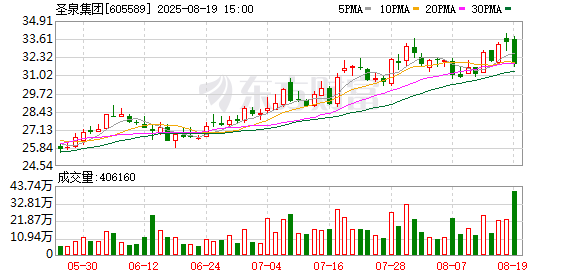
圣泉集团上半年净赚5亿元背后:现金流净流出2.83亿元,短期借款激增五成至23亿元
Mei Ri Jing Ji Xin Wen· 2025-08-19 09:00
Core Viewpoint - In the first half of 2025, Shengquan Group reported significant revenue and profit growth driven by the booming demand for AI servers and the increasing penetration of new energy vehicles, but it also faces financial pressures due to negative cash flow and rising debt levels [2][4][7]. Financial Performance - The company achieved operating revenue of 5.35 billion yuan, a year-on-year increase of 15.67% [3]. - The net profit attributable to shareholders reached 500.94 million yuan, up 51.19% from the previous year [3]. - The net cash flow from operating activities was -283 million yuan, indicating a cash outflow despite improvements from the previous year's -505 million yuan [8][11]. Debt and Cash Flow - Short-term borrowings surged by 50.32% to 2.32 billion yuan, while long-term borrowings increased by 252.13% to 984 million yuan [8][11]. - The asset-liability ratio rose to 35.65%, up from 33.84% at the end of the previous year, reflecting increased financial leverage [11][12]. Business Segments - Traditional business segments, such as phenolic resin and casting auxiliary materials, generated 3.86 billion yuan in revenue, a 13.43% increase, serving as a stabilizing force for the company [6]. - The advanced electronic materials and battery materials segments reported combined revenue of 846 million yuan, a 32.43% increase, showcasing strong growth potential [5]. R&D Investment - R&D expenses reached 285 million yuan, a 25.42% increase from the previous year, focusing on emerging technologies [4][5]. - The company emphasizes the necessity of R&D investment to maintain competitiveness in a rapidly evolving market [4][13]. New Growth Areas - Shengquan Group's biomass business generated 516 million yuan in revenue, a 26.47% increase, indicating strong growth potential [14]. - The company is investing 1.78 billion yuan in a 300MW wind power project, which is expected to provide stable energy supply and align with national energy transition goals [15][16].