餐饮上市潮

Search documents
“微利时代”下,餐饮品牌如何破局?
Hu Xiu· 2025-09-26 03:38
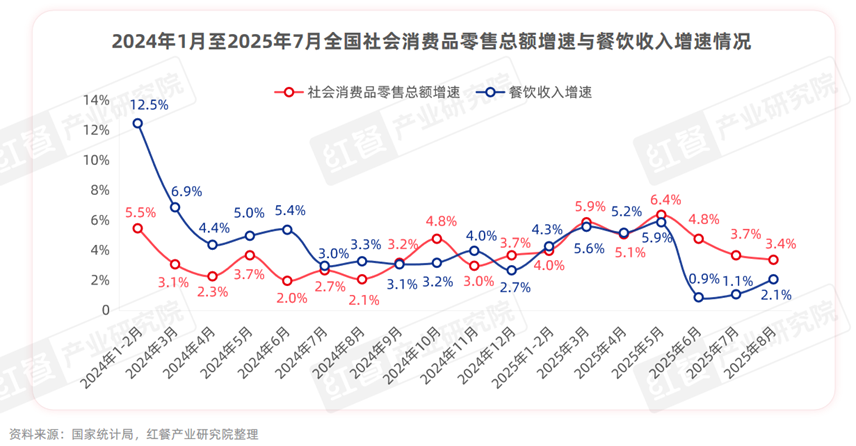
Core Insights - The Chinese catering industry is experiencing a slowdown in growth, with a significant decline in revenue growth rates and a shift in consumer spending habits [2][16][18] - The industry is undergoing a transformation characterized by increased chain operations, innovative marketing strategies, and a focus on product differentiation [5][24][35] Market Overview - National catering revenue from January to August 2025 reached 3.6 trillion yuan, with a year-on-year growth of 3.6%, down 3 percentage points from the same period in 2024 [2] - The number of catering outlets in China exceeded 7.6 million by August 2025, a decrease of 1.9% compared to 2024 [3] Chain Operations - The chain rate in the catering industry has accelerated, with the overall chain rate increasing from 15% in 2020 to an estimated 25% in 2025 [5][6] - The fast food segment saw a 4 percentage point increase in chain rate from 2023 to 2024, reaching 29% [6] Delivery Market Dynamics - The national food delivery market exceeded 1.27 trillion yuan in 2024, growing by 6.2% year-on-year, and is expected to exceed 1.4 trillion yuan in 2025 [9][10] - Daily food delivery orders peaked at over 200 million by August 2025, doubling from 2024 [10] Consumer Behavior - Consumer spending on dining is becoming more cautious, with a significant drop in the proportion of consumers expecting to increase their dining expenditures in 2025 [16][18] - The average per capita consumption in the catering sector fell to 36.6 yuan by August 2025, a decrease of 7.7% from 2024 [18] Industry Trends - The catering industry is witnessing a "listing wave," with several major brands going public in 2025, although many are facing financial challenges [19][22] - The average lifespan of catering outlets has decreased, with many businesses closing within two years of operation [22] Product Innovation - Brands are focusing on product innovation, with over 5,263 new products launched from January to July 2025 [25][28] - Regional ingredients and flavors are becoming key areas for product development [28][29] Marketing Strategies - Short drama marketing is emerging as a new trend, with many brands producing series to engage consumers [35] - User-generated content (UGC) marketing is gaining popularity, with brands launching interactive campaigns to enhance consumer engagement [37] Digital Transformation - The catering industry is increasingly adopting digital and AI technologies to enhance operational efficiency and customer engagement [38][41] - Brands are implementing digital systems for supply chain management and customer relationship management [39][42] International Expansion - Chinese catering brands are exploring overseas markets, with over 30 brands opening their first international locations since 2024 [43] - However, many brands are adopting a more cautious approach to international expansion in 2025 [45][46] Segment Highlights - The "small stir-fry" segment is gaining popularity, particularly in Jiangxi cuisine, with significant social media engagement [52] - The hot pot market is experiencing a decline in outlet numbers and average spending, while smaller hot pot formats are thriving [55][58] - The fast food segment is growing steadily, driven by consumer demand for value [61] - The ready-to-drink beverage market is stabilizing, with tea drinks entering an adjustment phase while coffee drinks continue to grow [64][67]

番茄资本创始人卿永:国内餐饮可出手的机会不多了
经济观察报· 2025-05-10 04:57
Core Viewpoint - The future of restaurant investment will move away from a scattergun approach to a more focused and meticulous strategy, emphasizing the need for investment institutions that understand both capital and industry, capable of identifying and nurturing opportunities [1][14] Group 1: Recent Developments in Restaurant IPOs - New tea beverage brand Bawang Chaji (CHA.O) officially listed on NASDAQ on April 17, becoming the first new-style tea beverage company to enter the US stock market, with a market capitalization exceeding $5 billion after a 12% opening day increase [2] - In the week prior, Hong Kong restaurant brand Niu Daren successfully listed on NASDAQ, raising $120 million, while another brand, Yujian Xiaomian, submitted its prospectus to the Hong Kong Stock Exchange, aiming to become the first listed Chinese noodle restaurant [2] - The recent surge in restaurant IPOs has drawn attention, with several brands, including Mixue Ice Cream and Guming, also having listed in Hong Kong [2] Group 2: Investment Trends and Market Dynamics - According to Qing Yong, founder of Tomato Capital, the current wave of IPOs is a continuation of the investment boom in the restaurant sector that peaked in 2021, which saw 178 financing events totaling over 21 billion yuan [3] - The 2021 investment frenzy led to inflated valuations, with brands like Manner and Hutouju achieving single-store valuations exceeding 100 million yuan and 375 million yuan respectively [4] - However, investment in the restaurant sector has cooled significantly, with a 20% year-on-year decrease in financing events in 2023, as capital shifts towards mature enterprises [4] Group 3: Challenges and Future Outlook - Current restaurant investments face the challenge of limited available projects, with many enterprises under pressure to exit their investments, making IPOs a necessary choice [4][5] - The investment landscape has shifted, with a more cautious valuation approach now prevalent, with PE ratios for quality projects at 15 times and ordinary projects at 10 times [10] - The market is witnessing a transformation where only those with sustainable cash flow and reasonable growth will receive valuations aligned with their fundamentals [10][12] Group 4: Investment Strategies and Focus Areas - The financing logic in the restaurant industry has changed, with three main types of companies seeking funding: those nearing IPO, those facing exit pressure, and those with validated single-store models ready for scaling [11][12] - Investment institutions are increasingly focusing on nurturing quality entrepreneurs and building a comprehensive industry ecosystem, moving away from traditional financial investment models [12][13] - Companies are exploring overseas markets for greater investment opportunities, with the US market offering stable single-store profit models and mature exit mechanisms [15]