骗取出口退税

Search documents
中国税务部门曝光4起骗取出口退税违法案件
Xin Lang Cai Jing· 2026-02-27 10:11
Core Viewpoint - The Chinese tax authorities have exposed four cases of fraudulent export tax refund schemes, highlighting the ongoing issue of tax evasion in the export sector [1][2] Group 1: Fraudulent Activities - Some companies have rebranded non-refundable fertilizer products as refundable industrial chemical products to evade supervision [1] - Other companies have fabricated invoices and created false input tax claims, matching them with real export goods to create a false "invoice-goods consistency" [1] - Additional methods used by companies include multiple layers of fake invoices, false transactions, over-reporting low-value goods, and fraudulent foreign exchange settlements, forming a seemingly intricate tax evasion network [1] Group 2: Enforcement Actions - The tax authorities have imposed penalties on the involved parties, including the recovery of 201 million yuan from three companies in Tianjin and a three-year suspension of their export tax refund processing [1] - The export tax fraud involves multiple sectors such as production, trade, customs, logistics, and foreign exchange, characterized by strong concealment and high difficulty in investigation [1] - Eight departments, including tax and public security, are enhancing collaboration to establish a normalized mechanism for combating tax fraud, creating a comprehensive and integrated enforcement system from administrative law to criminal justice [1] Group 3: Impact and Future Measures - By 2025, the joint efforts of the eight departments are expected to further enhance the mechanism, with a cumulative inspection of 76,000 suspected fraudulent companies and recovery of over 10 billion yuan in export tax losses [1] - The actions taken against tax fraud not only serve as a deterrent to wrongdoers but also protect compliant businesses, thereby maintaining a fair competitive market environment and supporting healthy foreign trade development [2]
空壳工厂跨省“买单”,4起骗取出口退税违法案曝光
Bei Jing Ri Bao Ke Hu Duan· 2026-02-27 09:30
Core Viewpoint - Multiple departments in regions such as Tianjin, Heilongjiang, Guizhou, and Chongqing have jointly investigated and exposed cases of fraudulent export tax refunds, highlighting the ongoing issue of tax fraud in the export sector [1][2][3]. Group 1: Case Summaries - In Tianjin, three export companies controlled by Yang Rongdong were found to have fraudulently obtained export tax refunds totaling 201 million yuan through false contracts and fake invoices from 2020 to 2022 [1]. - In Heilongjiang, seven companies controlled by Liu Jingwei were investigated for fraudulently obtaining export tax refunds amounting to 66.9745 million yuan from 2020 to 2023 using false agricultural product invoices [2]. - In Guizhou, the company controlled by Yu Jian was found to have fraudulently obtained export tax refunds of 54.6509 million yuan from 2020 to 2022 through various illegal methods including false invoices and inflated export prices [2]. - In Chongqing, Hongyi Biotechnology (Chongqing) Co., Ltd. was investigated for obtaining export tax refunds of 1.8316 million yuan from 2021 to 2023 through fictitious transactions and fake invoices [3]. Group 2: Legal Consequences - The Tianjin case resulted in the prosecution of Yang Rongdong and five others for tax fraud, with a total of 201 million yuan to be recovered and a three-year suspension of export tax refunds for the involved companies [1]. - Liu Jingwei received a 15-year prison sentence for his role in the Heilongjiang case, with other accomplices receiving sentences ranging from 2 years and 10 months to 12 years [2]. - In the Guizhou case, Yu Jian was sentenced to 13 years in prison, with additional accomplices receiving sentences between 2 years and 6 months to 5 years and 2 months [2]. - The Chongqing case led to the prosecution of four individuals for multiple charges including tax fraud and invoice fraud [3]. Group 3: Regulatory Response - The tax authorities emphasized that fraudulent export tax refunds undermine tax revenue and disrupt fair market competition, calling for compliance and lawful tax practices among businesses [3]. - A collaborative mechanism involving tax, public security, courts, and other regulatory bodies will be strengthened to combat tax-related fraud effectively [3].
涉“买单配票”、虚构交易等 税务部门曝光4起骗取出口退税违法案件
Yang Shi Xin Wen· 2026-02-27 09:01
Group 1 - Multiple departments in Tianjin, Heilongjiang, Guizhou, and Chongqing have jointly investigated and exposed four cases of fraudulent export tax refund claims [1][2][3][4] - In Tianjin, three companies controlled by Yang Rongdong were found to have defrauded export tax refunds totaling 201 million yuan from 2020 to 2022 through various illegal means [1] - In Heilongjiang, seven companies controlled by Liu Jingwei were found to have defrauded export tax refunds amounting to 66.9745 million yuan from 2020 to 2023, with Liu receiving a 15-year prison sentence [2] - In Guizhou, the company controlled by Yu Jian was found to have defrauded export tax refunds of 54.6509 million yuan from 2020 to 2022, with Yu sentenced to 13 years in prison [3] - In Chongqing, Hongyi Biotechnology (Chongqing) Co., Ltd. was found to have defrauded export tax refunds of 1.8316 million yuan from 2021 to 2023, with four individuals facing prosecution [4]
子公司骗税被罚没2400万元,负责人被判刑
Mei Ri Jing Ji Xin Wen· 2025-12-20 10:33
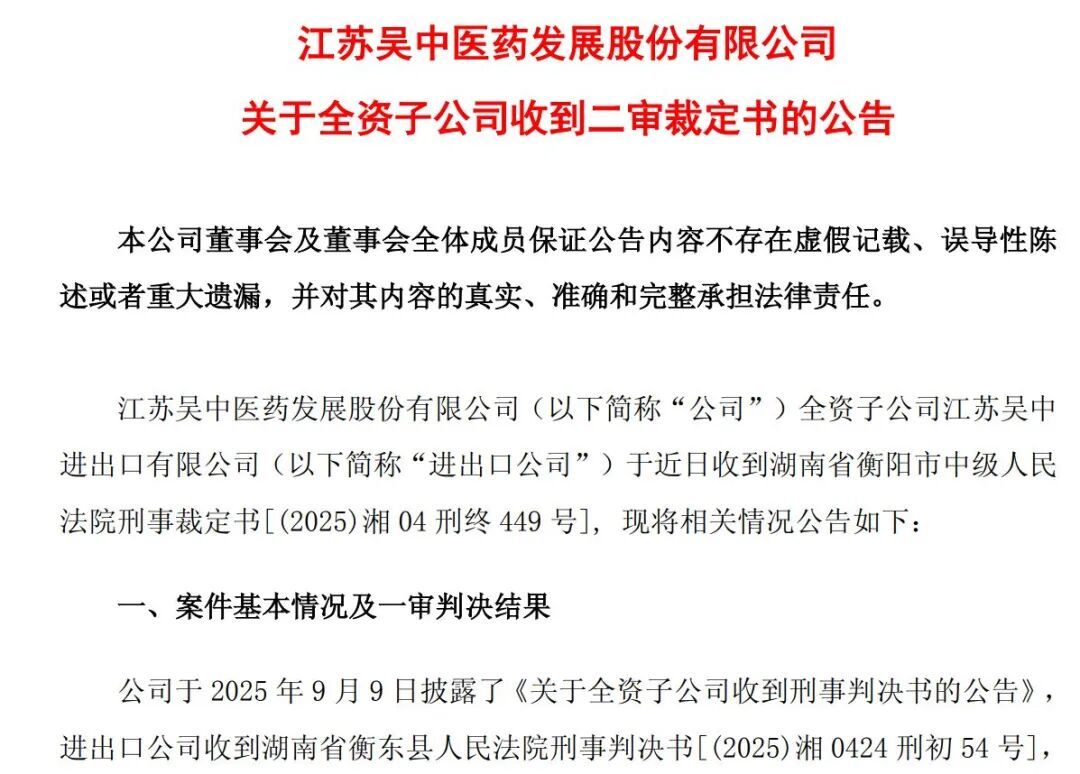
Core Viewpoint - The final ruling on a tax fraud case involving Jiangsu Wuzhong and its subsidiary, Wuzhong Import and Export Co., has been announced, confirming the company's ongoing financial and operational challenges, including an impending delisting from the stock market [1][2]. Group 1: Tax Fraud Case - Jiangsu Wuzhong's subsidiary, Wuzhong Import and Export, was found guilty of tax fraud, resulting in a fine of 8 million yuan and a prison sentence of 3 years and 6 months for the company's former chairman, Yang Feng [1]. - The fraudulent activities occurred from July 2011 to December 2018, during which the company illegally obtained approximately 242 million yuan in export tax rebates and profited over 16 million yuan through service fees [4]. - The case revealed that Wuzhong Import and Export disguised its operations to facilitate tax fraud, significantly impacting its financial performance, as evidenced by a drastic profit drop from 14.67 million yuan in 2018 to just 180,600 yuan in 2019 [5]. Group 2: Company Delisting - Jiangsu Wuzhong is facing delisting due to continuous financial fraud and misuse of funds, with the last trading day expected to be December 29, 2025 [2]. - The company has been under scrutiny for failing to disclose its actual controlling shareholders, which has compounded its legal and financial troubles [7]. - Despite the ongoing legal issues, Jiangsu Wuzhong claims that the court ruling will not affect its normal business operations [1].


判了!子公司骗税被罚没2400万元,负责人被判刑!母公司连续多年财务造假,被实控人钱氏姐弟“掏空”,将被上交所摘牌
Mei Ri Jing Ji Xin Wen· 2025-12-20 09:00
Core Viewpoint - A tax fraud case involving Jiangsu Wuzhong and its subsidiary has reached a final verdict, with significant implications for the company's future and ongoing operations [1][2]. Group 1: Legal Proceedings and Verdict - Jiangsu Wuzhong's wholly-owned subsidiary, Wuzhong Import and Export Co., received a final ruling from the Hunan Province Hengyang Intermediate People's Court, upholding the original judgment [1]. - The first-instance judgment revealed that Wuzhong Import and Export was found guilty of tax fraud, resulting in a fine of 8 million yuan, and the former legal representative, Yang Feng, was sentenced to 3 years and 6 months in prison along with a fine of 123,000 yuan [1][4]. - The court also ordered the confiscation of illegal gains amounting to 16 million yuan, which had been seized by law enforcement [1]. Group 2: Financial Implications and Company Operations - Jiangsu Wuzhong announced that the verdict would not affect its normal business operations, stating that the company's current operational status remains stable [1]. - The tax fraud case spanned from July 2011 to December 2018, during which Wuzhong Import and Export fraudulently obtained approximately 242 million yuan in export tax rebates [4]. - The company had previously reported a significant drop in profits from Wuzhong Import and Export, with a 98.77% decrease in 2019 compared to 2018, which was later linked to the fraudulent activities [5]. Group 3: Company’s Listing Status and Investor Rights - Jiangsu Wuzhong is facing delisting, with only six trading days remaining before its stock enters a delisting period, expected to conclude on December 29, 2025 [2][7]. - Despite the impending delisting, investors who purchased shares between April 20, 2019, and February 26, 2025, retain the right to claim compensation for losses incurred [6][7]. - The company is under scrutiny for financial misconduct, including inflated revenues exceeding 1.7 billion yuan over four years, which has led to potential legal repercussions for its current management [6].

退市之际 江苏吴中子公司骗税案终审落槌:收缴违法所得1600万元并处罚金800万元
Mei Ri Jing Ji Xin Wen· 2025-12-19 15:09
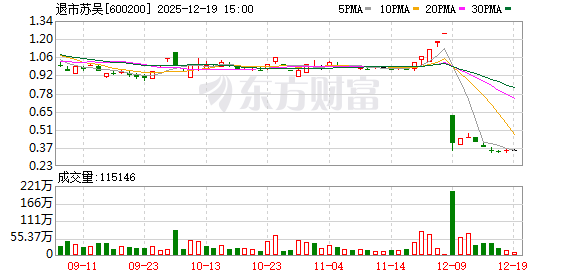
Core Viewpoint - Jiangsu Wuzhong (SH600200) is facing a final ruling on a tax fraud case involving its wholly-owned subsidiary, which has implications for its impending delisting due to financial misconduct and related issues [2][3]. Group 1: Legal Proceedings - Jiangsu Wuzhong's subsidiary, Wuzhong Import and Export Co., received a final ruling from the Hunan Province Hengyang Intermediate People's Court, upholding a previous judgment that found it guilty of tax fraud, resulting in a fine of 8 million yuan [2]. - The former legal representative and chairman of Wuzhong Import and Export, Yang Feng, was sentenced to 3 years and 6 months in prison and fined 123,000 yuan for his role in the fraud [2][6]. - The court ordered the confiscation of 16 million yuan in illegal gains from the subsidiary, which will be turned over to the national treasury [2]. Group 2: Company Operations and Financial Impact - Jiangsu Wuzhong announced that the legal ruling will not affect its normal business operations, stating that the company's current operational status remains normal [2]. - The company is in the process of delisting, with its stock entering a delisting preparation period on December 9, 2025, and the last trading day expected to be December 29, 2025 [3]. - The tax fraud case spanned from July 2011 to December 2018, during which the subsidiary allegedly defrauded approximately 242 million yuan in export tax rebates [6]. Group 3: Financial Performance and Irregularities - In 2018, Wuzhong Import and Export reported a profit of 14.67 million yuan, but this figure plummeted to only 180,600 yuan in 2019, a decrease of 98.77%, raising concerns about the legitimacy of its financial reporting [7]. - The fraudulent activities were linked to a network of related transactions that inflated revenues by over 1.7 billion yuan over four years, involving the current controlling shareholders of Jiangsu Wuzhong [8]. Group 4: Investor Implications - Investors who purchased shares between April 20, 2019, and February 26, 2025, and incurred losses after the stock's delisting can claim compensation from Jiangsu Wuzhong [9]. - The company’s stock will be delisted and transferred to the National Equities Exchange and Quotations system after the delisting period, but the ability of investors to recover losses may be complicated by the company's financial condition [9].
退市之际,江苏吴中子公司骗税案终审落槌:收缴违法所得1600万元并处罚金800万元
Mei Ri Jing Ji Xin Wen· 2025-12-19 14:57
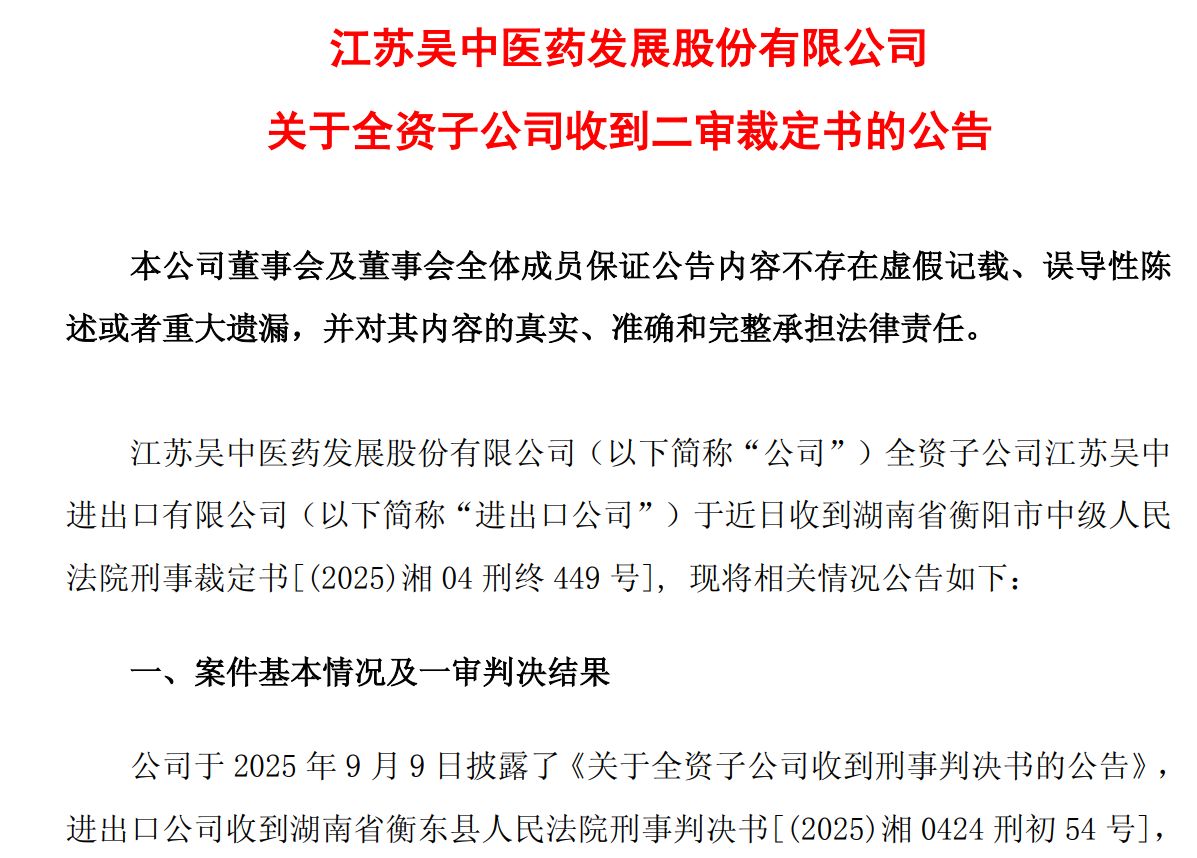
Core Viewpoint - A tax fraud case involving Jiangsu Wuzhong and its subsidiary has reached a final verdict, coinciding with the company's impending delisting due to financial misconduct [2][6]. Group 1: Legal Proceedings - Jiangsu Wuzhong's wholly-owned subsidiary, Jiangsu Wuzhong Import and Export Co., received a final ruling from the Hunan Hengyang Intermediate People's Court, upholding the original judgment that found it guilty of tax fraud, imposing a fine of 8 million yuan [1]. - The former legal representative and chairman of Jiangsu Wuzhong Import and Export, Yang Feng, was sentenced to 3 years and 6 months in prison and fined 123,000 yuan for his role in the fraud [1][4]. - The fraudulent activities spanned from July 2011 to December 2018, resulting in approximately 242 million yuan in export tax refunds obtained through illegal means [4]. Group 2: Financial Impact and Company Operations - Jiangsu Wuzhong's stock is set to enter a delisting period, with the last trading day expected to be December 29, 2025, due to continuous financial fraud and misuse of funds [2][6]. - Despite the legal issues, Jiangsu Wuzhong stated that the judgment would not affect its normal business operations, and the company is currently functioning normally [1][2]. - The subsidiary's profits were significantly inflated due to the fraudulent activities, with a notable drop in profits from 14.67 million yuan in 2018 to just 180,600 yuan in 2019, a decrease of 98.77% [5]. Group 3: Investor Implications - Investors who purchased Jiangsu Wuzhong's stock between April 20, 2019, and February 26, 2025, may have the right to claim compensation for losses incurred after the company's delisting [6][7]. - The delisting process will not affect investors' rights to seek compensation, although it may complicate the recovery of funds due to the company's financial condition [7].
“资金疑云”牵出骗税黑洞 ——揭秘温州畅豪国际贸易有限公司骗取出口退税案件
Sou Hu Cai Jing· 2025-12-03 23:41
Core Viewpoint - The case of Wenzhou Changhao International Trade Co., Ltd. involved fraudulent export tax refunds amounting to 19.6792 million yuan through the issuance of false VAT invoices without actual goods transactions [1][2][3]. Group 1: Fraudulent Activities - Wenzhou Changhao International Trade Co., Ltd. engaged in fraudulent activities by paying fees to 12 upstream companies to issue 1,528 false VAT invoices, resulting in the illegal acquisition of export tax refunds [1][2]. - The company reported an unusually high foreign exchange settlement amount of 82.7 million yuan from June 2015 to December 2017, with no corresponding shipping expenses [3]. - The company’s financial records showed a total payment of 300 million yuan for goods from June 2015 to August 2023, while only 2.15 million yuan was spent on shipping and agency fees, significantly lower than industry averages [3]. Group 2: Investigation and Evidence - A joint task force comprising tax authorities, police, and banking officials was formed to investigate the case, tracing over 1,700 invoices and identifying a pattern of concentrated invoice issuance from upstream companies [4]. - The investigation revealed that the upstream companies had a close relationship, with the same financial personnel managing multiple entities, indicating potential collusion in issuing false invoices [4]. - The task force uncovered a total of 160 million yuan in fraudulent funds and identified the main perpetrator, Zhou, and 12 upstream companies involved in the scheme [4]. Group 3: Legal Consequences - The legal actions taken against Wenzhou Changhao International Trade Co., Ltd. included the recovery of 1.3507 million yuan in tax and penalties, along with a fine of 20 million yuan imposed by the court [5]. - Zhou, the legal representative of the company, was sentenced to ten years and three months in prison and fined 1.2 million yuan for his role in the fraudulent activities [5]. - The tax authorities emphasized their commitment to combating tax fraud and maintaining tax order to ensure national tax security [1][5].

最高人民法院发布依法惩治危害税收征管犯罪典型案例
Yang Shi Wang· 2025-11-24 02:23
Core Viewpoint - The Chinese judicial system is intensifying efforts to combat tax-related crimes, particularly focusing on the transition from traditional tax management to data-driven approaches, highlighting the increasing sophistication of tax evasion methods [1][2]. Group 1: Tax Crime Trends - Tax crime methods are evolving, with new techniques such as "yin-yang contracts" being used to evade taxes, making detection and prosecution more challenging [1][2]. - The judicial system is committed to maintaining tax order and promoting compliance through the prosecution of various tax crimes, including tax evasion and fraudulent tax refunds [2]. Group 2: Case Summaries - Case 1: Individuals used 880 fraudulent VAT invoices to evade taxes amounting to over 23 million yuan, resulting in significant prison sentences [3][4]. - Case 2: A real estate company and its manager evaded over 386,000 yuan in taxes through deceptive practices, leading to fines and imprisonment [6][7]. - Case 3: An individual was sentenced for maliciously evading tax payments totaling over 406,000 yuan by transferring funds to avoid detection [9][10]. - Case 4: A textile company was found guilty of fraudulently claiming 870 million yuan in export tax refunds through circular export practices [12][14]. - Case 5: A logistics company was penalized for illegally selling VAT invoices, resulting in a prison sentence and substantial fines [16][17]. - Case 6: An individual was sentenced for issuing fraudulent VAT invoices, with significant penalties imposed [20][21]. - Case 7: A group was convicted of using false export documentation to claim over 140 million yuan in tax refunds [23][25]. - Case 8: A company was found guilty of misrepresenting silver exports to fraudulently claim tax refunds, resulting in severe penalties [27][28]. Group 3: Legal Implications - The judicial system emphasizes the importance of distinguishing between tax evasion and tax fraud, with different legal consequences based on the nature of the crime [5][11][22]. - The increasing complexity of tax crimes necessitates a robust legal framework to ensure effective prosecution and deterrence [19][26][29].
当心!涉税“三假”就在身边:教你一眼识别,合规经营有保障
21世纪经济报道· 2025-08-26 12:54
Core Viewpoint - The article discusses the "three false" tax-related illegal activities, emphasizing the importance of compliance in business operations to avoid legal repercussions and maintain market order [2][3][4]. Group 1: Definition of "Three False" Tax-Related Illegal Activities - "Three false" tax-related illegal activities include: - "Fake enterprises" that exist solely to issue false invoices without actual business operations [5]. - "Fake exports" where companies fabricate export activities to fraudulently claim export tax refunds [9]. - "Fake declarations" involving false reporting to illegally obtain tax benefits or evade taxes [10]. Group 2: Characteristics of "Three False" Tax-Related Illegal Activities - Characteristics of fake enterprises include: - Established in regions with tax incentives or lax tax supervision, lacking real business operations and necessary staff [14]. - Abnormal financial activities, such as issuing false invoices and creating fictitious transaction records [14]. - Fake exports are characterized by: - No actual export activities, using forged customs information and purchasing invoices to claim refunds [9]. - Fake declarations involve: - Fabricating documents to obtain tax reductions or using dual contracts to inflate costs [10]. Group 3: Penalties for "Three False" Tax-Related Illegal Activities - Penalties for fake enterprises include: - Administrative fines ranging from 5,000 to 500,000 yuan based on the amount of false invoices issued [18]. - Criminal penalties for serious offenses, including imprisonment and fines based on the amount of tax fraudulently claimed [19]. - For fake exports, penalties include: - Recovery of fraudulently claimed tax amounts and fines ranging from 1 to 5 times the amount [22]. - For fake declarations, penalties involve: - Recovery of taxes owed plus fines ranging from 0.5 to 5 times the amount evaded [28]. Group 4: Recommendations for Businesses - Companies should establish robust invoice management systems to ensure proper issuance and use of invoices [32]. - It is crucial to verify supplier qualifications to ensure legitimate transactions and legal invoice sources [32]. - Businesses must maintain clear and accurate financial records to prevent fraudulent practices [32]. - Export companies should adhere strictly to export tax refund regulations to ensure the legality of their operations [32]. - Continuous education on tax regulations and cooperation with tax authorities is essential for compliance [33].