
虚开增值税专用发票

Search documents
全文发布丨贵金属行业税务合规报告(2026)
Sou Hu Cai Jing· 2026-01-26 08:51
Core Insights - Precious metals like gold and silver hold a critical position in the global economic landscape, combining commodity, financial, and monetary attributes. The Chinese government aims to enhance the quality of the gold industry through a three-year development plan from 2025 to 2027, addressing issues such as resource security and technological capabilities [3][6]. Group 1: 2025 Precious Metals Industry Overview - China is the largest producer and consumer of gold globally, with a production of 377.24 tons and consumption of 985.31 tons in 2024, maintaining its leading position for 18 and 12 consecutive years, respectively [6][8]. - The Ministry of Industry and Information Technology and other departments have outlined nine core areas for high-quality development in the gold industry, focusing on enhancing resource security and technological innovation [6][9]. - By 2027, the gold resource security capacity is expected to increase by 5%-10%, with gold and silver production projected to grow by over 5% [6]. Group 2: 2025 Taxation Environment and Compliance - The report emphasizes tax compliance as a core focus, providing insights into the tax policy environment and regulatory trends affecting the precious metals industry [4]. - The introduction of a new tax management model for gold aims to establish compliance standards and enhance regulatory oversight, particularly in export tax refunds [3][4]. Group 3: Tax Risk Observations in 2025 - Some companies have exploited the high value and liquidity of gold to engage in fraudulent activities, such as fictitious invoicing and manipulating material ratios to qualify for export tax refunds [10][11]. - Notable cases include a company that fraudulently claimed export tax refunds amounting to 17.28 million yuan by misrepresenting the gold content in products [15][19]. Group 4: 2026 Tax Environment Analysis - The implementation of the new VAT law in 2026 will further tighten export tax refund management, standardizing penalties for late submissions and clarifying responsibilities for entrusted exports [30][31]. - The tax authorities are set to enhance oversight through digitalization and data analysis, aiming to improve compliance and reduce tax evasion [35][36]. Group 5: New Gold Tax Policy and Compliance Risks - The new gold tax policy, effective from November 1, 2025, introduces a classification management model based on the purpose of gold usage, differentiating between investment and non-investment purposes [40][41]. - Companies must now report any changes in the intended use of gold to the exchange, which will help mitigate risks associated with tax fraud and invoice manipulation [51][52]. Group 6: Export Tax Refund Risks for Precious Metal Products - The evolution of export tax refund policies for precious metals has shifted from lower refund rates to stricter controls, with significant implications for compliance and tax planning [55][56]. - The tightening of regulations aims to prevent tax fraud related to precious metals, with a focus on ensuring that companies adhere to the legal requirements for export refunds [55][56].

司尔特(002538.SZ):收到《不起诉决定书》
Ge Long Hui A P P· 2026-01-21 11:00
Core Viewpoint - The company, Si Er Te (002538.SZ), has received a non-prosecution decision from the Xuanzhou District People's Procuratorate in Anhui Province, indicating that it will not face criminal charges related to alleged unit crimes and is considered a victim in a separate case involving embezzlement [1][2]. Group 1 - The company was previously involved in a case where its former chairman, Jin Guoqing, allegedly arranged for false procurement contracts to siphon funds into a private account, without actual transactions taking place [2]. - The company was implicated in a scheme where it allegedly created false sales records of organic fertilizers to fraudulently obtain government subsidies between January 2020 and February 2022 [2]. - The court determined that the company did not intend to defraud the state through the issuance of false VAT invoices, leading to the decision of non-prosecution [2].

32家空壳公司、税额超5000万,一张完税证明牵出涉税犯罪网络
Xin Lang Cai Jing· 2025-12-30 06:40
Core Viewpoint - The article highlights a significant case of tax fraud involving the illegal purchase and sale of value-added tax (VAT) invoices, leading to legal consequences for the involved parties, including prison sentences and fines [1][9]. Group 1: Tax Fraud Case Overview - In May 2023, a mining company in Sanmenxia was investigated for issuing a suspicious tax payment certificate, which led to the discovery of a larger tax fraud network [2]. - The investigation revealed that the mining company had received 10 VAT invoices totaling nearly 9.9 million yuan from a telecommunications company, with no actual business transactions recorded [2]. - A total of 32 companies controlled by an individual named Zhang were found to be involved in issuing 5,150 fraudulent VAT invoices, amounting to 54.14 million yuan in tax [4]. Group 2: Criminal Activities and Methods - Zhang and his associates devised a scheme to acquire VAT invoices to reduce tax burdens and secure government subsidies, leading to the purchase of fraudulent invoices [3][4]. - The criminal organization established a structured process for invoice procurement, involving intermediaries and multiple shell companies to facilitate the fraud [4][5]. - The scale of the operation expanded significantly, with Zhang's companies generating substantial illegal profits through the sale of fraudulent invoices [4][5]. Group 3: Legal Proceedings and Outcomes - The case was transferred to the Sanmenxia District Procuratorate for prosecution, where the complexity of the case required thorough evidence review and legal application [6][9]. - A total of 14 individuals were prosecuted, receiving sentences ranging from six months to two years and six months, with some receiving probation [9]. - Following the court's decision, the procuratorate initiated property enforcement supervision, ensuring that the illegal gains were returned to the state treasury [9].

“水果第一股”退市,超600亿市值蒸发,创始人身陷囹圄
Yang Zi Wan Bao Wang· 2025-12-26 10:36
Core Viewpoint - Hong Jiu Fruit (06689.HK), once hailed as the "first stock of fruits," is set to be delisted from the Hong Kong Stock Exchange on December 30, marking the end of its journey as a major player in the fruit distribution industry after facing severe financial disclosure issues [1][2]. Group 1: Company Overview - Hong Jiu Fruit was recognized as the largest fruit distributor in China by sales revenue in 2022, particularly dominating the durian and imported dragon fruit markets [4]. - The company was founded by Deng Hong Jiu in 1987 and achieved significant wealth, ranking 85 billion yuan on the Hurun Rich List in 2022 [4]. Group 2: Financial Issues - The company has been suspended from trading since March 2024 due to failure to disclose financial reports, resulting in a market value decline from a peak of 67 billion HKD (approximately 60.3 billion RMB) to 2.795 billion HKD, a drop of over 95% [1][2]. - KPMG, the auditing firm, discovered irregularities, including a prepayment balance of approximately 4.47 billion yuan, with 3.42 billion yuan paid to new suppliers in the fourth quarter, raising concerns about the financial authenticity [2]. Group 3: Governance and Legal Challenges - In April 2024, the chairman Deng Hong Jiu and several board members were taken into custody for alleged loan fraud and issuing false VAT invoices, leading to a collapse in the company's governance structure [2][4]. - Despite attempts to restructure in May 2024, the resignation of three independent non-executive directors rendered the audit committee non-functional, further deteriorating the company's governance [4].
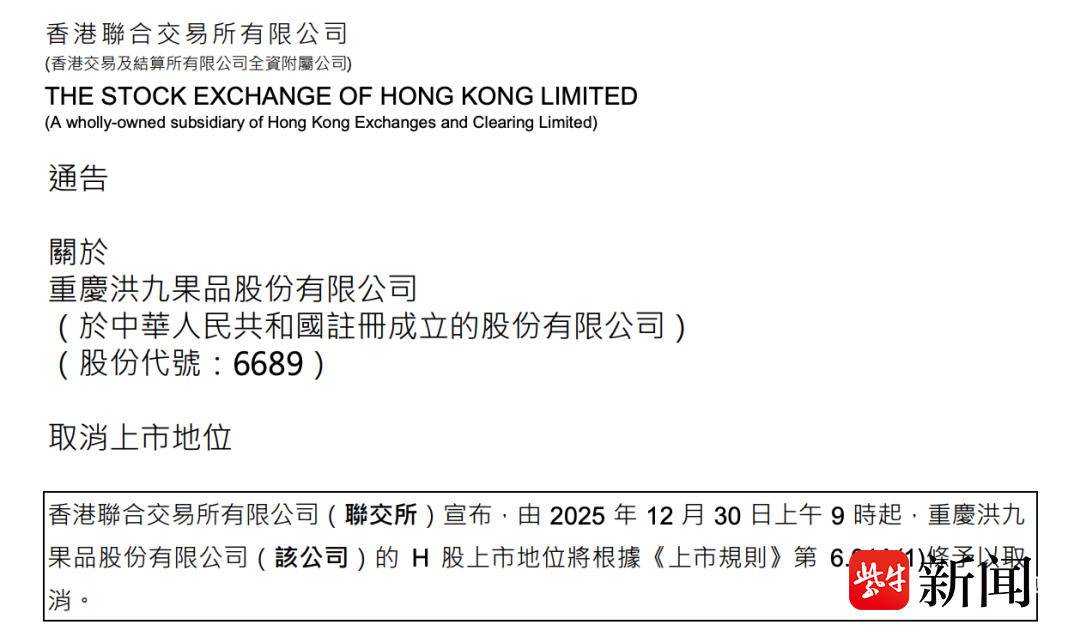
水果第一股将退市,多名高管此前被抓,公司市值缩水600亿,昔日榴莲大王凉凉
21世纪经济报道· 2025-12-25 15:09
Core Viewpoint - Hongjiu Fruit (06689.HK), once known as the "first fruit stock" in China, is set to be delisted from the Hong Kong Stock Exchange on December 30, following a prolonged suspension of over a year and a half due to failure to disclose financial reports on time [1][2]. Group 1: Company Performance and Financials - Hongjiu Fruit was listed on the Hong Kong Stock Exchange in September 2022, reaching a peak market value of HKD 67 billion (approximately CNY 60.3 billion) [1]. - In its first year of listing, the company reported revenue of CNY 15 billion, which was six times higher than its revenue in 2019, marking a significant achievement in the fruit industry [1]. - By the time of its suspension, the company's stock price had plummeted to HKD 1.74, resulting in a market capitalization of only HKD 2.795 billion, a decline of over 95% from its peak [2]. Group 2: Audit and Financial Irregularities - The company faced scrutiny from its auditor, KPMG, regarding a prepayment balance of approximately CNY 4.47 billion as of the end of 2023, with CNY 3.42 billion paid to several new suppliers lacking historical transaction records [2]. - KPMG resigned as the company's auditor in April 2024, and the company has not disclosed its annual report for 2023 or any subsequent periodic reports [2]. Group 3: Management and Legal Issues - The founder, Deng Hongjiu, along with several executives, were taken into custody in early 2025 due to investigations related to loan fraud and potential issuance of false VAT invoices [4][6]. - Following the suspension of trading and operational disruptions, the company began implementing salary cuts and layoffs, with reports indicating that nearly CNY 60 million from an employee stock ownership plan had been misappropriated [6][7]. - The company filed for restructuring in May 2025, and all independent non-executive directors resigned, leaving the company without any independent oversight [7].

最高法发布依法惩治危害税收征管犯罪典型案例
Zhong Guo Xin Wen Wang· 2025-11-24 03:14
Core Viewpoint - China's tax regulation is shifting from "invoice-based tax management" to "data-driven tax governance," with increased efforts to combat tax-related crimes and enhance compliance [1] Group 1: Tax Crime Trends - Tax-related crimes are evolving with more sophisticated and concealed methods, such as using "yin-yang contracts" for tax evasion and secretly transferring assets to avoid tax liabilities [1] - The emergence of professional and information-driven criminal activities complicates the detection and prosecution of tax crimes [1] Group 2: Judicial Actions and Cases - The Supreme People's Court has released typical cases to guide judicial decisions and strengthen the punishment of tax crimes, aiming to enhance tax compliance [1] - Various cases highlight different methods of tax evasion, including the use of false invoices, "yin-yang contracts," and fraudulent export tax refunds [2] Group 3: Case Summaries - Case 1: Individuals used 880 false VAT invoices to evade taxes amounting to over 23 million yuan, resulting in significant prison sentences [3][4] - Case 2: A real estate company and its manager evaded over 3.86 million yuan in taxes through deceptive practices, leading to fines and imprisonment [6] - Case 3: An individual transferred funds to evade tax collection, resulting in a sentence of three years with a four-year probation [10] - Case 4: A company fraudulently obtained 870 million yuan in export tax refunds through circular exports, leading to a life sentence for the main perpetrator [14] - Case 5: A logistics company sold fake VAT invoices, resulting in a 15-year prison sentence for the owner [17] - Case 6: An individual was sentenced for issuing false VAT invoices to obtain tax refunds, highlighting the need for strict penalties [21] - Case 7: A group used fraudulent methods to claim over 140 million yuan in export tax refunds, resulting in severe penalties [24] - Case 8: A company disguised silver as a different product to fraudulently claim export tax refunds, leading to significant fines and prison time for the responsible individuals [26][28]
最高人民法院发布依法惩治危害税收征管犯罪典型案例
Yang Shi Wang· 2025-11-24 02:23
Core Viewpoint - The Chinese judicial system is intensifying efforts to combat tax-related crimes, particularly focusing on the transition from traditional tax management to data-driven approaches, highlighting the increasing sophistication of tax evasion methods [1][2]. Group 1: Tax Crime Trends - Tax crime methods are evolving, with new techniques such as "yin-yang contracts" being used to evade taxes, making detection and prosecution more challenging [1][2]. - The judicial system is committed to maintaining tax order and promoting compliance through the prosecution of various tax crimes, including tax evasion and fraudulent tax refunds [2]. Group 2: Case Summaries - Case 1: Individuals used 880 fraudulent VAT invoices to evade taxes amounting to over 23 million yuan, resulting in significant prison sentences [3][4]. - Case 2: A real estate company and its manager evaded over 386,000 yuan in taxes through deceptive practices, leading to fines and imprisonment [6][7]. - Case 3: An individual was sentenced for maliciously evading tax payments totaling over 406,000 yuan by transferring funds to avoid detection [9][10]. - Case 4: A textile company was found guilty of fraudulently claiming 870 million yuan in export tax refunds through circular export practices [12][14]. - Case 5: A logistics company was penalized for illegally selling VAT invoices, resulting in a prison sentence and substantial fines [16][17]. - Case 6: An individual was sentenced for issuing fraudulent VAT invoices, with significant penalties imposed [20][21]. - Case 7: A group was convicted of using false export documentation to claim over 140 million yuan in tax refunds [23][25]. - Case 8: A company was found guilty of misrepresenting silver exports to fraudulently claim tax refunds, resulting in severe penalties [27][28]. Group 3: Legal Implications - The judicial system emphasizes the importance of distinguishing between tax evasion and tax fraud, with different legal consequences based on the nature of the crime [5][11][22]. - The increasing complexity of tax crimes necessitates a robust legal framework to ensure effective prosecution and deterrence [19][26][29].
国元证券保代孙彬被司尔特报案,成今年首位被起诉保代,曾任金种子酒、洽洽食品、广大特材保荐代表人
Xin Lang Cai Jing· 2025-10-13 10:03
Core Viewpoint - The announcement from Sierte (002538.SZ) regarding the transfer of a case involving former executives and intermediary personnel to the local prosecutor's office has caused significant concern in the brokerage community [1][5]. Group 1: Case Details - The case involves ten suspects, including former chairman Jin Guoqing and former general manager Jin Zhenghui, with charges including embezzlement, bribery, fraud, and issuing false VAT invoices [5]. - Notably, Sun Bin, a representative from the securities service intermediary, is also implicated and may become the first sponsor representative to be sent for prosecution in 2025 [5]. - The investigation was triggered by internal audits revealing irregularities in the accounts of a subsidiary, leading to a report filed by the company in January 2024 after several executives resigned [5]. Group 2: Financing History - Since its listing in 2011, Sierte has conducted four refinancing activities from 2014 to 2019, all sponsored by Guoyuan Securities [5]. - Sun Bin was involved in two significant financing projects: a private placement raising 1.07 billion yuan in September 2015 and an 800 million yuan convertible bond issuance in 2019 [5]. Group 3: Market Reactions - Sun Bin has been withdrawing from multiple ongoing projects since June 2025, raising market speculation about his status prior to the confirmation of his involvement in the Sierte case [6].

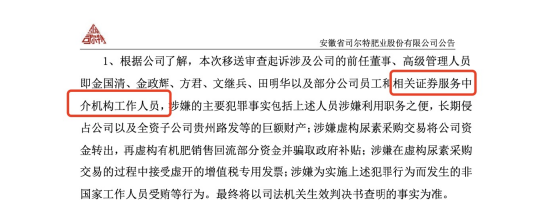
国元证券保代孙彬被司尔特报案成今年首位被起诉保代 今年7月已卸任金种子酒、洽洽食品、广大特材保荐代表人
Xin Lang Zheng Quan· 2025-10-13 09:32
Core Viewpoint - The announcement from Sierte (002538.SZ) regarding the transfer of a case involving former executives and intermediary personnel to the local prosecutor's office has caused significant concern in the brokerage community [1] Group 1: Case Details - The case involves ten suspects, including former chairman Jin Guoqing and former general manager Jin Zhenghui, with charges including embezzlement, bribery, fraud, and issuing false VAT invoices [4][5] - Sun Bin, a representative from Guoyuan Securities, is also implicated and may become the first sponsor representative to be sent for prosecution in 2025 [4][6] Group 2: Financial Background - Sierte has conducted four refinancing projects from 2014 to 2019, all sponsored by Guoyuan Securities, including a private placement raising 1.07 billion yuan in September 2015 and an 800 million yuan convertible bond issuance in 2019 [5] - The investigation was triggered by internal audits revealing irregularities in the accounts of a subsidiary, leading to a report filed by the company in January 2024 [5] Group 3: Implications for Securities Industry - Sun Bin has recently withdrawn from multiple ongoing projects, raising market speculation about his status prior to the case's escalation [6] - The case highlights potential risks associated with the oversight and accountability of securities service intermediaries in financing projects [5][6]

司尔特(002538.SZ):收到《移送审查起诉告知书》和《委托诉讼代理人/申请法律援助告知书》
Ge Long Hui A P P· 2025-09-29 14:56
Core Points - The company, Sierte (002538.SZ), has received a notice from the Xuancheng Public Security Bureau regarding the transfer of a case involving former executives suspected of embezzlement and other crimes [1] - The case involves multiple individuals, including former directors and senior management, who are accused of misappropriating substantial company assets and engaging in fraudulent activities [1][2] Summary by Sections - **Criminal Allegations**: The allegations include embezzlement of large sums from the company and its wholly-owned subsidiary, as well as fabricating transactions to misappropriate funds and obtain government subsidies [1] - **Legal Proceedings**: The case has been transferred to the Xuancheng People's Procuratorate for prosecution, with specific individuals named in the allegations, including charges of bribery and fraud [1] - **Company's Position**: The company is identified as a victim in the embezzlement case, and even if found guilty of unit crime, it would only face fines, with criminal responsibility primarily directed at the responsible individuals [2]