
高端白酒消费

Search documents
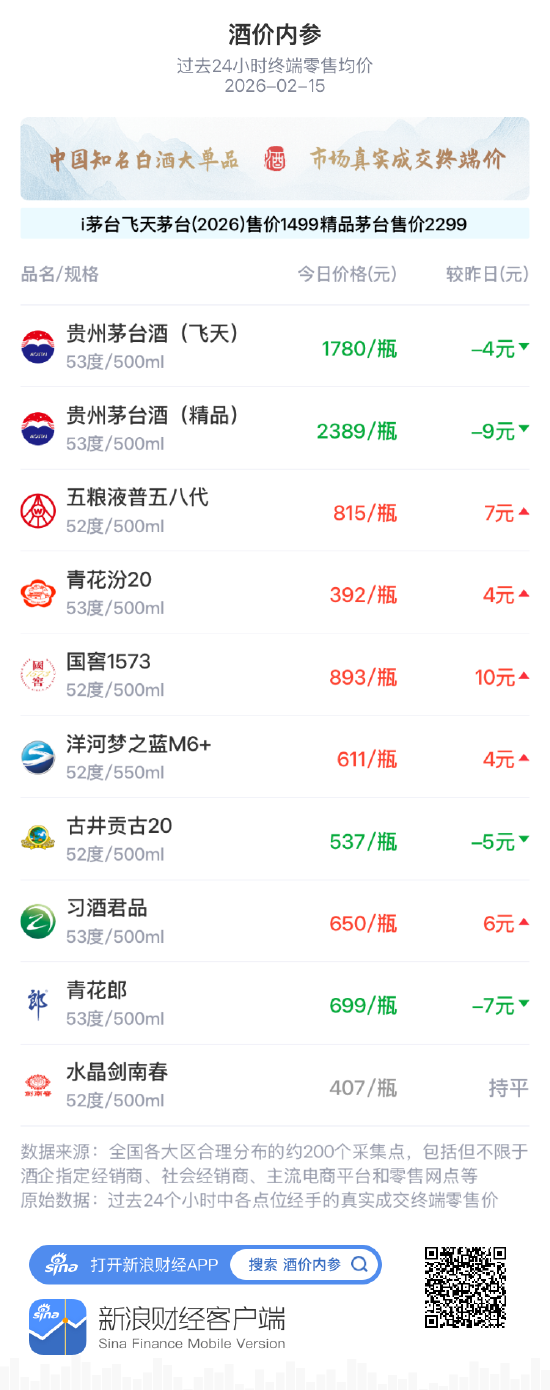
酒价内参2月15日价格发布 总价小幅回升节前走势分化
Xin Lang Cai Jing· 2026-02-15 01:13
Core Insights - The article discusses the recent trends in the Chinese liquor market, specifically focusing on the retail prices of the top ten baijiu products, which showed a mixed performance with some prices increasing while others decreased [1][6]. Price Trends - As of February 15, the total retail price for a package of the top ten baijiu products was 9,173 yuan, reflecting a slight increase of 6 yuan from the previous day [1][6]. - Among the ten products, five saw price increases, four experienced declines, and one remained unchanged [1][6]. Individual Product Performance - The products that increased in price included: - Guojiao 1573, which rose by 10 yuan per bottle [1][6]. - Wuliangye Pu 58th generation and Xijiu Junpin, which increased by 7 yuan and 6 yuan per bottle, respectively [1][6]. - Qinghua Fen 20 and Yanghe Dream Blue M6+, both of which rose by 4 yuan per bottle [1][6]. - The products that decreased in price included: - Premium Moutai, which fell by 9 yuan per bottle [1][6]. - Qinghua Lang, which decreased by 7 yuan per bottle [1][6]. - Gujing Gonggu 20, which dropped by 5 yuan per bottle [1][6]. - Feitian Moutai, which saw a minor decline of 4 yuan per bottle [1][6]. - The price of Shuijing Jian Nan Chun remained stable at 407 yuan per bottle [1][6]. Market Analysis - The data for the "Liquor Price Reference" is collected from approximately 200 sampling points across various regions, including designated distributors, social distributors, e-commerce platforms, and retail outlets [4][9]. - The introduction of the iMoutai platform selling Feitian Moutai at 1,499 yuan and Premium Moutai at 2,299 yuan has begun to influence market prices significantly [4][9]. - Lin Yuan, chairman of Linyuan Investment, indicated that the price reform for core products on the iMoutai platform could have profound implications for the company and the industry, potentially opening up new sales growth opportunities [4][9]. - The analysis suggests that the demand for high-end baijiu remains strong, with a significant supply-demand gap still present [4][9].







三论白酒-看好茅台领军行业上行
2026-02-11 05:58
Summary of the Conference Call on the Baijiu Industry Industry Overview - The high-end baijiu consumption during the Spring Festival saw a year-on-year decline of approximately 8%, with Moutai and Wuliangye outperforming the industry average [1][2] - The overall baijiu consumption environment in Chengdu, Sichuan, showed positive trends leading up to the Spring Festival, with high-end, mid-high-end, and mid-low-end products expected to decline by about 8% [2] Key Insights and Arguments - Moutai benefited from the "i Moutai" platform and price reductions, while Wuliangye's eighth generation gained market share due to its cost-effectiveness [1] - The gifting scenario saw slight growth driven by mass high-end consumption, while government consumption significantly declined, with about 90% already digested [1][5] - Business banquets decreased by over 10%, with an expected reduction of about 20% [3] - Moutai's wholesale price stability at around 1,550 RMB depends on supply conditions, particularly for Feitian Moutai and non-standard products [1][8] - As of now, Moutai's overall shipment progress for Feitian and non-standard products has decreased by over 30% year-on-year, primarily to digest 2025 inventory [10] Performance of Key Brands - Wuliangye's eighth generation saw a year-on-year sales increase of over 30% during the Spring Festival, recovering to 2024 levels, although the 1,618 series declined by 10% due to price reductions [12][13] - Luzhou Laojiao's Guojiao 1573 experienced a 25% decline in sales, with shipment volume down over 30% [14] - Other mid-high-end brands like Honghualang and Jian'nanchun showed mixed results, with Honghualang up by 9 percentage points and Jian'nanchun stable year-on-year [15] Market Dynamics and Future Outlook - Moutai's market divergence points include the stability of post-holiday wholesale prices and whether demand can maintain double-digit growth [4][20] - The correlation between Moutai prices and urban residents' disposable income shows an annual growth rate of about 8% for income and 12% for Moutai prices, indicating potential for stronger growth as demand recovers [23] - The overall expectation for high-end baijiu consumption during the Spring Festival has improved, with a revised decline estimate of around 8% [17] - Future performance of Wuliangye remains uncertain due to varying regional feedback and concerns over sales transparency [25] Additional Considerations - The impact of the Japanese market on local high-end consumption growth is acknowledged, but the primary drivers are attributed to the wealth effect from the stock market and gradual consumption recovery [19] - The historical performance of Moutai during past adjustment cycles indicates its resilience and potential for significant growth when mass high-end demand recovers [24] - Recommendations suggest selectively increasing positions in the baijiu sector while monitoring performance in the second and third quarters [26]