高贝塔股

Search documents
一文读懂:华尔街“抛AI”妖风祸从何来?
Xin Lang Cai Jing· 2026-02-05 13:15
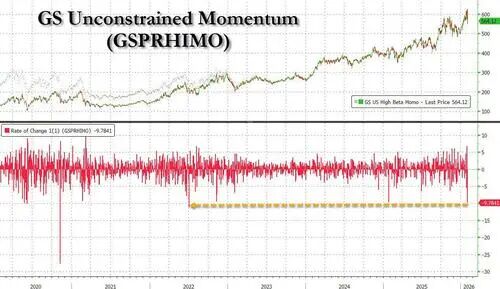
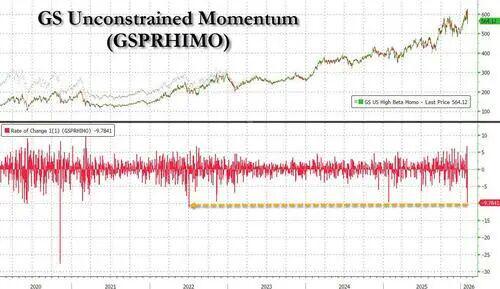
Core Viewpoint - Momentum traders experienced significant losses, marking one of the worst days since mid-2022, primarily driven by a sell-off in high-beta stocks and a shift in market dynamics [1][6][19]. Group 1: Market Dynamics - The sell-off on Wednesday was attributed to fundamental factors and position adjustments, revealing underlying volatility despite a seemingly stable S&P 500 index [3][5]. - The average volatility of S&P 500 constituents was approximately seven times that of the index itself, indicating sharp movements in individual stocks [5]. - Goldman Sachs noted that the sell-off was largely driven by the underperformance of long positions in high-beta stocks, which had previously been market leaders [6][10]. Group 2: Sector Performance - The market saw a reversal from crowded themes such as AI and high-beta stocks, with early-cycle stocks and defensive sectors performing well [8][10]. - High-performing sectors like memory chips and non-profitable tech stocks experienced significant pullbacks, while negative momentum themes rebounded [15][19]. - The sell-off was characterized by extreme factor reversals, with momentum factors facing their worst drawdown in over three years [8][19]. Group 3: Trading Behavior - The market's behavior on Wednesday was marked by a disconnection between index performance and individual stock movements, with nearly three-quarters of stocks outperforming the S&P 500 [14]. - Retail participation was notably absent during the sell-off, contrasting with aggressive buying during previous rebounds [14]. - The pressure from leveraged ETFs was significant, with an estimated $18 billion in selling pressure on that day, particularly affecting tech and semiconductor stocks [12][19]. Group 4: Future Outlook - Historical patterns suggest that such momentum stock pullbacks can present mid-term buying opportunities, although caution is advised due to potential further downside risks [17][19]. - Analysts from Morgan Stanley and Goldman Sachs agree that the current market conditions may lead to further adjustments, but they also see potential for short-term rebounds [17][19].


比DeepSeek风暴还惨烈,华尔街“抛AI”妖风祸从何来?
3 6 Ke· 2026-02-05 09:02
Core Insights - Momentum traders experienced significant losses, marking one of the worst days since mid-2022, as high-beta stocks faced severe declines [1][6][15] - The S&P 500 index components exhibited an average volatility approximately seven times that of the index itself, indicating underlying market turbulence despite a seemingly stable index [2][4] - The sell-off was primarily driven by fundamental factors and position adjustments rather than panic selling, with a notable absence of retail participation [5][14] Group 1: Market Dynamics - The recent market downturn was characterized by extreme factor reversals, with momentum factors suffering their worst drawdown in over three years [8] - High-beta stocks, particularly in sectors like AI and technology, faced significant selling pressure, while previously lagging sectors rebounded strongly [10][15] - The market's structure amplified volatility, with leveraged ETFs contributing to substantial selling pressure, estimated at around $18 billion on that day [12] Group 2: Investment Strategies - Goldman Sachs noted that the high-beta winners from the past year are experiencing a sharp reversal, with many momentum-heavy portfolios declining [15][16] - Historical patterns suggest that such momentum stock pullbacks can present mid-term buying opportunities, although caution is advised due to potential further downside risks [17][19] - Morgan Stanley's analysis echoed similar sentiments, indicating that crowded positions in AI and storage sectors faced significant sell-offs, while their short momentum strategy gained [17][19]